When your balcony stares straight into a neighbor’s kitchen, renter friendly balcony privacy ideas stop being decoration and start being basic quality of life. For first-time renters in dense apartment complexes, the balcony is often the only outdoor space you have — and right now it can feel like sitting on a stage.
The good news: every idea below installs without drilling into the building. The better news: each one comes with its own lease-rule caveat, because “no drilling” does not automatically mean “landlord approved,” and the last thing you need in your first year of renting is a lease-violation letter taped to your door.
Short answer: The most reliable renter-friendly balcony privacy ideas are outdoor curtains on a tension cable, a freestanding living plant screen, bamboo railing panels, mesh privacy fabric, a faux ivy trellis, freestanding privacy dividers, and a tilted shade umbrella. Every one of these installs without drilling — but check your lease’s balcony and exterior-appearance rules before buying anything, since some buildings restrict what the outside of your unit looks like.
Summary

Most balcony privacy roundups are really product roundups: here is a screen, here is a price, good luck. They are written for anyone with a balcony, which means the lease-rule reality of a first-time renter in a managed complex gets skipped entirely. This list is built for that reality — neighbor-facing sightlines, wind on upper floors, and landlords who care what the building looks like from the street.
You will get seven ideas ordered by how practical they are for a first-timer, a specific lease-rule caveat attached to every single one, and a comparison table at the end that lines up cost, privacy level, and reversibility side by side. Start with the idea that matches your biggest constraint — budget, wind, or how fast you need it up.
1. Outdoor Privacy Curtains

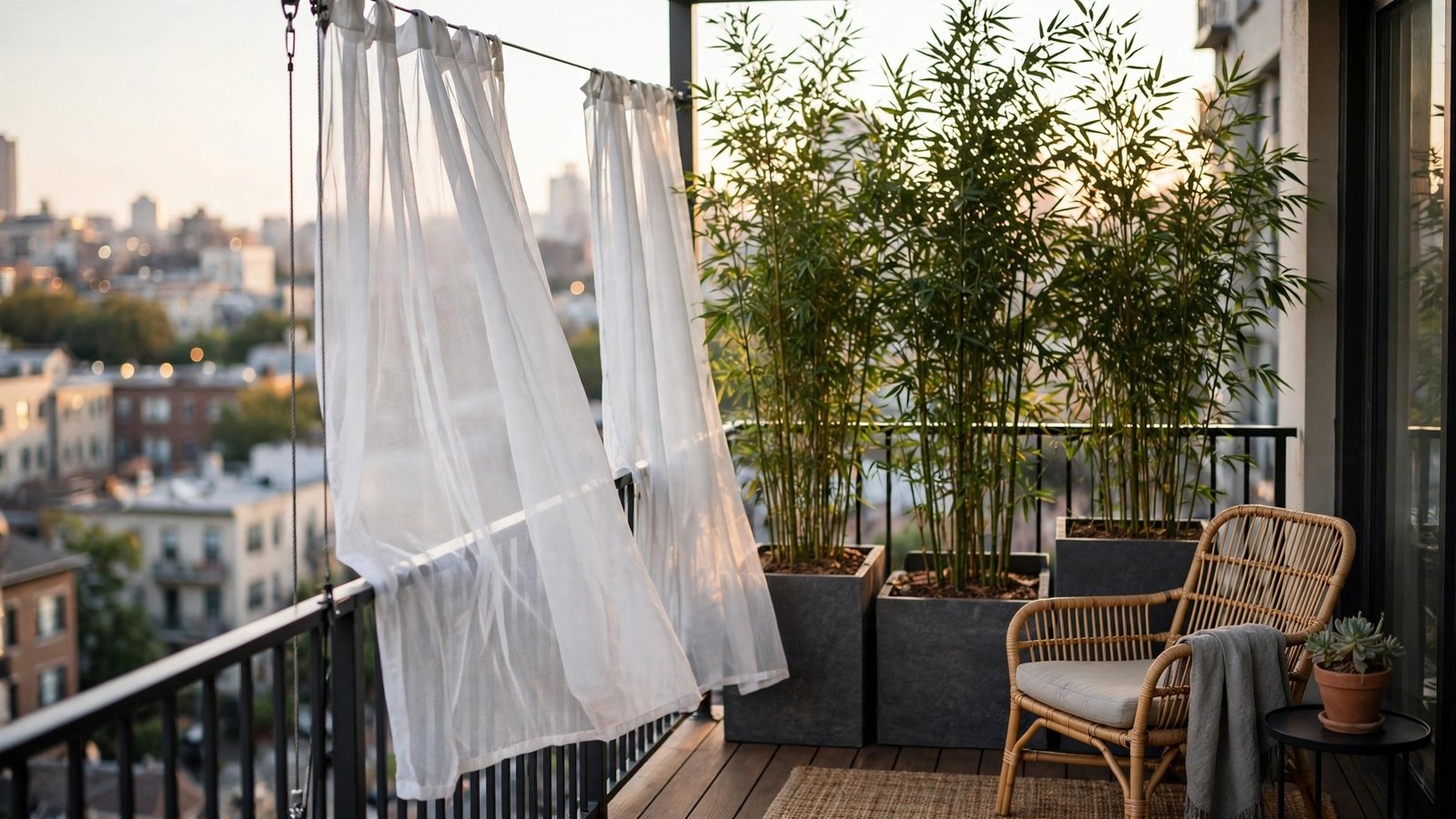
Weatherproof outdoor curtains strung along a tension cable or tension rod between the balcony walls can close off a neighbor-facing side in under an hour. Outdoor-rated fabric resists water and mildew, and the whole setup comes down in minutes at move-out, which is what makes it attractive for renters.
Mount the cable high enough that the curtains fall just past the railing, and choose weighted hems or add curtain weights so the panels hang straight instead of billowing inward. On higher floors, tie the panels back on windy days — a full curtain wall catches wind like a sail. For tie-back hooks on the railing-side wall, small adhesive hooks can work; read our guide on whether Command Strips damage walls before trusting them outdoors, since moisture weakens most adhesives.
Lease caveat: Some leases ban anything visible from the building’s exterior, and curtains are the most visible option here. Curtains are usually treated more leniently than fixed screens because they are clearly temporary, but confirm the exterior-appearance rules first. All example prices in this article should be treated as rough estimates — flag them for the editor to verify.
2. Living Plant Screen

Tall, narrow planters lined up just inside the railing grow into a living privacy wall over a season or two. Clumping bamboo (non-invasive — this matters, since running bamboo is banned in some jurisdictions) and tall ornamental grasses are the workhorses; if you have no interest in watering schedules, quality faux plants achieve the visual effect on day one.
Because the planters are freestanding, most leases treat them exactly like any other potted plant, which puts this idea among the safest on the list. Keep every pot fully inside the railing line, and check whether your lease mentions balcony weight limits before loading up on large ceramic planters full of soil. Planter-and-plant setups typically run about $30–$80 per large planter (example price).
Lease caveat: Watch the water, not the plants. Dripping water onto the balcony or unit below is one of the most common balcony-related complaints and lease violations, so use saucers or drip trays under every pot.
3. Bamboo Railing Panels

Natural reed or bamboo roll fencing unrolls to cover the open side of your railing and reads as an intentional design choice rather than a barrier. Attach it with UV-rated zip ties every few feet through the railing balusters — standard zip ties become brittle in sun within months, so the UV rating is worth the small price difference. Expect roughly $20–$50 for a roll long enough for a standard balcony railing (example price).
The gaps between reeds let light and air through while breaking up the direct sightline, which makes this a solid middle ground between a full block and nothing at all. Trim any overhang so the panel ends flush with the railing posts.
Lease caveat: This option changes how the building looks from the outside, which is exactly what some leases and HOA rules restrict. Bamboo panels are cheap and quick, but they are also the most likely idea on this list to draw a uniformity complaint — a quick email to the leasing office before installing saves a lot of hassle.
4. Mesh Privacy Fabric

High-density mesh shade fabric zip-tied to the railing is the most affordable full-coverage balcony privacy screen for apartment renters — roughly $15–$35 for a roll long enough for a standard railing (example price). It blocks a high percentage of direct sightlines while letting air pass straight through, which is the feature that matters on windy upper floors where solid panels become sails.
Measure the railing height and length before ordering, and secure the fabric at the top, bottom, and middle of each section so it cannot work loose and flap. Dark neutral colors read as intentional from the street; bright patterns tend to draw complaints.
Lease caveat: Check the exterior-appearance rules the same way as with bamboo panels — some buildings permit dark mesh but prohibit patterns, and a few ban railing covers outright. Because this is attached to the building’s railing (even reversibly), it sits in a grayer area than freestanding options.
5. Faux Ivy Trellis

An expandable faux-leaf trellis — a willow or plastic lattice frame with attached greenery — expands to fit most railing widths and gives you a green wall with zero watering. Zip-tie it to the railing the same way as bamboo panels, or lean a freestanding trellis planter against the exposed side for an even more reversible version.
From the neighbor’s side it reads as foliage, not fencing, which makes it one of the less confrontational-looking options here. Plan on replacing it after a season or two of full sun — the leaves fade and get brittle. Panels typically run about $20–$40 each (example price).
Lease caveat: Same exterior-look caution as bamboo and mesh. Also confirm nothing in your lease prohibits artificial plants on balconies — a small number of buildings restrict them for fire-safety or appearance reasons.
6. Freestanding Privacy Panels

A purpose-built freestanding divider — a wooden slat panel, a metal frame with outdoor fabric, or an accordion-style room divider weighted at the base — needs no attachment to the building at all. You set it on the exposed side of the balcony and angle it at the exact sightline you want to block.
Since nothing touches the railing or walls, this is typically the least likely option on this list to trip a lease rule. The trade-off is stability: wind on a balcony is stronger than indoors, so the base needs real weight — sandbags, weighted planter bases, or a divider heavy enough to stand on its own. Typical cost runs about $50–$150 (example price).
Lease caveat: “Freestanding” only helps if it genuinely stays put. A divider that blows into the railing or over the edge is a safety problem, and safety problems override “but it wasn’t attached.” Bring lightweight dividers inside before storms.
7. Tilted Shade Umbrella
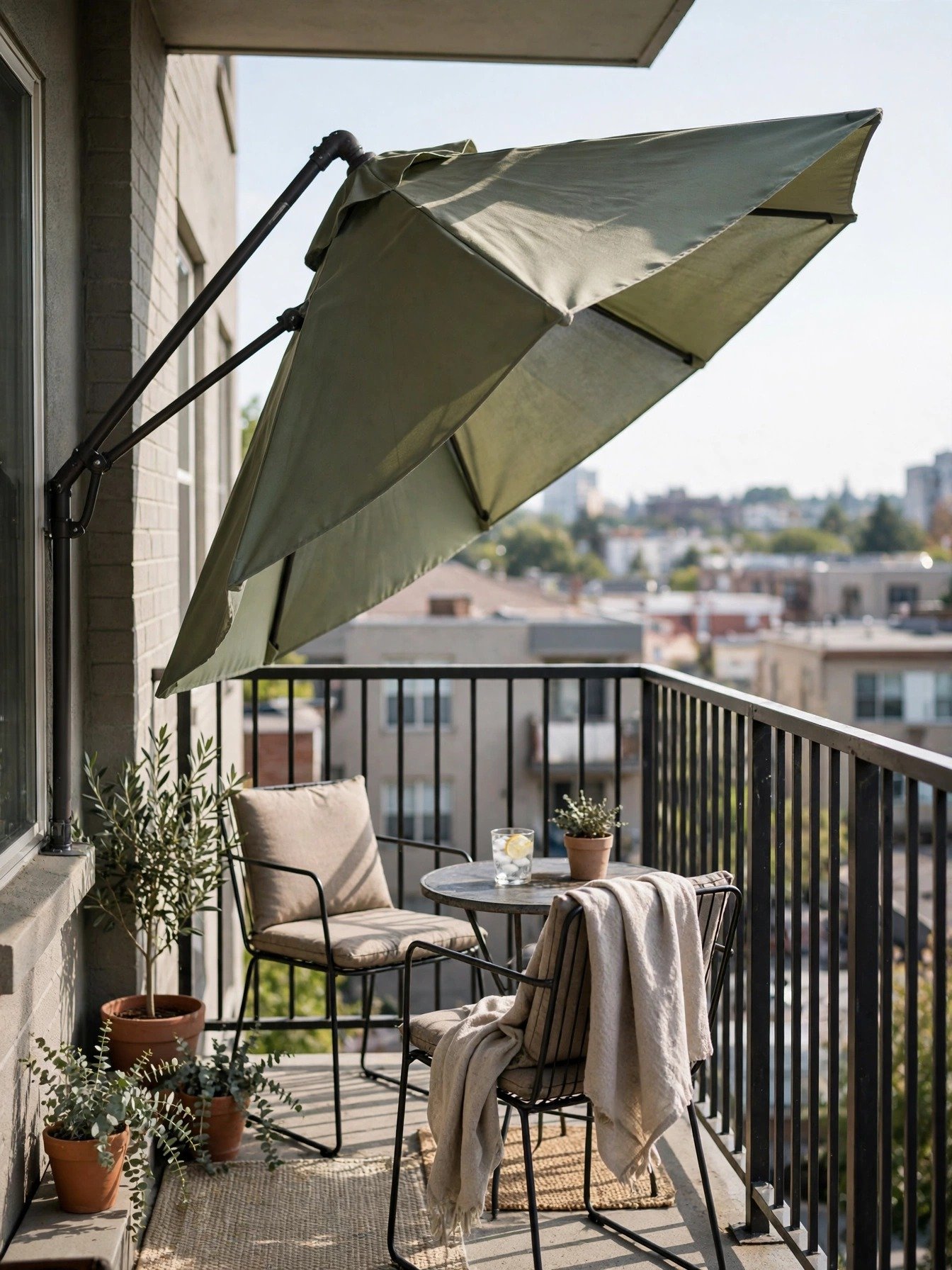
A cantilever or offset umbrella tilted toward the neighbor’s line of sight blocks views from above and across while doubling as shade. Angle it at the exposed side during the hours the neighbor is most likely to be looking, and close it when you are not using it.
Because it is patio furniture, leases rarely restrict umbrellas — but “rarely” is not “never.” Some complexes limit umbrella size, prohibit anything that extends above the railing line, or require umbrellas to be closed in high wind. Expect roughly $40–$120 depending on size and build (example price).
Lease caveat: Check for a specific umbrella clause in the balcony rules. If there is one, it usually covers wind — a surprising number of balcony-umbrella disputes are really wind disputes.
[EDITOR’S PICK: which option would you personally choose, and why? Leave blank if you don’t have a genuine opinion here — fill in or delete this placeholder before publishing.]
Quick comparison — cost, privacy, and reversibility at a glance:
| Idea | Typical cost (example) | Privacy level | How reversible |
|---|---|---|---|
| Outdoor privacy curtains | ~$25–$60 per panel | High — closes a full side | Minutes: take down the rod |
| Living plant screen | ~$30–$80 per large planter | Medium–high once grown | Move the pots |
| Bamboo railing panels | ~$20–$50 per roll | Medium — dappled light | Snip the zip ties |
| Mesh privacy fabric | ~$15–$35 per roll | Medium–high | Snip the zip ties |
| Faux ivy trellis | ~$20–$40 per panel | Medium–high | Unclip and fold |
| Freestanding privacy panels | ~$50–$150 | High — aimed at one sightline | Pick up and move |
| Tilted shade umbrella | ~$40–$120 | Medium — directional | Close and carry inside |
Prices are rough examples as of October 2026 — verify current pricing before publishing.
FAQ
Are renter-friendly balcony privacy ideas actually allowed by landlords?
There is no universal rule — “no drilling” is not the same as “approved.” Check your lease’s sections on balconies, exterior alterations, and exterior appearance, plus any HOA or building addendum. When in doubt, a short email to the leasing office with a photo of what you plan to install usually gets a straight answer, and it creates a paper trail.
What should I check in my lease before adding balcony privacy?
Look for four things: balcony and patio rules, any exterior-appearance or “uniform look” clause, HOA addendum rules if the building has one, and anything about attaching items to railings or walls. Also check for umbrella-specific clauses and balcony weight limits if you plan on large planters.
How do I block my neighbor’s view of my balcony without drilling?
Use freestanding options — lined-up tall planters, a freestanding privacy panel, or a tilted umbrella — since these touch nothing on the building. If you need full railing coverage, reversible attachments like zip-tied mesh fabric or bamboo panels are the next step, but confirm the exterior-appearance rules first.
What is the cheapest way to add balcony privacy?
Mesh privacy fabric is usually the cheapest full-coverage option, roughly $15–$35 for a railing-length roll (example price). If you only need to block one sightline rather than the whole railing, a single faux ivy trellis panel (~$20–$40, example) aimed at that angle can cost even less.
Can a balcony privacy screen get me in trouble with my HOA?
Yes, if the building requires a uniform exterior look. HOAs and managed complexes most often object to anything that changes the building’s appearance from the street or common areas. Freestanding, furniture-like options (planters, dividers, umbrellas) are usually the safest starting point in HOA-managed buildings.
How do I keep privacy screens from blowing away on a high floor?
Choose breathable materials — mesh, slats, or reed — that let wind pass through instead of catching it. Secure attached screens with UV-rated zip ties at the top, middle, and bottom of each section. Weigh down freestanding pieces properly, and bring lightweight items inside before storms.
Can I hang curtains on a balcony without drilling?
Yes. A tension rod or tensioned cable strung between the balcony walls holds outdoor curtains without a single hole, as long as the span is not too wide for the rod’s rated length. Use weighted hems and tie the panels back in strong wind.
Conclusion

The short version: renter friendly balcony privacy ideas work best when you match the idea to your biggest constraint — budget, wind exposure, or how fast you need it up. A mesh panel and a bag of zip ties can solve the problem this weekend; a living plant screen takes longer to fill in but survives almost any lease rule.
Whatever you pick, spend five minutes with the balcony rules before you buy — it beats five minutes of installing followed by a violation notice. For more renter-safe projects, browse our Decorating & Small Space Living section, including our renter-friendly entryway ideas for the space just inside the door. If this helped you plan your setup, save it for move-in day and share it with anyone whose balcony has an audience.

Maren started MyFirstLease after a rough first lease taught him everything the internet didn’t. He covers the logistical side of renting — move-in checklists, utilities, and the unglamorous first-week stuff nobody explains — and oversees everything published on the site.