Learning how to style thrifted furniture in a small apartment is one of the fastest ways for a budget-conscious first-time renter to furnish a place that feels like home without spending new-furniture money. This guide walks through the whole process in order — measuring first, inspecting before paying, cleaning every find, unifying mismatched pieces, and refreshing them without paint — so a collection of secondhand pieces ends up looking intentional instead of accidental.
It is written for a first-time renter furnishing a small apartment mostly from thrift stores, Facebook Marketplace, and estate sales, on a tight budget and under a lease that probably bans painting and drilling. The distinct angle here is the sequence itself: most styling guides start with color palettes and end with shopping tips, while this one treats styling as a workflow where the buying decisions, the cleaning, and the lease-safe refresh all happen before a single piece is placed. If you are starting from an empty room, our guide to decorating an apartment on a budget pairs well with the steps below.
Start by measuring your room and doorways, then buy only solid, right-sized pieces that pass a wobble, smell, and pest check. Clean everything before it comes inside, tie mismatched finds together with one repeated wood tone or color, refresh surfaces without paint, and place one piece at a time so the room stays breathable.
Executive Summary

Thrifted furniture works especially well in a small apartment because each piece matters more when there are only a few of them — one good secondhand armchair or solid wood dresser can carry a whole room, while three cheap flat-pack pieces crowd it. The catch is that thrifted pieces arrive in different eras, finishes, and conditions, so they need a system: a short list of measurements, a firm inspection routine, and one unifying thread that makes a 1970s dresser sit comfortably next to a modern side table.
This guide covers that system step by step. It starts with measuring and shopping with a list, moves through inspecting and cleaning secondhand finds, then covers how to mix eras without visual chaos, how to give every piece a clear job in a small footprint, and how to refresh wood and upholstery without paint or permanent changes. It closes with a placement routine and a budget worksheet, plus answers to the questions renters ask most about thrifted furniture, lease rules, and deposits.
1. Measure First, Shop Second

A tape measure is the cheapest styling tool a first-time renter owns, and it should be used before any thrift run, not after a piece is already in the car. Small apartments punish guessing: a dresser that is two inches too wide blocks a closet door, and a sofa that cannot turn through the hallway becomes a curbside donation. Measure the wall where each piece will live, the width of the front door and any interior doorways, the stairwell or elevator opening, and the walking path the piece must travel. Write the numbers on a card kept in a wallet or phone, along with the maximum footprint for each missing piece — for example, a side table no wider than 20 inches, or a bookshelf no deeper than 12 inches.
Shop from that card, not from enthusiasm. Thrift stores reward impulse buying because prices are low and stock turns over fast, which is exactly how a small apartment ends up with a second armchair nobody needs. A short written list — one armchair, one side table, one dresser — keeps the trip focused, and it also keeps spending honest: a budget-conscious renter furnishing with secondhand finds should know the total furnishing budget before entering the store, not discover it at the register. As a rough guide, as of 2026, thrifted armchairs commonly run $25–$75, solid wood side tables $10–$30, and dressers $40–$100, though prices vary widely by city and store. For a bigger-picture spending plan, see our 90-day plan to furnish a first apartment for under $1,500.
Measure the piece in the store, too. A fabric tape measure in a pocket beats eyeballing it, and most thrift stores will let a buyer check a piece against their card before paying. Pay attention to height as well as width: a low, leggy piece keeps sightlines open and makes a small room feel larger, while a tall, boxy piece closes the room in. Pieces with visible legs and open space underneath read lighter than pieces that sit flat on the floor, which is why a mid-century style dresser on tapered legs usually suits a small apartment better than a bulky chest that reaches the floor.
2. Inspect Before You Pay

Every secondhand piece needs a hands-on inspection before money changes hands, because thrift stores generally sell as-is and returns are rare. Start with structure: rock the piece gently from side to side and press down on the seat or top. A slight wobble at a joint often means loose glue or a weakened dowel, which can be fixable but should lower the price a buyer is willing to pay. Drawers should slide without sticking or falling out, doors should close without sagging, and chair legs should sit flat on the floor without rocking.
Then check the surfaces and the smell. Look under cushions, inside drawers, and underneath the piece, where damage and pests hide. Pass on anything with signs of bed bugs — dark specks, shed skins, or a musty sweet odor in seams and joints — and on upholstery with stains or odors that do not lift with a sniff test, since deep cleaning has limits. Solid wood, metal, and ceramic age well and can usually be refreshed; particle board and MDF, the material in most flat-pack furniture, swells when wet, crumbles at the edges, and cannot be refinished, so a damaged particle-board piece is rarely worth even a low price.
Ask the practical questions before loading it up. Does the store help carry it out, or is a friend and a vehicle needed? Will it fit through the apartment door — the measurements from step one answer this. Is there a delivery option, and what does it cost? A $30 dresser that needs a $60 delivery is a $90 dresser. For upholstered pieces bought from a private seller, ask how the piece was stored and whether the home had pets or smoking indoors, and be ready to walk away if the answers are vague. Walking away is free; living with a piece that smells or wobbles is not.
3. Clean Every Find First

No thrifted piece should go straight from the store into a bedroom or living room. Clean it in a garage, balcony, entryway, or outdoors first, and let it air out before it joins the rest of the apartment. For solid wood, wipe all surfaces — including the underside and drawer interiors — with a damp cloth and a mild soap solution, then dry the wood thoroughly so moisture does not sit in joints. A beeswax polish or a small amount of furniture oil can revive tired wood and bring back color, and it costs far less than refinishing. Our guide to cleaning furniture when moving covers the same deep-clean basics for any piece coming into a new home.
Upholstery needs a deeper pass. Vacuum every surface, including seams, crevices, and the underside, with an upholstery attachment, then spot-clean visible marks with a cleaner made for the fabric type and test it first on a hidden patch. A fabric-safe disinfecting spray or a steam cleaner, borrowed or rented if buying one is out of budget, helps with pieces from unknown homes. If a cushion cover unzips, wash it on a gentle cycle if the care label allows. If an upholstered piece still smells strongly after cleaning and a day of airing out, it is usually better to leave it behind or use it only in a ventilated space than to hope the smell fades once it is inside a small apartment.
Metal and glass pieces are the easiest wins: wash glass with soap and water, wipe metal frames, and tighten any loose screws. For any piece, photograph it before cleaning and keep the receipt if there is one — not for the store, but for move-out records, since a renter may want proof that a scratch or mark arrived with the piece rather than during the tenancy. Cleaning also doubles as a final inspection: a piece that looked fine in a dim thrift store often reveals a cracked joint or a sticky drawer once it is wiped down in daylight.
4. Pick One Unifying Thread

Mismatched pieces look like clutter when nothing connects them, and they look collected and intentional when one thread runs through all of them. The thread can be a wood tone, a color, a material, or a shape — but it should be only one thread at a time, repeated across the room. Warm wood tones with warm wood tones, for example, or one accent color repeated in a cushion, a lamp base, and a piece of art. A consistent palette of warm neutrals, natural wood, and a single accent color lets pieces from different decades sit together without competing.
Start with the largest piece in the room and let it set the thread. If the biggest find is a honey-oak dresser, the side table, the chair legs, and the shelf should echo that warm tone rather than introducing a second, clashing wood. If the largest piece is a dark walnut bookshelf, lean into dark wood and brass rather than adding pale pine and chrome. This does not mean everything must match — matching sets are exactly what make a room feel like a showroom — it means the pieces should share a family resemblance. Two wood tones can work if one clearly dominates and the other appears only in small accents.
Textiles are the easiest way to tie pieces together without buying anything new. A throw blanket draped over a chair arm, a cushion on a thrifted bench, and a small rug under a side table can all carry the same color, and textiles are also easy to swap at move-out or when tastes change. The same trick works with metals: if the lamp is brass, a brass picture frame and a brass tray on the dresser repeat the note without overwhelming the room. When a piece refuses to fit the thread — a bright red plastic chair in a room of warm wood and cream — it is usually better to place it in a different room or pass it on than to force it in.
5. Give Each Piece a Job

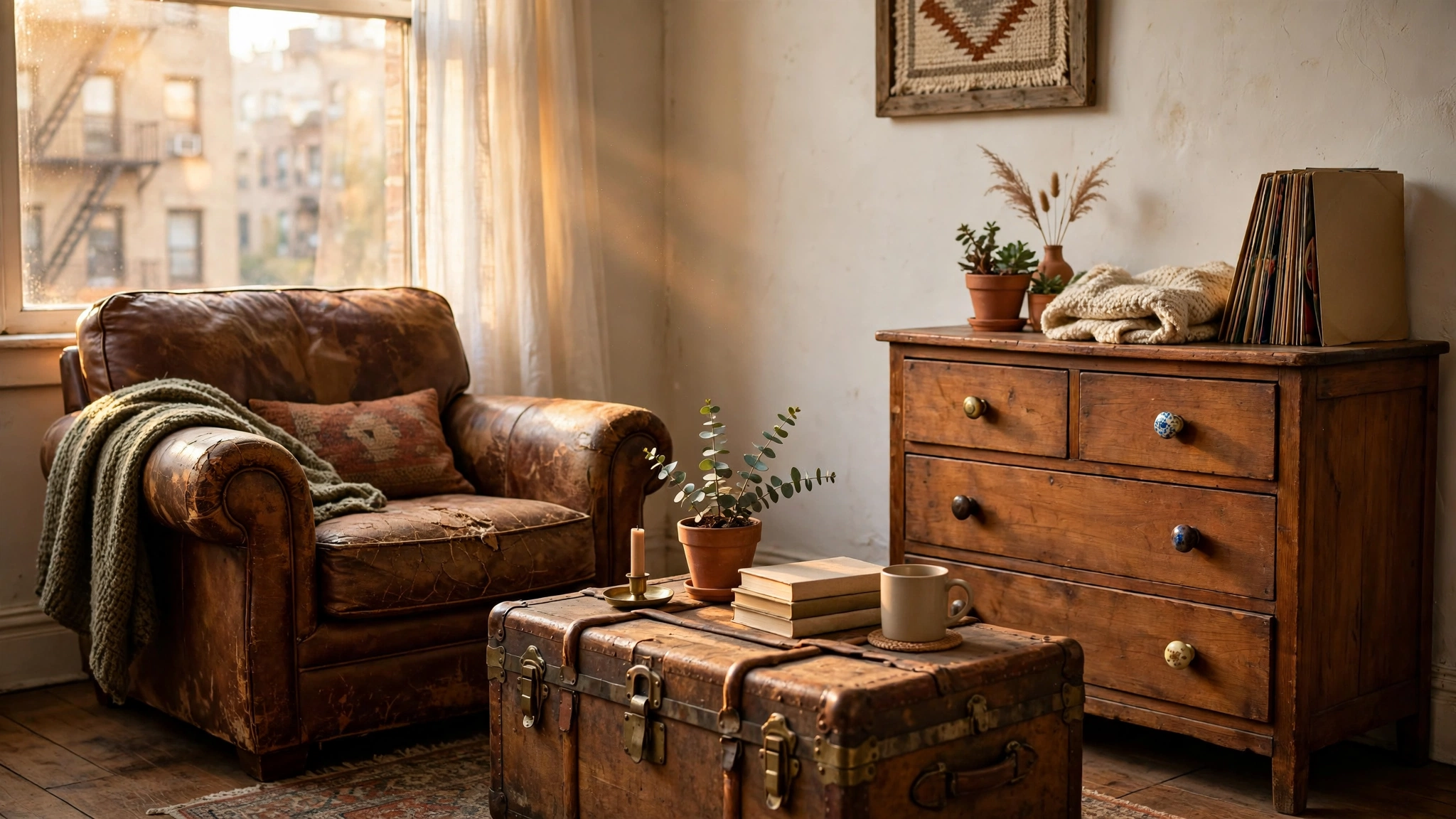
In a small apartment, every piece of furniture has to earn its floor space, and thrifted furniture is at its best when a piece does two jobs at once. A vintage trunk becomes a coffee table with storage inside. A solid wood dresser doubles as a television stand. A small bench by the door holds shoes underneath and bags on top. A narrow bookshelf beside a chair holds books, a lamp, and a phone charger. Before buying a piece, name its job out loud: if it has no clear job and no clear spot, it does not come home, no matter how good the price is.
Think beyond a piece’s original function, but stay honest about what it can actually do. A sturdy trunk makes a fine coffee table; a flimsy one does not. A ladder shelf can hold plants and books; it cannot hold a television. A small dresser can anchor a bedroom wall and store clothes; it cannot serve as a desk unless its height and depth suit sitting at it. Measure the job as well as the piece: a coffee table should sit roughly level with the seat of the sofa, and a side table should be within easy reach of the chair it serves.
Multi-use pieces also help a small apartment stay flexible for roommates, guests, and moving day. A folding thrifted chair tucks against a wall when nobody needs it. A small rolling cart moves from kitchen to living room and back. A storage ottoman holds blankets and becomes extra seating. Pieces that fold, roll, or stack are worth more in a small rental than pieces that only do one thing in one place, and they are easier to move when the lease ends, which matters for a first-time renter who may not stay in the same apartment for long.
6. Refresh Without Paint

Many renters assume a thrifted piece needs paint to look new again, but painting is often the riskiest refresh in a rental. Some leases ban painting furniture indoors because of fumes and mess, and a painted piece can be hard to undo if the finish chips or the next apartment’s style does not suit it. The good news is that most thrifted pieces can be refreshed without paint at all, using reversible changes that cost little and leave no trace.
Start with hardware. New knobs and pulls change the personality of a dresser or cabinet completely, and they can be swapped back before move-out — keep the originals in a labeled bag. A set of simple knobs runs about $10–$25 as of 2026, and a screwdriver is usually the only tool needed. Next, look at the surface: a beeswax polish revives dull wood, a scratch-repair marker or a dab of matching stain hides small nicks, and a piece of peel-and-stick liner inside drawers covers stained interiors and can be removed later. None of these changes touch the lease, because nothing is drilled, glued, or painted.
Upholstery can be refreshed the same way. A washable slipcover or a well-fitted throw over a chair changes its color without reupholstering it. A cushion with a removable, washable cover replaces a tired seat cushion for $15–$35 as of 2026. For a wooden chair with a worn seat, a new seat pad tied on with fabric ties is a ten-minute fix. If a piece is structurally sound but its finish is badly damaged — deep gouges, peeling veneer, or water rings that will not lift — it is usually wiser to choose a different piece than to commit to a full refinish in a rental, where dust, fumes, and drying space are all hard to manage. Check the lease before any refresh that involves solvents, stains, or spray finishes, and do that work outdoors or in a ventilated space, never inside a small apartment.
7. Place It, Then Adjust

Styling is the last step, not the first, and it works best one piece at a time. Bring the largest piece in first, place it against its wall, and live with it for a day before adding the next piece. This sounds slow, but it prevents the most common small-apartment mistake: filling every wall and corner in a single afternoon and then living for a year with a room that has no breathing space. A small apartment needs open floor and clear walkways more than it needs one more side table.
When placing pieces, protect the floors and the deposit. Felt pads under chair and table legs cost a few dollars and prevent scratches on wood and vinyl floors. A small rug under a heavy dresser or a chair that gets dragged daily protects the finish underneath. Photograph the walls and floors at move-in, and photograph them again after placing heavy furniture, so there is a record of what was already there. Avoid drilling into walls to hang things above thrifted pieces — freestanding lamps, leaning frames, and removable hooks are the renter-friendly alternatives, and some leases ban adhesive hooks outright, so check the lease and test one hook in a hidden spot before relying on them.
Once the big pieces are placed, add the small layers last: a lamp on the side table, a stack of books on the trunk, a plant on the dresser. Step back and look at the room from the doorway, which is how guests and the renter will actually see it. If a corner feels crowded, remove one thing rather than rearranging everything — small apartments improve more from subtraction than from addition. If a piece still feels out of place after a week, move it to another room or pass it on; a thrifted piece that cost $30 can be rehomed for $30, which makes experimenting cheap and low-risk.
Thrifted Furniture Budget Worksheet
Use this worksheet to plan a thrifted-furniture furnishing budget before the first store visit. Prices are typical thrift-store ranges as of 2026 and vary by city, store, and condition; refresh costs cover cleaning supplies, hardware, and slipcovers or cushions.
| Piece | Typical thrift price (as of 2026) | Typical refresh cost | Notes |
|---|---|---|---|
| Armchair | $25–$75 | $10–$30 (cleaning, cushion cover) | Check joints, smell, and bed-bug signs first |
| Side table | $10–$30 | $5–$15 (polish, new knob) | Measure height against the chair it serves |
| Dresser | $40–$100 | $10–$25 (knobs, drawer liner) | Drawers must slide; check for particle board |
| Bookshelf | $20–$60 | $5–$15 (polish, felt pads) | Keep depth under 12 inches in tight rooms |
| Coffee table or trunk | $20–$50 | $5–$20 (polish, liner) | Must be sturdy enough for daily use |
| Dining chairs (pair) | $20–$50 | $10–$25 (seat pads, cleaning) | Sit-test both chairs in the store |
| Lamp | $5–$20 | $5–$15 (new shade or bulb) | Check the cord and socket before buying |
| Example total: living-room set | $75–$185 | $25–$75 | Armchair + side table + trunk + lamp |
FAQ
Where should a first-time renter look for thrifted furniture?
Thrift stores, charity shops, estate sales, and Facebook Marketplace are the most reliable sources in most US cities, along with local buy-nothing groups and curbside finds on moving weekends. Thrift stores offer the lowest prices and the most variety, while Marketplace and estate sales often have better-condition pieces from people moving or downsizing. Visit midweek when new stock arrives and crowds are smaller, and check a store’s furniture section first — good pieces sell fast.
How do I know if a secondhand piece is worth buying?
Check three things: structure, material, and smell. The piece should be stable with no serious wobble, made of solid wood or metal rather than swollen particle board, and free of strong odors or pest signs. Drawers should slide, doors should close, and upholstery should be cleanable. If two of the three fail, walk away — another piece will turn up, and a bad buy costs more in cleaning, repairs, and lost space than it saves.
Can I mix different styles of thrifted furniture in one small room?
Yes, if one unifying thread ties them together. Pick a single wood tone, color, or material and repeat it across the pieces, and let the largest piece set the direction. Different eras actually help a room look collected rather than staged, as long as the pieces share that thread and each one has a clear job. If a piece clashes with the thread, move it to another room instead of forcing it in.
How do I style thrifted furniture without painting it?
Swap the hardware, polish the wood, line the drawers, and change the textiles. New knobs, a beeswax polish, peel-and-stick drawer liner, a washable slipcover, or a new cushion cover can transform a piece without paint, and all of it can be undone before move-out. This matters in a rental because many leases restrict painting and permanent changes, and a no-paint refresh keeps the deposit safe.
Is thrifted upholstered furniture safe to bring into an apartment?
It can be, with a careful inspection and a thorough cleaning. Check seams, joints, and under cushions for bed-bug signs, smell the piece, and ask the seller about pets and storage. Vacuum, spot-clean, and air out every upholstered find before bringing it inside, and pass on anything with pest signs or an odor that survives cleaning. When in doubt, choose wood or metal pieces, which are far easier to clean and inspect.
What if my lease bans adhesive hooks or wall changes?
Style without the walls. Use freestanding lamps, leaning frames, and furniture itself — a bookshelf, a dresser top, a side table — to display art and objects instead of hanging them. A leaning mirror or a framed print propped on a dresser gives the same effect as a hung frame with no holes and no adhesive. Check the lease for the exact wording on hooks and nails, and photograph the walls at move-in so pre-existing marks are documented.
How much should a first-time renter budget for furnishing with thrifted furniture?
A basic living-room set — armchair, side table, trunk or coffee table, and lamp — typically runs $75–$185 for the pieces plus $25–$75 for cleaning and refresh supplies, as of 2026. Add pieces one room at a time instead of buying everything at once, and keep a small reserve for delivery or a cleaning rental. Buying slowly also prevents the clutter that comes from furnishing a whole apartment in one weekend.
Conclusion

Figuring out how to style thrifted furniture in a small apartment comes down to a simple order of operations: measure first, inspect before paying, clean every find, tie the pieces together with one thread, give each piece a job, refresh without paint, and place things slowly. A first-time renter on a tight budget does not need matching sets or new furniture to have a home that feels intentional — a few solid secondhand pieces, chosen carefully and styled with restraint, will do it for a fraction of the price. Start with the one piece the apartment needs most, buy it well, and let the room grow from there. Browse more ideas in the Decorating & Small Space Living section.
Save this guide and share it with a fellow renter who is furnishing a first apartment on a thrift-store budget.

Maren started MyFirstLease after a rough first lease taught him everything the internet didn’t. He covers the logistical side of renting — move-in checklists, utilities, and the unglamorous first-week stuff nobody explains — and oversees everything published on the site.