

Learning how to make a small apartment look bigger on a budget is one of the highest-payoff projects a first-time renter can take on. You can’t knock down walls or repaint without your landlord’s say-so, but you don’t need to — most of what makes a room feel cramped is fixable with placement, light, and a few cheap swaps.
This guide is written for first-time renters furnishing a studio or one-bedroom for the first time, with under $300 for the whole decor effort. Every trick below is renter-safe, meaning it’s fully removable and won’t cost you your deposit, and each one comes with rough budget math so you can see the total before you spend a dollar.
Direct answer: Make the room brighter, keep the floor visible, and pull the eye upward. A large mirror across from a window, curtains hung near the ceiling, furniture on legs, one big light-colored rug, and vertical storage can make a studio feel far roomier — all renter-safe and removable, for roughly $250 to $300 total.
Summary

Small apartments feel cramped for three predictable reasons: not enough light, a floor plan chopped up by bulky furniture, and visual clutter pulling the eye down. The 14 tricks in this guide attack all three with renter-friendly moves — nothing drilled, painted, or permanent.
Each section groups one or two tricks under a single idea, with rough cost ranges and a running total so the whole project stays under $300. Pick the tricks that fit your worst problem first: if your place is dark, start with mirrors and lighting; if it feels cluttered, start with the floor and storage sections.
1. Mirrors That Multiply Light
A mirror doesn’t just decorate a small room — it borrows light from the window and hands it back. Place one large mirror directly across from or beside your biggest window and you effectively double your daylight, which is the single cheapest way to make a room feel larger.
Trick 1: Park your biggest mirror opposite the window. Light bounces off the glass and throws a second “window” of brightness deep into the room. Angle it slightly if a straight-on placement glares. A full-length mirror leaning against the wall (no mounting needed) often runs roughly $25–$40 at big-box stores.
Trick 2: Go big instead of building a gallery wall. One large mirror reflects far more light than five small frames, and a wall of little frames reads as clutter in a small space. If you already own small mirrors, group them tightly in one cluster on a single wall rather than scattering them.
2. Hang Curtains High
Curtains hung at the window’s top corners chop a wall into a small square. The same panels, mounted near the ceiling and extended wider than the frame, make the window — and the wall — look dramatically taller and wider.
Trick 3: Mount the rod 4–6 inches below the ceiling. The long vertical line pulls the eye upward, which reads as ceiling height. Renter-safe options: use the existing rod brackets if there are any, or a tension rod inside the window frame if drilling isn’t allowed. A wider replacement rod often runs roughly $15–$25.
Trick 4: Extend the rod 6–10 inches past each side of the window. When the curtains stack to the sides of the glass instead of covering it, the full window stays exposed to daylight. Light, inexpensive curtain panels (a pair often runs roughly $20–$35) in a color close to your wall tone keep the effect seamless.
3. Furniture With Legs

Trick 5: Choose sofas, chairs, and dressers that show floor underneath. When you can see flooring continue under a piece of furniture, your brain counts that space as part of the room. A sofa on 4–6 inch legs reads noticeably lighter than the same sofa sitting flat on the floor — and this trick costs nothing, since it’s a choosing decision, not a purchase. If you already own a flat-bottomed piece, screw-in furniture legs are a cheap retrofit, often roughly $10–$15 for a set. Skip skirts, dust ruffles, and slipcovers that pool to the floor; they hide the floor line and visually bulk up the piece.
4. One Big Rug

The most common small-apartment rug mistake is buying a rug that’s too small. A tiny rug floating in the middle of the floor chops the room into islands; a large one ties it together.
Trick 6: Size the rug to fit your furniture, not your floor. In a living area, get a rug big enough that at least the front legs of the sofa and chairs sit on it — a 5×7 foot rug works in most studio living zones, an 8×10 if the room allows. This single decision does more for “one big room” feeling than almost anything else. A basic 5×7 often runs roughly $70–$120.
Trick 7: Go light and low-pile. A light-colored, low-pile rug keeps the floor plane bright and easy to see across, which reads as spaciousness. Thick shag or dark, high-contrast patterns break the floor into visual pieces. One rug per zone is plenty — two small rugs in one room restart the chopping problem.
5. Light, Cohesive Colors

You probably can’t repaint, but your textiles are a paint job you can take with you. Rooms feel bigger when large surfaces — walls, curtains, bedding, rug — sit in the same light color family with minimal contrast.
Trick 8: Match big textiles to your wall tone. White or off-white curtains against white walls, cream bedding against beige walls: when large surfaces blend, the eye glides instead of stopping at boundaries, and boundaries are what make rooms feel small. Light throw pillow covers or a light throw blanket (often roughly $5–$12 each) are the cheapest way to shift a dark sofa toward the light.
Trick 9: Cap the palette at two or three colors. Pick one light neutral, one slightly deeper neutral, and one accent you repeat in small doses. Every new color you introduce is a new visual “zone,” and zones shrink rooms. This is also why matching your storage baskets to each other (see trick 11) matters.
6. Clear the Floor
Nothing shrinks a room faster than a floor you can’t see. Cluttered floors, shoes, bags, and piles make even a decent-sized studio feel like a storage unit.
Trick 10: Move storage off the floor plane. Under-bed bins (often roughly $8–$15 each) swallow off-season clothes and linens, and an over-the-door hook rack (often roughly $10–$15) takes bags, robes, and jackets off chairs and doorknobs. Both come with you on move-out day and need zero holes.
Trick 11: Corral the rest in matching containers. You don’t need to own less — you need what you own to look like one thing instead of twelve. A set of identical baskets or bins (often roughly $5–$10 each) on a shelf reads as a single calm block; mixed boxes and bags read as clutter. Group remotes, chargers, and mail into one basket per surface.
7. Store Vertically

Small apartments run out of floor long before they run out of wall. Every square foot of vertical storage you add is floor space you get back.
Trick 12: Pick one tall, narrow shelf over a wide bookcase. A 5–6 foot tall unit with a small footprint (often roughly $30–$60) holds as much as a wide dresser while eating a fraction of the floor. Keep the top shelves styled light — books and baskets below eye level, a plant or empty space up top so it doesn’t loom.
Trick 13: Put the backs of doors and empty wall strips to work. Over-door racks, adhesive wall hooks, and a narrow rolling cart (damage-free mounting with removable strips, a multi-pack often roughly $8–$12) turn dead space — behind the bedroom door, the wall beside the fridge, the bathroom door — into storage without touching the floor plan. This is the renter’s substitute for built-ins. For more no-drill ideas room by room, see our guide to no-drill bathroom upgrades.
8. Layer the Lighting
A single overhead light leaves corners dark, and dark corners read as walls closing in. Three small light sources beat one bright one for perceived size.
Trick 14: Light the corners you’re ignoring. A floor lamp in the darkest corner plus a small table lamp on a shelf or dresser erases the shadows that shrink a room at night. Warm white bulbs (2700–3000K) keep it cozy rather than clinical. A basic floor lamp often runs roughly $25–$40; check secondhand first, since lamps are one of the easiest things to find used. If your lease includes harsh overhead fluorescents, leave them off and live on your lamps — the room will feel bigger and calmer instantly.
[EDITOR’S PICK: which option would you personally choose, and why? Leave blank if you don’t have a genuine opinion here.]
9. Budget Math for All 14

Here’s a sample cart that covers every trick above and stays under $300. Prices are rough ballpark ranges for planning — confirm at your local store, since prices shift.
| Buy | Rough range |
|---|---|
| Large leaning mirror (Tricks 1–2) | $25–$40 |
| Wider curtain rod + light panels (Tricks 3–4) | $35–$60 |
| Area rug 5×7, light and low-pile (Tricks 6–7) | $70–$120 |
| Under-bed bins ×2 (Trick 10) | $16–$30 |
| Tall narrow shelf (Trick 12) | $30–$60 |
| Over-door hook rack (Trick 13) | $10–$15 |
| Matching baskets ×3 (Trick 11) | $15–$30 |
| Removable hook/strip multi-pack (Trick 13) | $8–$12 |
| Light throw covers ×2 (Trick 8) | $10–$24 |
| Floor lamp (Trick 14) | $25–$40 (or $0 secondhand) |
| Estimated total | ~$245–$430 |
That top end overshoots, so trim to fit: buy the rug secondhand, skip the lamp if your place has decent light, or stage the shelf for month two. A realistic under-$300 version: mirror $30 + rod and curtains $45 + secondhand rug $40 + bins $20 + shelf $45 + hooks $12 + baskets $15 + strips $10 + throws $15 + secondhand lamp $10 = about $242. The legless-to-legged furniture swap (Trick 5) and the palette discipline (Trick 9) cost nothing at all. If you’re still tallying move-in costs, our studio moving cost breakdown can help you budget the move itself.
10. Mistakes That Shrink Rooms

These aren’t tricks, but they’re the reason tricks fail — each one below quietly undoes the work of the sections above.
- Pushing all furniture against the walls. A few inches of breathing room behind a sofa actually reads as more space than furniture vacuum-sealed to the baseboards.
- Blocking the window. Tall bookshelves or drying racks in front of glass kill your best light source. Keep window walls as clear as possible.
- Dark, heavy curtains. Blackout drapes in a dark color are a cave-maker. If you need darkness to sleep, use light-colored blackout panels instead.
- Too many small decor items. Ten tiny objects on a shelf read as clutter; three larger ones read as style. When in doubt, remove one thing.
- Ignoring the entry. Shoes and bags piled by the door greet you with chaos. One hook rail or a single basket by the door fixes the first impression of the whole apartment.
FAQ
Where should I put a mirror to make a small apartment look bigger?
Directly across from your largest window, or on the wall beside it. That’s where it catches the most daylight and throws it back into the room. A leaning full-length mirror needs no mounting hardware, which keeps it deposit-safe.
What is the best rug size for a small apartment?
Bigger than you think: at least large enough for the front legs of your sofa and chairs to sit on it — usually 5×7 feet for a studio living zone, 8×10 if the room allows. One large rug beats two small ones, which chop the floor into pieces.
Why does furniture with legs make a room look bigger?
Because you can see the floor continuing underneath it. Visible floor registers as room area to your eye; a flat-bottomed piece hides that area and reads as one solid block. Aim for 4–6 inches of clearance.
What colors make a rental look bigger if I can’t paint?
Light textiles that match your wall tone — white or cream curtains on white walls, light bedding, a pale rug. Keep the palette to two or three colors total so the eye glides instead of stopping at every boundary.
How do I add storage without drilling holes?
Go vertical with freestanding pieces: a tall narrow shelf, over-door racks, and adhesive removable hooks for light items. Under-bed bins handle the rest. Everything comes with you on move-out day.
What’s the cheapest way to declutter a rental?
Contain, don’t purge: group what you own into matching baskets and bins so twelve scattered items read as one calm block. Under-bed bins and one basket per surface cost little and change the whole feel of a room.
Can these tricks work in a studio apartment?
Yes — studios benefit most, because one big open room shows every trick at once. The mirror, the large rug, and the high curtains do the heaviest lifting when there’s only one room to transform.
Conclusion
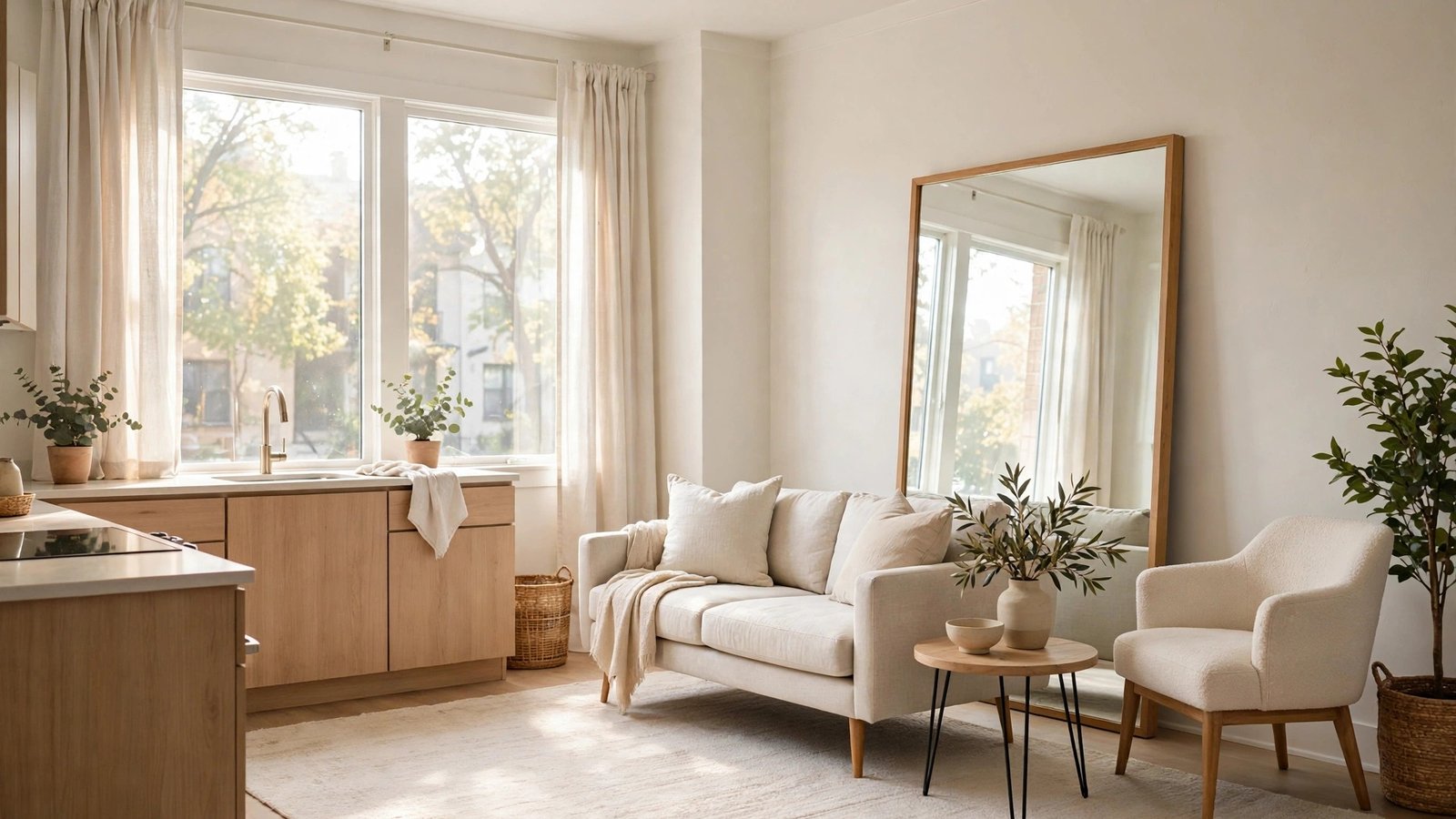
You don’t need a renovation budget or your landlord’s permission to change how your place feels. With roughly $250 and a weekend, the combination of a well-placed mirror, high curtains, leggy furniture, one big rug, and cleared floors can make a studio feel like a genuinely larger home. If you’re learning how to make a small apartment look bigger on a budget, start with whichever trick targets your worst problem — light, floor space, or clutter — and add the rest as your budget allows. Found this useful? Save it for move-in weekend and share it with a fellow first-time renter.

Maren started MyFirstLease after a rough first lease taught him everything the internet didn’t. He covers the logistical side of renting — move-in checklists, utilities, and the unglamorous first-week stuff nobody explains — and oversees everything published on the site.