
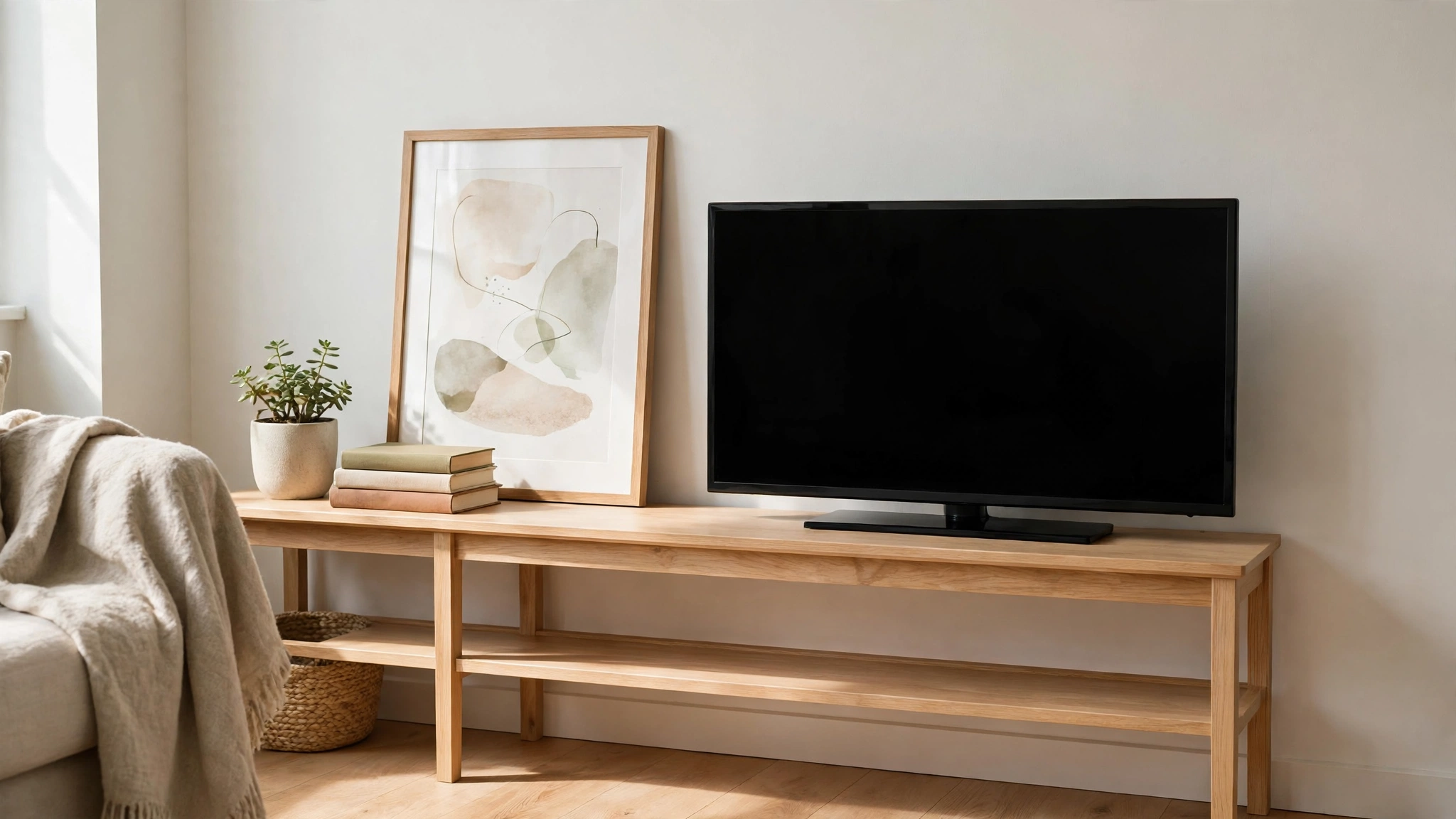
If your living room is small, your TV is probably the biggest thing on the wall — and if you rent, you probably cannot drill into that wall to mount it. Small apartment TV wall decor ideas renters no drilling searches usually return the same mounted-screen photos, which does not help when your lease says no holes. This guide is for a first-time renter in a small living room who needs a TV setup that looks finished, stays stable, and leaves the walls untouched at move-out.
Everything here is built around furniture, leaning pieces, and removable decor. There is no wall mount, no drilled anchor, and no in-wall cord channel. You will get placement rules first, then nine practical sections on stands, backdrops, gallery walls, cord-hiding, console styling, and light — plus a short checklist to run before you spend anything.
Direct answer: The best no-drill TV wall for a small rental starts with a slim freestanding console or freestanding TV stand, the screen centred at seated eye level, cords routed behind the furniture in a paintable cord cover, and lightweight decor hung with removable adhesive around — not above — the screen. Check your lease first, and check any stand’s weight rating and anti-tip instructions before buying.
Executive Summary
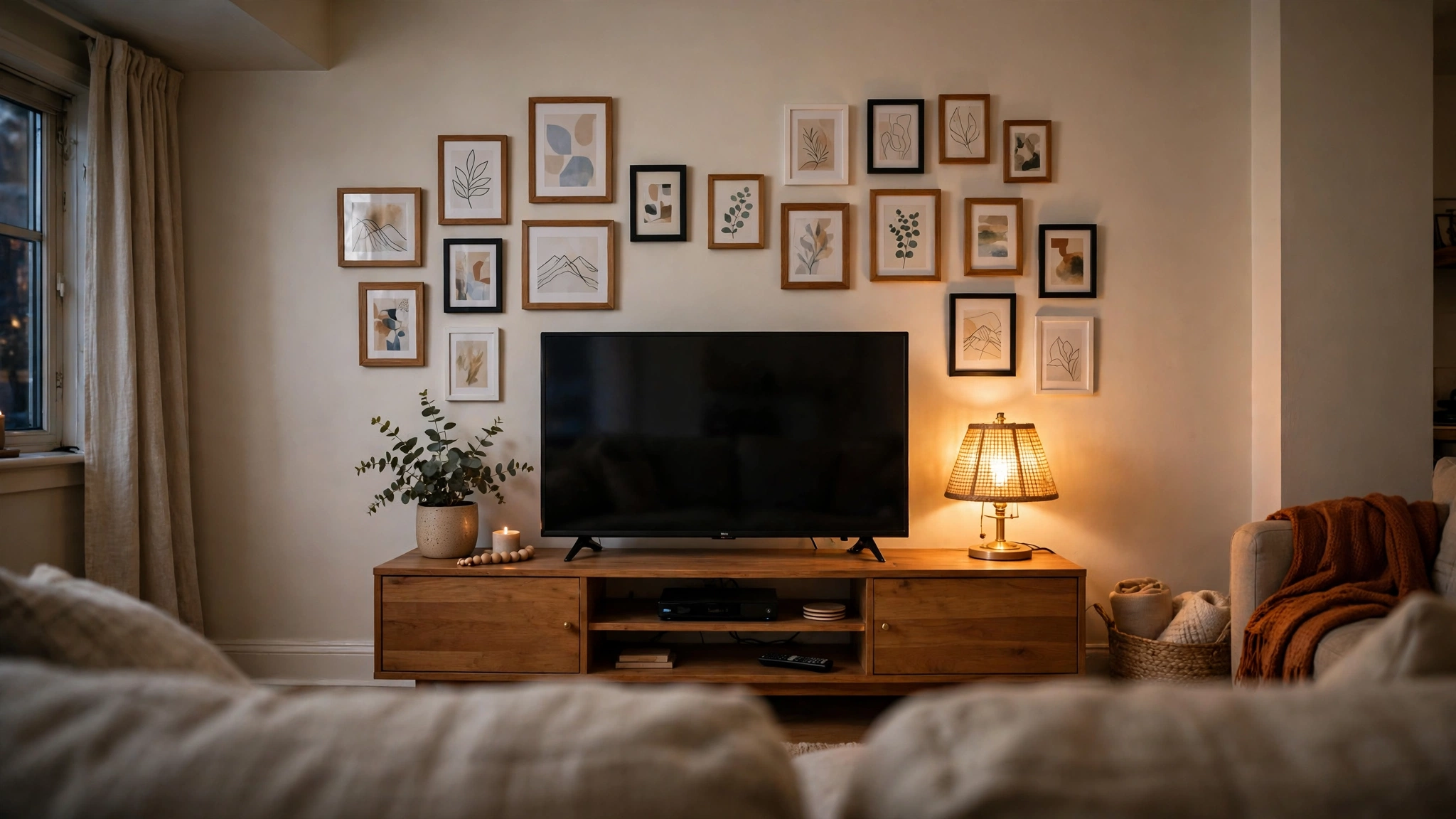
A finished-looking TV wall in a rental is less about the TV and more about what sits under and around it. A console that is wider than the screen, a leaning frame or ladder behind it, and a few pieces of art at the same height as the screen do more than a mount ever could in a small room — and none of it touches the wall with a drill.
This article walks through the order that works: pick the wall and the viewing distance, choose a stand that can actually hold your TV safely, build a backdrop with leaning or adhesive pieces, hide the cords where nobody walks, then style the console and the light around it. Prices are given as ranges, marked as-of-2026, because exact prices change by store and season. Lease, adhesive, and deposit notes appear wherever a choice could cost you money at move-out.
1. Start With Placement, Not the Wall

The wall you choose matters more than anything you hang on it. Put the TV on the longest uninterrupted wall, with the sofa directly opposite, so nobody watches at an angle and the screen does not block a door, a window, or the path to the kitchen. A corner can work in a very small room, but only if the sofa can face it squarely; a TV angled across a corner with the sofa still facing the long wall is a neck ache, not a layout.
Measure before you shop. Sit on the sofa and note where your eyes rest — the centre of the screen should sit roughly at that height, usually around 40 to 42 inches from the floor for a standard sofa. Then measure the viewing distance: a common rule of thumb is about 1.5 times the screen’s diagonal, so a 43-inch TV suits roughly 5 to 6 feet and a 55-inch TV suits roughly 7 to 8 feet. If your room cannot give a 55-inch TV that distance, a smaller screen will look better and feel less overwhelming than a big one crammed into a short room.
Leave a clear walkway of at least 30 inches beside or behind the seating, and keep the TV away from radiators, direct sun glare, and the swing of any door. Tape the TV’s width on the wall with painter’s tape and live with the outline for a day. It costs nothing, it needs no holes, and it stops the most common small-room mistake: buying a console for a TV that never fit the wall in the first place.
2. Freestanding Stands That Anchor the Wall
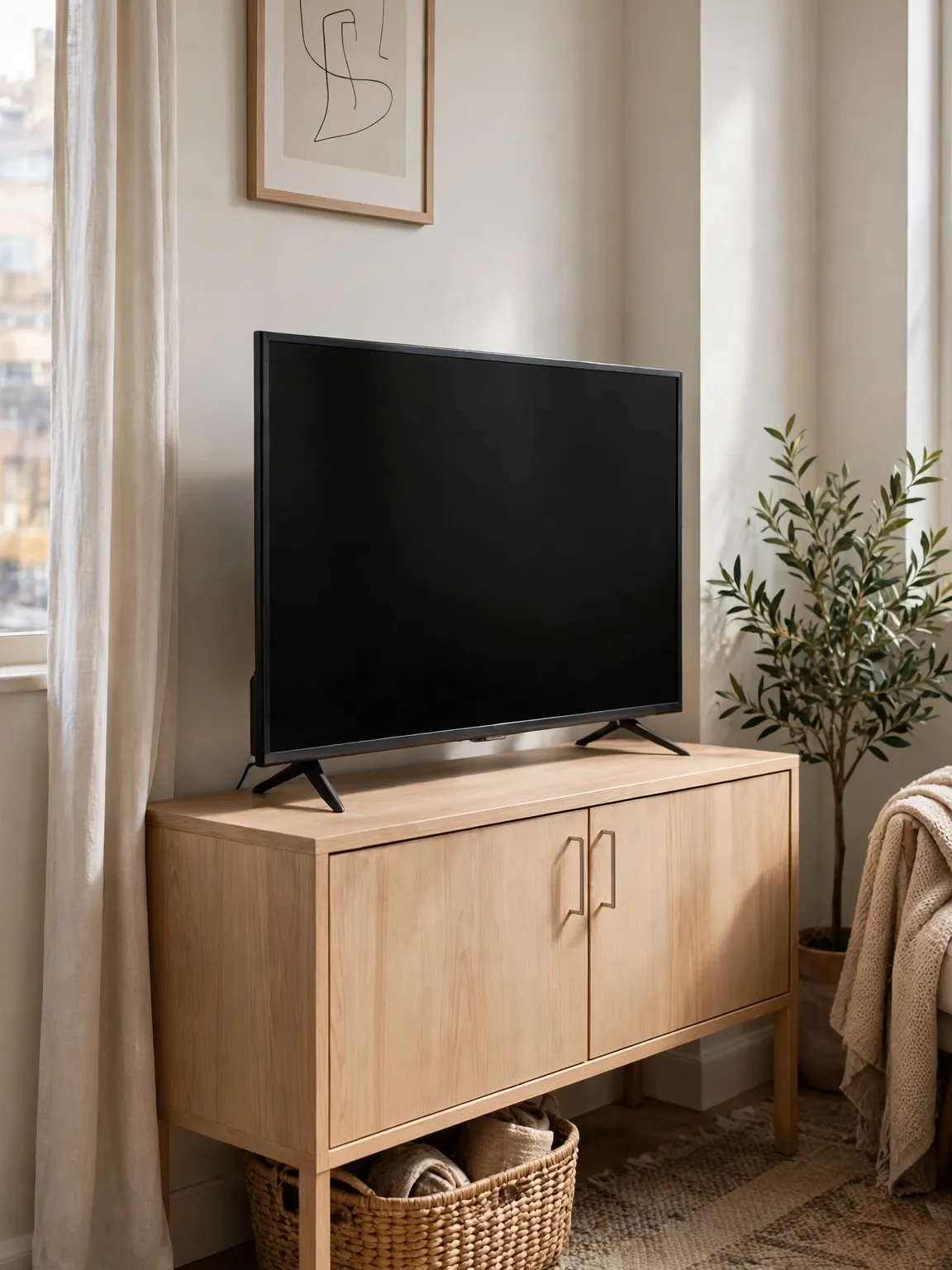
A freestanding stand is the renter’s answer to a wall mount. Two types cover most small living rooms. A slim console — 12 to 16 inches deep, 16 to 20 inches high, and at least as wide as the TV, ideally a few inches wider on each side — gives you storage and a surface to style. A freestanding TV stand, the kind with a vertical post and a base that sits on the floor, gives you the floating look of a mount with nothing attached to the wall, and some models roll, which helps when you rearrange or clean behind the set.
Check the numbers before you buy, not after. Confirm the stand’s weight rating covers your TV with room to spare, confirm the TV’s feet sit fully on the surface with no overhang, and confirm the stand is deep enough that the screen cannot be nudged forward off the edge. Freestanding does not automatically mean stable: a top-heavy TV on a narrow stand can tip, especially in a home with children or pets, or on a floor that is not level. Use the anti-tip strap or hardware supplied with the stand or TV if the instructions call for it, follow the manufacturer’s instructions exactly, and check whether your lease or building rules require anchoring — if anchoring means drilling, that setup is not the right one for your rental, and a wider, heavier, lower console is the safer choice. Never assume a setup is tip-proof; treat stability as something you verify, not something you guess.
Budget-wise, a basic slim console runs roughly $80–$250 as-of-2026, and a freestanding post stand roughly $60–$150 as-of-2026, depending on size and materials. Secondhand consoles are worth checking first — a solid wood piece with a wide base often beats a new flat-pack one on stability — but measure it the same way, and check that all feet and fixings are present before you pay.
3. Leaning Frames and Ladders as a Backdrop

When you cannot hang anything heavy, lean it. A large framed print, a leaning mirror, or a decorative ladder propped against the wall behind or beside the TV creates the layered backdrop a mounted gallery wall would give, with zero holes. The trick is scale: one large leaning piece reads as intentional, while five small leaning pieces read as clutter waiting to fall.
Place a leaning frame to one side of the TV, not directly behind it, so the screen stays the centre of the composition and the frame does not compete with it. A leaning ladder works the same way on the other side — drape a throw over one rung, or hang a lightweight woven piece from it, and keep the top rung below the top of the TV so the ladder frames the screen instead of towering over it. Keep leaning pieces on a flat floor, away from the walkway, and check that they cannot be knocked over by a door, a pet, or a child reaching for the remote. In a home with small children, a leaning mirror or frame should be the kind that is light enough to move easily and positioned where it cannot fall onto someone — and if a piece feels unstable, take it down rather than trusting it to stay put.
Peel-and-stick wallpaper is the other backdrop option, used as a single panel behind the TV rather than a whole wall. A low-contrast linen or subtle pattern, cut to roughly the width of the console, gives the TV wall a defined zone. Check your lease first — some leases ban peel-and-stick products outright — and test a small piece in a hidden spot, because removal can pull paint on some finishes, and paint repair at move-out can cost more than the wallpaper saved. If your lease is silent on it, ask your landlord in writing and keep the reply.
4. Build a Gallery Wall Around the Screen
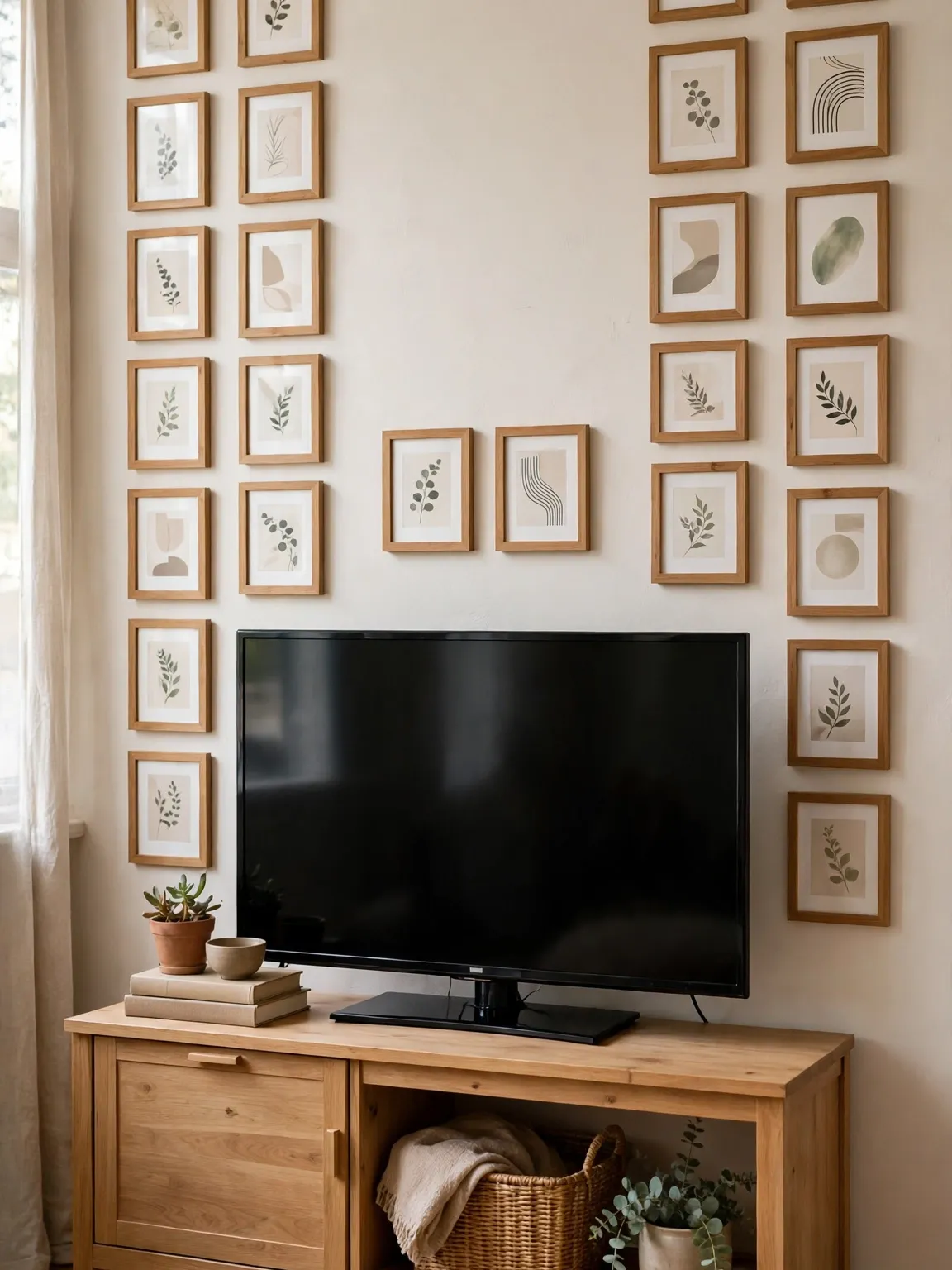
A gallery wall around a TV works when the art is treated as a frame for the screen, not as competition for it. Start with the TV as the centre, then place art in a loose grid or a pair of vertical columns on either side, keeping the pieces at roughly the same height as the screen. Two or three pieces per side is plenty in a small room; a salon wall of a dozen small frames will fight the TV for attention and make the wall feel busy.
Keep every piece light. Adhesive picture-hanging strips and small removable hooks are made for this, but they have weight limits — check the rating on the packet, weigh the frame if you are unsure, and never hang a heavy framed mirror or a glass-fronted piece on adhesive alone. Follow the strip instructions for surface preparation and removal, and test on a hidden patch first: adhesive can damage some paints and textured finishes, and the repair comes out of your deposit. If a piece is too heavy for adhesive, lean it (see section 3) or put it on the console instead.
Layout first, stick second. Cut paper templates the size of each frame, tape them to the wall with painter’s tape, and adjust the spacing — 2 to 3 inches between frames is a good starting point — before anything adhesive touches the paint. Mix one or two personal photos with abstract prints or simple line art so the wall looks collected rather than bought in one trip, and leave at least one empty patch of wall so the eye has somewhere to rest. A gallery wall that covers every inch of wall around the TV makes the screen look bigger, not smaller.
5. Hide Cords Without a Single Hole
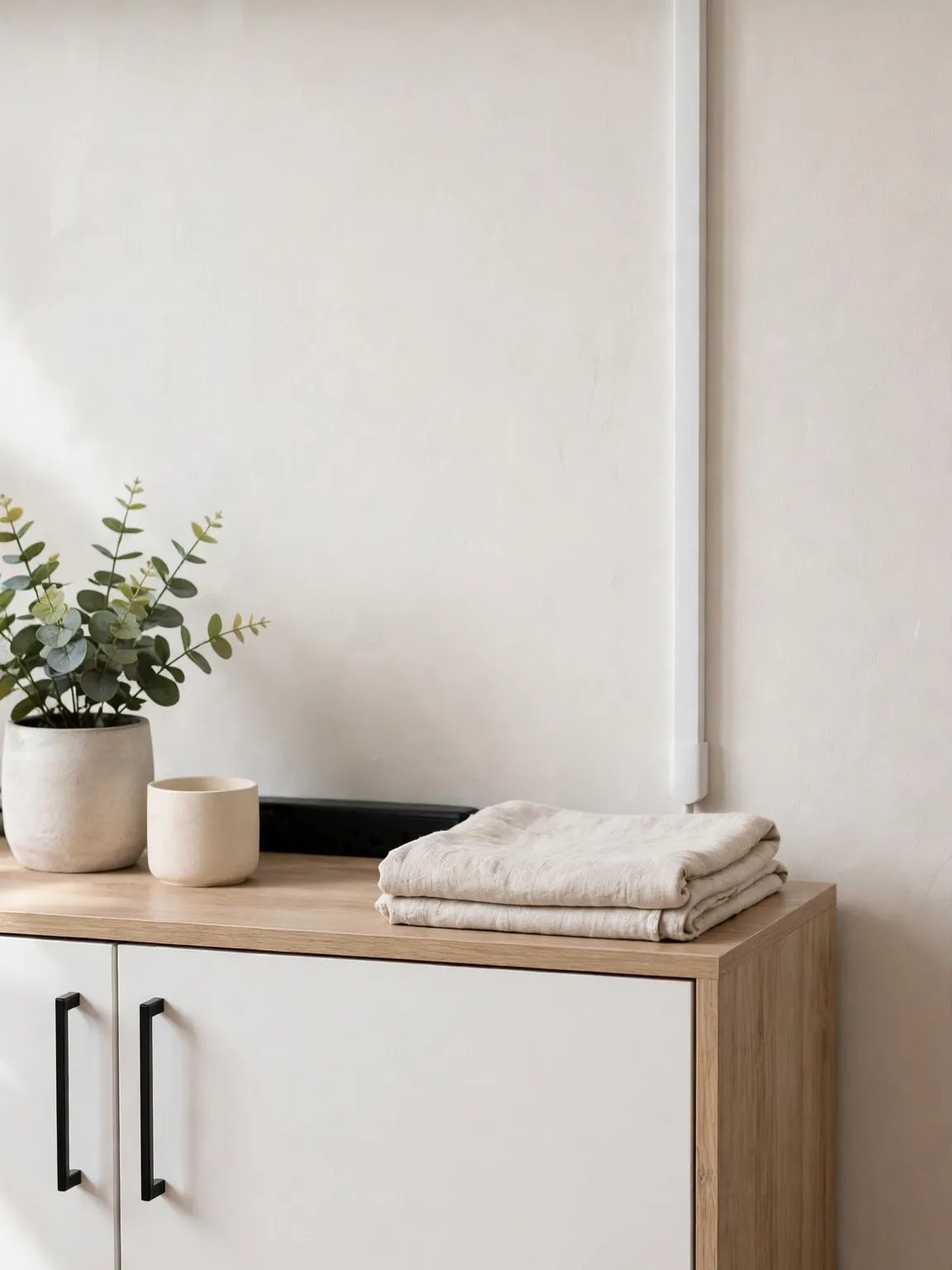
Cords are what make a renter’s TV wall look unfinished, and they are also the part most likely to be tripped over in a small room. The fix is routing, not cutting: gather the TV, console, soundbar, and streaming-device cables together, bundle them with reusable ties, and run them down the back of the console in a single vertical line instead of letting them dangle in separate loops.
A paintable cord cover — a slim plastic channel that sticks to the wall with adhesive — is the cleanest option, at roughly $10–$25 as-of-2026 for a standard length. Measure the run from the back of the TV to the outlet, cut the channel to length, and paint it the wall colour before you stick it up so it disappears. Check the adhesive instructions and your lease: on some paint finishes the adhesive can pull paint on removal, so test a small section first, and never run a cord cover across a walkway or under a rug, where it becomes a trip hazard. For a fuller step-by-step on routing, lengths, and what to avoid, see the companion guide on how to hide TV cords in an apartment rental — this section is the short version; that guide is the detailed one.
If adhesive is not allowed in your lease, run the bundled cords behind the console and down its back leg, held with small adhesive cable clips on the furniture itself — not the wall — or inside a fabric cord sleeve that matches the console. Keep the power strip on the floor behind the console, not on top of it, and leave enough slack that the TV can be moved for cleaning without yanking a plug. Never run cords under a rug, through a doorway, or behind a radiator, and never overload one outlet or power strip: check the ratings on the strip and the devices, and if anything feels hot or smells of burning, unplug it and get advice rather than carrying on.
6. Style the Console Like a Sideboard
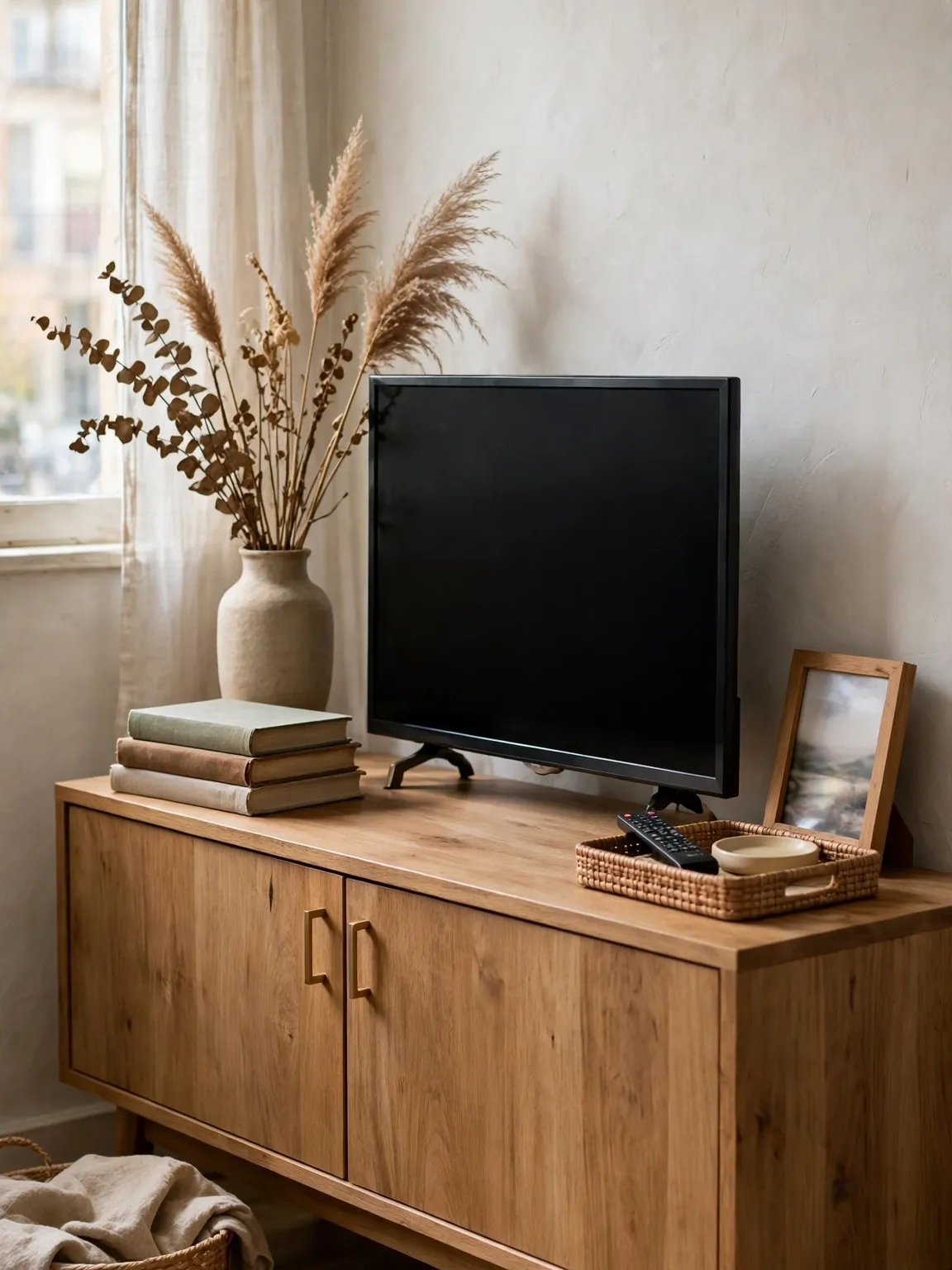
Once the TV is placed and the cords are hidden, the console is what makes the wall look decorated rather than just occupied. Treat it like a sideboard: a low, horizontal surface with a few grouped objects, not a shelf crammed with everything you own. Three groups work well — something tall on one side, something low and wide in the middle, and something small on the other side — with empty space between them.
A tall group could be a vase with dried stems or a small stack of books with a candle on top; keep candles away from the TV’s vents and never leave one burning unattended, and check your lease, since some buildings restrict open flames. The middle group should stay low so it does not block the bottom of the screen — a shallow tray, a small plant, or a folded throw. The third group is the place for a personal object: a framed photo, a small sculpture, or a souvenir that means something to you. Keep anything fragile away from the edge, and keep the remote in a small tray or basket so it does not migrate to the sofa cushions.
Below the console, use the storage honestly. Closed doors hide consoles, games, and chargers; open shelves need baskets or boxes, or they become visual clutter that competes with the screen. A console roughly $80–$250 as-of-2026 usually includes one or the other — pick closed storage if you have a lot to hide, open shelving only if you will actually keep it tidy. Leave ventilation gaps around any console, streaming box, or game console: electronics need airflow, and a closed cabinet with no gap can overheat them.
7. Use Light to Make the TV Disappear

A black rectangle dominates a small room when it is off. Light is the cheapest way to shrink it. A bias light — a short LED strip stuck to the back of the TV, shining onto the wall behind it — softens the contrast between the bright screen and a dark room, and it costs roughly $15–$30 as-of-2026. Stick it to the TV itself, not the wall, so nothing adhesive touches your paint, and pick a warm white rather than a colour-changing party mode for everyday watching.
Layer the rest of the light at the same height as the TV, not above it. A small table lamp on the console, or a floor lamp just beside it, gives the wall a warm pool of light that makes the screen feel like part of the furniture rather than a hole in the wall. Keep lamp cords in the same bundled run as the TV cords, and keep any LED strip or lamp away from curtains, bedding, and other soft furnishings — LED strips produce little heat, but a strip or lamp pressed against fabric is still a risk worth avoiding, and a lamp that can be knocked over should sit well back from the edge.
If the TV faces a window, glare will undo all of this. A sheer curtain or a light-filtering blind on that window, hung with a tension rod or adhesive hooks if your lease bans drilling, cuts the reflection without darkening the room. For more on no-drill window options, see the site’s guide to renter-friendly window decor ideas — the same tension-rod and adhesive approach works here. Avoid placing a mirror directly opposite the TV: it doubles the glare and the black rectangle at once.
8. Small-Space Tricks That Keep It Proportional
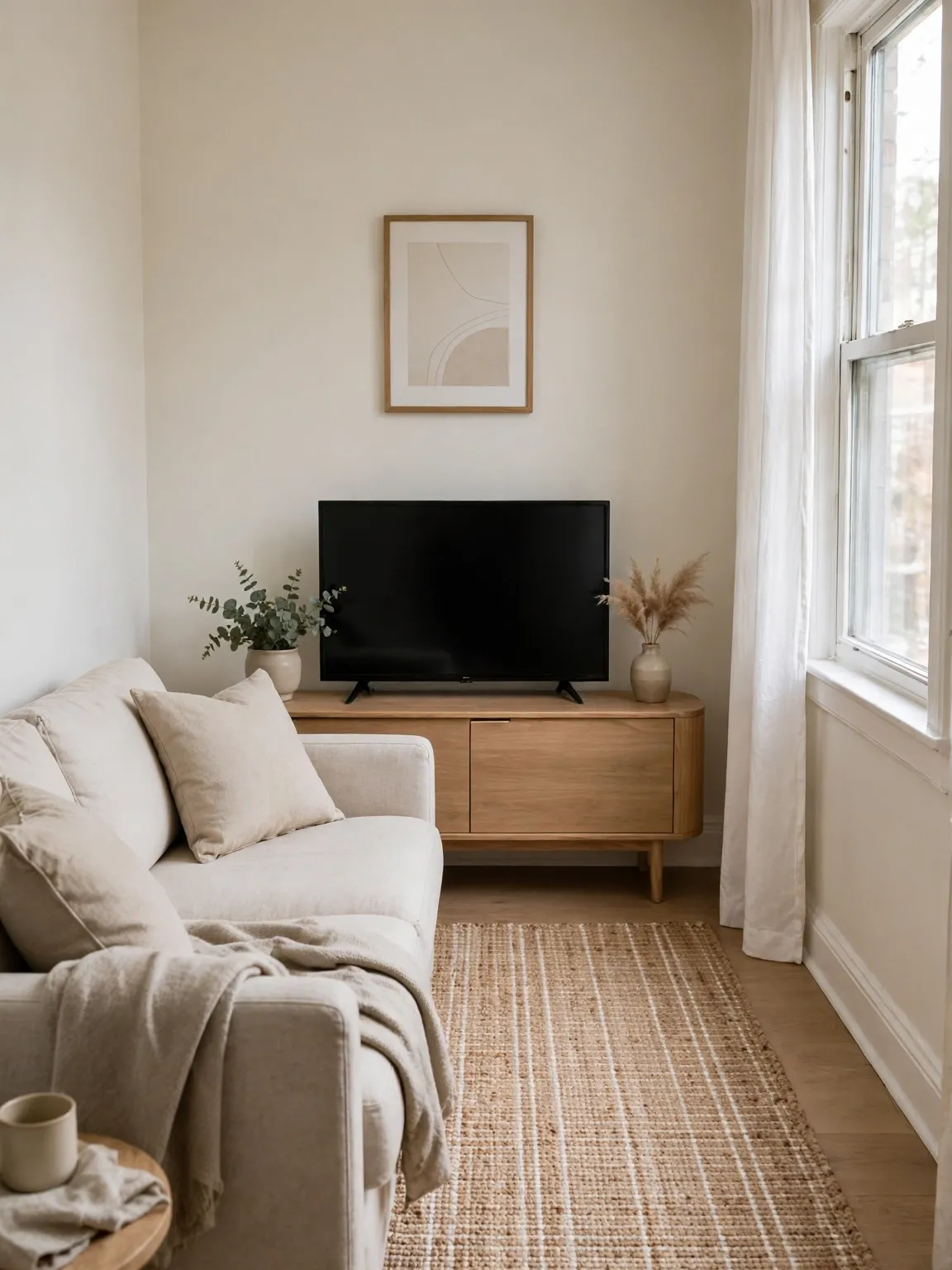
Proportion is the difference between a TV wall that looks designed and one that looks like a TV that happened. The console should be wider than the TV; the art should be smaller than the TV; and nothing on the wall should be taller than the screen unless it is a leaning piece deliberately framing it. When every element is roughly the same size, the wall feels crowded; when the TV is clearly the largest thing and everything else steps down from it, the room feels calm.
Colour helps too. A console and frames in one or two tones that already appear in the room — the sofa, the rug, the curtains — tie the TV wall to the rest of the space, while a bright or high-contrast console turns the TV wall into a separate, louder zone. If the wall behind the TV is a strong colour, keep the decor quiet; if the wall is white, a mid-tone console and warm wood frames add the contrast the screen needs.
Finally, give the TV wall a boundary. A rug that runs from the sofa to the console marks the viewing zone and stops the TV wall bleeding into the rest of the room; a rug that stops halfway leaves the layout feeling unfinished. In a studio or open-plan rental, the back of the sofa or a low bookshelf can mark the same boundary from the other side. If the room still feels crowded after all of this, the honest fix is usually to remove one thing from the wall, not add another — a small room rewards restraint more than a large one does.
9. Renter-Safe Checklist Before You Buy Anything

Run this checklist before you spend money, not after the delivery arrives. It is also the practical asset for this article: copy it into your notes, fill in your own measurements, and take it shopping with you.
Measure-first worksheet
| What to measure | Your number | Why it matters |
|---|---|---|
| Wall width available for the TV | ___ inches | Console must fit with room to spare |
| TV width and weight | ___ in / ___ lbs | Stand rating must exceed the weight |
| Seated eye height | ___ inches from floor | Screen centre should sit near this |
| Sofa-to-TV distance | ___ feet | Checks the screen size suits the room |
| Walkway beside the seating | ___ inches | Needs at least 30 inches clear |
| Outlet position | ___ inches from TV | Sets the cord-cover length |
Before-you-buy checklist
- Lease checked: does it ban drilling, adhesive, peel-and-stick, or open flames? If anything is unclear, ask the landlord in writing and keep the reply.
- Stand weight rating confirmed against the TV’s actual weight, with feet fully on the surface.
- Anti-tip instructions read; if anchoring is required and drilling is banned, choose a different setup.
- Adhesive weight limits checked against each frame; heavy pieces get leaned or placed on furniture, never hung on adhesive.
- Cord route planned from TV to outlet, with a cover or sleeve that stays off walkways and out from under rugs.
- Deposit risks noted: test adhesive and peel-and-stick on a hidden patch first, and photograph the wall before and after.
- Return window checked, in case the console or stand does not fit once it is in the room.
Photograph the wall on move-in day and again after you set the TV wall up. Those two photos are your evidence at move-out that the wall went back the way you found it — or, if a small adhesive mark does appear, that you can show exactly what changed and fix it before the inspection.
FAQ
Can I decorate a TV wall in a rental without drilling anything?
Yes. Use a freestanding console or TV stand for the screen, leaning frames or a ladder for a backdrop, and adhesive strips or hooks only for lightweight art, within their weight ratings. Check your lease first, since some leases restrict adhesive products as well as drilling.
What size TV works in a small apartment living room?
It depends on viewing distance more than room size. As a rule of thumb, sit about 1.5 times the screen’s diagonal away — roughly 5 to 6 feet for a 43-inch TV and 7 to 8 feet for a 55-inch TV. If your sofa cannot give a larger screen that distance, a smaller screen will look and feel better.
How do I hide TV cords in a rental?
Bundle the cables behind the console, run them in one vertical line to the outlet, and cover that run with a paintable adhesive cord cover (roughly $10–$25 as-of-2026) or a fabric sleeve. Never run cords under a rug, across a walkway, or through a doorway. The detailed version is in the site’s guide to hiding TV cords in a rental.
Is a freestanding TV stand safe without wall anchoring?
It can be, if the stand is rated for your TV’s weight, the TV’s feet sit fully on the surface, and you follow the manufacturer’s anti-tip instructions. But freestanding does not automatically mean stable, and no setup can be guaranteed tip-proof — check the instructions and your lease, and choose a wider, lower, heavier console if anchoring is required and drilling is banned.
Can I use adhesive hooks for a gallery wall around a TV?
Yes, for lightweight frames only. Check the weight rating on the packet, weigh the frame if you are unsure, and test the adhesive on a hidden patch first, since it can pull paint on some finishes. Heavy or glass-fronted pieces should be leaned or placed on the console instead.
How high should a TV be in a small living room?
The centre of the screen should sit roughly at seated eye level, usually around 40 to 42 inches from the floor for a standard sofa. Measure your own seated eye height rather than copying a number — sofa heights vary, and a screen hung or stood too high is the most common cause of neck strain.
How do I make a big black TV look less dominant when it is off?
Put a bias light behind it, keep the console and frames in tones already in the room, and flank the screen with art or leaning pieces at the same height so the TV reads as part of a composition. A low console styled like a sideboard and a rug marking the viewing zone help just as much as anything on the wall.
Conclusion
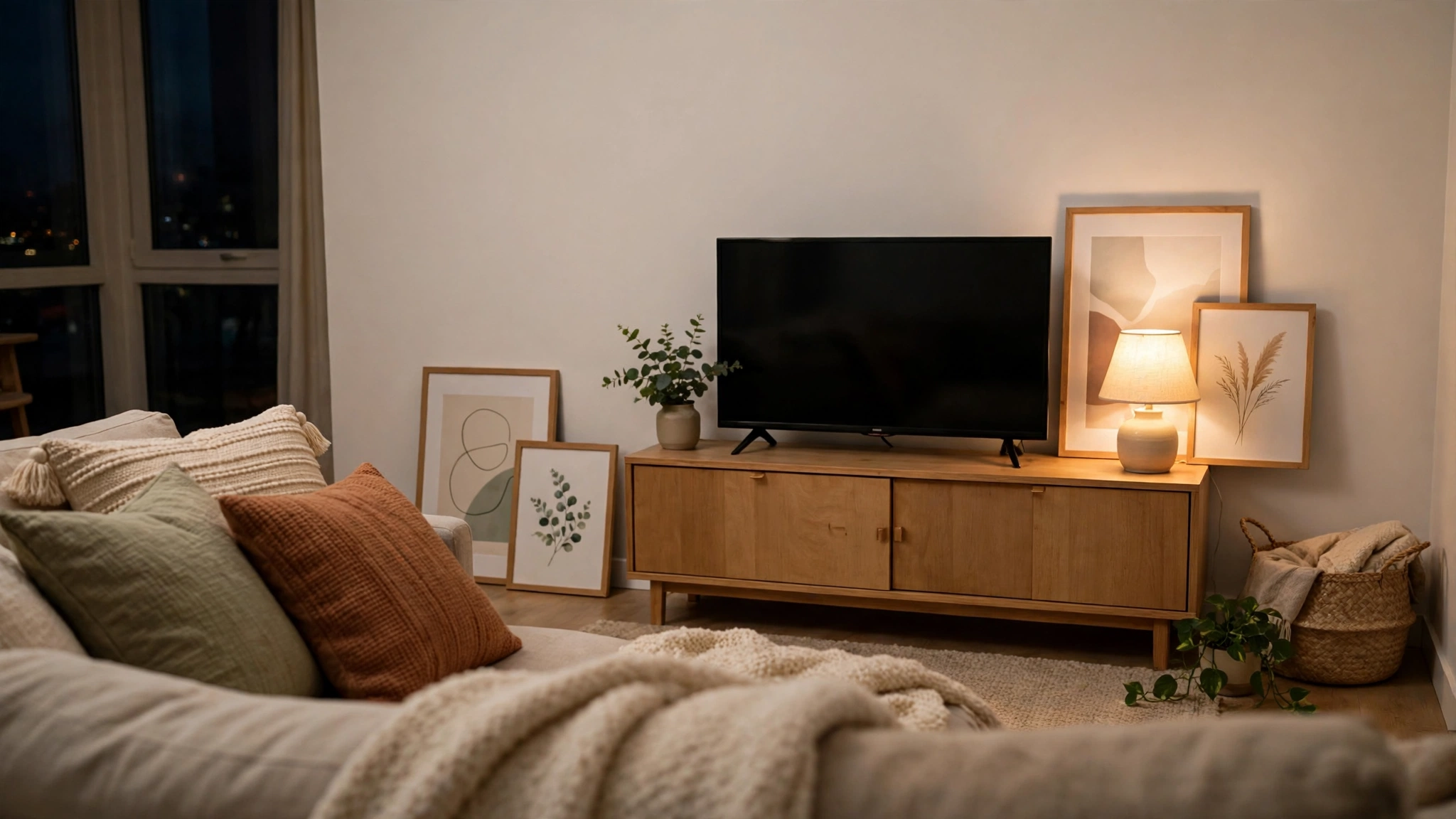
A renter’s TV wall does not need a drill, a mount, or a big budget — it needs the right wall, a stand that can genuinely hold the screen, and decor that frames the TV instead of fighting it. Small apartment TV wall decor ideas renters no drilling work best when the console is wider than the screen, the cords have one tidy route to the outlet, and every adhesive piece is light enough for its rating. Measure first, check the lease, test adhesives on a hidden patch, and your TV wall can look finished now and hand back clean at move-out. If this helped, save it for your next furniture shop and share it with a fellow renter facing the same blank wall.

Maren started MyFirstLease after a rough first lease taught him everything the internet didn’t. He covers the logistical side of renting — move-in checklists, utilities, and the unglamorous first-week stuff nobody explains — and oversees everything published on the site.


