
If you are looking for renter friendly apartment accent wall ideas without paint, you are probably staring at a plain white wall behind your sofa or bed and wondering how to make it bold without risking your deposit. This guide is written for a first-time renter in exactly that spot: no painting allowed, no holes you want to explain later, and a real fear that one wrong adhesive could cost money at move-out.
You will get eleven ideas that are fully removable, ranked honestly by how cleanly they come off, plus the checks to run before you stick anything to a wall — which wall to pick, how your paint finish changes the risk, and how to test a product for a week before committing to a whole wall.
Pick one wall, test your product on a hidden patch for seven days, then choose the lowest-risk option that gives the look you want: fabric, curtains, or a leaning gallery for the safest exit; peel-and-stick wallpaper or panels for the boldest look, but only on smooth, well-cured paint. Remove slowly with gentle heat at move-out, and photograph the bare wall when you are done.
Executive Summary

An accent wall without paint is not one product — it is a spectrum of risk. At the safe end are things that barely touch the wall at all: a tapestry on a tension rod, floor-length curtains, or art leaning on furniture. At the bold end are peel-and-stick wallpaper and faux-wood panels, which cover a whole wall in one go but depend entirely on the paint underneath them. Most “removable” products work well on smooth satin or eggshell paint that has had weeks to cure, and most problems happen on flat or matte paint, fresh paint, or textured walls.
This article follows that risk order. It starts with choosing the right wall and reading your paint finish, then works through the ideas from boldest to safest, and ends with the removal routine that protects your deposit. Every idea includes what it costs as a planning range, where it works best, and what can go wrong — so the wall you pick is one you can take down without a repair bill.
1. Choose the Right Wall First

A renter friendly accent wall starts with the wall, not the product. The wall behind the sofa, the wall behind the bed, or the wall a visitor faces on entering the room are the usual candidates, because each one already has a clear focal point — furniture sitting against it. A wall with a door, a thermostat, a light switch in the middle, or a radiator is a poor choice: every cut-out and obstacle is a place where peel-and-stick material lifts, bubbles, or has to be trimmed, and every trim is a weak edge.
Check the surface before anything else. Run a hand over it. Smooth drywall takes peel-and-stick products well. Light orange-peel texture can still work for thicker wallpaper and panels, but thin decals and washi tape will not grip evenly and will lift at the edges within days. Heavy texture, popcorn finish, or flaking paint is a no-stick wall — choose a fabric, curtain, or furniture-backed idea from later sections instead, because no adhesive product will hold on it and the attempt itself can pull loose paint off.
Light matters too. A wall that gets direct afternoon sun will heat adhesive and can make cheap vinyl curl at the edges; a wall in a damp bathroom or a kitchen near steam will loosen most peel-and-stick products over time. The best first accent wall in a rental is usually a smooth, interior living-room or bedroom wall, away from direct sun and steam, with one large piece of furniture already against it. If the only wall available is textured or sun-baked, that does not rule out an accent wall — it rules out the adhesive ideas, and points toward the fabric and furniture ideas instead.
2. Peel-and-Stick Wallpaper

Peel-and-stick wallpaper is the boldest way to get an accent wall without paint, and the one most renters picture first. A single wall in a large-scale floral, a deep solid colour, or a bold geometric pattern changes a room in an afternoon, and modern removable wallpaper is designed to lift off in whole strips when it is time to leave. It is also the idea where the wall underneath matters most, so the preparation in H2 1 is not optional.
Measure the wall and order a little more than the measurement — one extra roll or panel covers pattern-matching waste and mistakes, and running short mid-wall is the most common reason a job ends up with a visible seam in the wrong place. Clean the wall with a barely damp cloth, let it dry fully, and apply from the top down, smoothing as you go and peeling back any section that traps air rather than pressing a bubble flat and hoping it settles. Work with a second person if the wall is wider than a single arm span; the paper is far easier to align straight when one person holds and the other smooths.
The honest removal note is this: on smooth satin or eggshell paint that has cured for at least a few weeks, quality peel-and-stick wallpaper usually lifts cleanly, especially if it is warmed gently with a hair dryer on a low setting and pulled back slowly at a low angle. On flat or matte paint, on paint less than a month old, or on walls that were painted over dust or old wallpaper, the same product can lift paint with it. That is why the seven-day test patch in H2 11 comes before a full wall, not after. Cost band as a planning range, as of 2026: roughly $30–$80 for a single accent wall in a small room, depending on the pattern and the wall size.
3. Removable Decals and Murals

If full wallpaper feels like too much commitment, removable decals and murals give the same focal point with far less wall covered. Large-scale decals — an arch behind the bed, a mountain scene in a living room, oversized leaves or geometric shapes — read as a designed feature wall from across the room, while leaving most of the paint untouched. That smaller contact area is exactly why they are lower-risk than a full wall of wallpaper: less adhesive on the wall means less that can go wrong at removal.
Placement is the whole skill here. Lay the pieces out on the floor first and mark the centre of the wall lightly with a pencil, so the design stays balanced and does not drift to one side as it goes up. Apply the largest piece first, then build around it, stepping back every few pieces to check the composition from the doorway — a design that looks even up close can look lopsided from where the room is actually entered. On textured walls, choose thicker vinyl decals rather than thin ones, and press the edges down firmly; thin decals will not grip texture and will curl within days.
At removal, decals are among the most forgiving options, because each piece is small and can be warmed and lifted individually. The exception is cheap, very thin vinyl left up for years in direct sun, which can become brittle and tear into small pieces — still removable, but slow. Keep the backing paper if the product came with it; decals stored flat on their backing can be reused in the next apartment, which is a genuine saving for a first-time renter who may move within a year or two. Cost band as a planning range, as of 2026: roughly $15–$60 for a large decal set or mural, depending on size.
4. Tapestries and Fabric Panels

A tapestry or a large piece of fabric is the lowest-risk way to cover a whole wall, because the fabric itself never sticks to the paint. It hangs from a rod, a tension rod, or removable hooks, and the wall behind it stays untouched. That makes it the best choice for textured walls, older paint, and any wall where an adhesive test has already failed — and it also softens echo in rooms with hard floors, which is a quiet bonus in a bare rental.
Hang it well and it reads as intentional rather than improvised. A tapestry that is wider than the sofa or bed beneath it anchors the wall; one that is narrower than the furniture looks like a poster that drifted. Hang the top edge a few inches above the furniture, not at the ceiling, and let the bottom fall just behind the sofa or bed so the eye reads one continuous feature rather than a floating rectangle. A lightweight curtain rod on removable hooks, or a tension rod wedged inside a shallow alcove, holds most tapestries without a single hole; check the weight limit on the hook packaging and stay well under it, because a hook that fails overnight can mark the wall on its way down.
Fabric also offers a trick the adhesive ideas cannot: the liquid-starch method, where a lightweight cotton fabric is smoothed onto the wall with diluted liquid starch and peels off later like a large decal. It works well on smooth walls and leaves no residue, but it is messier to apply, it needs a full day to dry, and it should be tested on a hidden patch first, because starch on flat paint can leave a faint sheen. For most first-time renters, hanging the fabric is the simpler and safer version of the same look. Cost band as a planning range, as of 2026: roughly $20–$60 for a tapestry or fabric panel with a rod and hooks.
5. Washi Tape Patterns

Washi tape is the cheapest accent wall in this guide, and one of the most striking when it is done boldly. Wide washi tape in a geometric pattern — large diamonds, thin vertical stripes, a grid, or a single oversized arch — goes straight onto the wall, costs very little, and is made to remove cleanly. Because the tape itself is the design, there is no pattern-matching, no smoothing, and no wasted material.
The difference between a washi wall that looks designed and one that looks improvised is scale and patience. Use wide tape, at least an inch across, and draw the pattern large: small, fussy shapes read as clutter from across the room, while a few big diamonds or a bold grid read as a deliberate feature. Mark the main lines lightly in pencil first, using a level or a long straight edge, and keep the spacing even — a grid that drifts by half an inch over a whole wall is visible from the doorway. Press each strip down firmly as it goes on, and trim the ends cleanly at the edges of the wall.
Removal is where washi tape earns its reputation: it usually lifts in clean strips with no residue, even from flat paint, because the adhesive is deliberately weak. The risk is not the wall but the tape itself — very cheap tape can tear and leave small pieces, and tape left up for years in a sunny room can become harder to lift. Both are fixed by warming the tape gently with a hair dryer and peeling slowly. If a pattern needs to last more than a year, step up to a mid-priced tape rather than the cheapest roll available. Cost band as a planning range, as of 2026: roughly $10–$30 for enough wide tape to cover one accent wall.
6. Faux Wood and Brick Panels

Peel-and-stick wood slats, fluted panels, and faux-brick panels give an accent wall texture and depth that flat wallpaper cannot, and they photograph like real millwork. Thin foam or lightweight vinyl panels with a peel-and-stick backing go up in rows, and a slat wall behind a sofa or a television is one of the most popular rental looks for a reason: it adds shadow lines and warmth to a flat white room without a saw, a nail gun, or a coat of paint.
Weight is the question to ask before buying. The thicker and heavier the panel, the stronger its adhesive has to be to hold it, and the stronger the adhesive, the higher the removal risk. Lightweight foam slats and thin vinyl panels are the renter-safe end of this category; heavy wood-look panels that need construction adhesive are not, and should be avoided in a rental entirely. Read the product description for the words “peel and stick” and “removable,” and check the weight per panel — if the listing does not say it removes cleanly, treat that as a warning, not an oversight.
Install them in level rows from the bottom up, leaving a hairline gap between panels so the wall can breathe and the panels can expand slightly with temperature changes. In a bedroom, a slat panel behind the bed acts as a headboard and a feature wall at once; in a living room, a narrow section behind the television is often more effective than a full wall, because the screen itself is already the focal point. At removal, warm each panel and pull slowly — panels that come off in one piece are the sign of a good product, and panels that snap are a sign to slow down rather than pull harder. Cost band as a planning range, as of 2026: roughly $40–$120 for a single accent wall, depending on panel type and wall size.
7. No-Nail Gallery Wall

A gallery wall is an accent wall in disguise: instead of covering the wall with one material, a group of frames, prints, and small objects arranged as one composition creates the same focal point, and every piece comes down with a removable strip rather than a nail. It suits a first-time renter who already owns prints, photos, or small art, because the wall is built from things already in the home.
Treat it as one composition, not a collection that grows randomly. Lay the frames out on the floor first, in the shape they will take on the wall — a grid for a tidy look, a loose cluster with one large anchor piece for a relaxed one — and photograph the layout before anything goes up. Keep the spacing even, usually two to three inches between frames, and keep the centre of the whole arrangement at eye level, not at the ceiling. One large piece anchors the group; without it, a gallery of small frames can look scattered, however carefully it is spaced.
Removable picture-hanging strips are the right fixings for this, and the weight rating on the packaging is a limit, not a suggestion — use two strips for anything over a few pounds, and follow the maker’s instructions on how long to press and how long to wait before hanging. At move-out, pull the strip tab straight down slowly, exactly as the instructions say; pulling outward is the mistake that takes paint with it. Lean larger frames against the wall on a console or a shelf below the gallery to add height without adding fixings. Cost band as a planning range, as of 2026: roughly $20–$60 for strips and a few frames, if prints are already owned.
8. Curtains as a Feature Wall

Floor-to-ceiling curtains hung across a whole wall turn that wall into a feature, with no adhesive on the paint at all. A full wall of linen-look or velvet-look curtains behind a sofa or a bed adds colour, texture, and softness in one move, and it has a practical side too: it softens echoes, blocks a draught from a cold wall, and hides an uneven or unattractive surface completely. For a wall that failed the adhesive test, this is often the best answer left.
The hardware is what makes it renter-safe. A tension rod wedged between two walls works in an alcove or a narrow room; in a wider room, a curtain rod on removable hooks or on a freestanding garment rack placed against the wall does the same job without drilling. Hang the rod high — a few inches below the ceiling rather than just above the window or furniture — and let the curtains fall to the floor, so the wall reads taller than it is. Choose curtains wider than the wall they cover, so they hang in soft folds rather than stretched flat; flat, stretched curtains look like a sheet pinned up, while gathered fabric looks like a designed drape.
Colour choice matters more here than with a small hanging, because a whole wall of fabric is a large block of colour. A deep, solid colour makes a strong feature in a living room; a pale, textured fabric makes a bedroom feel calm and soft. Keep the rest of the room’s textiles in the same family so the curtain wall feels connected to the room rather than dropped into it. When moving out, the curtains come down with the rod and pack flat — nothing on the wall needs repairing at all. Cost band as a planning range, as of 2026: roughly $30–$80 for a rod and a pair of floor-length curtains.
9. Shelving That Builds the Wall

A leaning bookcase, a ladder shelf, or an open shelving unit placed against a wall creates an accent wall out of furniture rather than a wall covering. The shelves themselves are the feature: books, plants, framed prints, and a few personal objects arranged on them give the wall colour and depth, and the whole thing is freestanding, so the wall behind it is never touched. For a renter who moves often, this is the most portable accent wall in this guide — it dismantles, moves, and reassembles in the next apartment.
Choose a unit that is tall and narrow enough to read as a feature rather than a storage unit. A leaning ladder shelf works well in a small room because its top rests lightly against the wall and its footprint is small; a wide, low bookcase works better as a room divider or a television stand. Anchor freestanding shelving against tipping if the household includes small children — a freestanding unit can be steadied with furniture straps that fix to the back of the unit and to a wall stud, but that does involve a fixing, so check the lease and use a removable strap or a heavy, low unit instead if drilling is not allowed. Keep heavy items low and light items high, both for stability and for how the eye reads the arrangement.
Style the shelves as one wall, not as separate shelves. Repeat one or two colours across the shelves, leave some empty space on each shelf so the arrangement can breathe, and put the largest object — a framed print, a large plant, a stack of books — at eye level where it anchors the whole wall. A strip of battery-powered LED lighting under one shelf adds warmth in the evening and costs nothing in wall fixings. Cost band as a planning range, as of 2026: roughly $40–$120 for a leaning shelf or small bookcase, before the objects displayed on it.
10. Lighting That Makes the Focal Point

Light can create an accent wall without covering it at all. A pair of plug-in wall sconces flanking a sofa, a battery-powered picture light over a large print, or a strip of warm LED lighting behind a shelf or a television draws the eye to one wall and makes it the focal point of the room, while the wall itself stays bare. This is the gentlest idea in the guide for the paint underneath, because nothing is stuck to the wall for longer than a removable strip holds a lightweight fitting.
Plug-in sconces are the strongest version of this idea. They mount with removable strips or rest on a small bracket, plug into an existing outlet, and give the wall the same symmetrical, designed look as hardwired sconces — flanking a bed or a sofa, they frame the wall the way a headboard or a large frame would. Battery-powered picture lights do the same job on a smaller scale over a single large print, and LED strips tucked behind a television or along the top of a shelf wash the wall with a warm glow that makes the whole wall feel intentional in the evening. Choose warm white light, not cool white, so the glow feels like lamplight rather than office lighting.
Keep the wiring tidy, because a loose cord across a wall ruins the effect. Run cords down behind furniture, use removable cord clips to hold them against the skirting board, and never run a cord under a rug where it can be damaged. Check the weight and heat guidance for any fitting that sits close to fabric or paper, and switch battery lights off when they are not in use. At move-out, the fittings come down with their strips and the wall is exactly as it was. Cost band as a planning range, as of 2026: roughly $25–$80 for a pair of plug-in sconces or a picture light and LED strip.
11. Removing It Cleanly at Move-Out

The deposit is protected on removal day, not on installation day, and the routine is the same for almost every idea in this guide: warm, pull slowly, and check as you go. Start with the seven-day test patch that should have been done before installation — a small piece of the same product, in a hidden spot such as behind a door or low behind furniture, left for a full week and then removed exactly as the instructions say. If the test patch lifts paint, leaves residue, or tears, the product is not safe for that wall, and it is far better to learn that from a hidden patch than from a full accent wall on the last day of the lease.
For the full removal, work in the cool of the day if possible, and warm each section gently with a hair dryer on a low setting before pulling. Pull peel-and-stick wallpaper and panels back slowly at a low angle, close to the wall, rather than yanking outward; pull removable-strip tabs straight down, exactly as the maker instructs; lift decals and washi tape one piece at a time. If residue remains, roll it off gently with a fingertip or a soft cloth rather than scraping with a blade, and clean the wall with a barely damp cloth only after all the adhesive is off. Photograph the bare wall in daylight when you are done, so there is a record of its condition.
Deposit-safe comparison — the ideas in this guide, ranked by removal risk:
| Idea | Removal risk | Cost band (planning range, as of 2026) | Best for |
|---|---|---|---|
| Curtains as a feature wall | Lowest — nothing sticks to the wall | $30–$80 | Textured or older walls |
| Tapestries and fabric panels | Lowest — hangs from a rod or hooks | $20–$60 | Textured walls, bedrooms |
| Shelving that builds the wall | Lowest — freestanding furniture | $40–$120 | Renters who move often |
| Lighting that makes the focal point | Low — light strips only | $25–$80 | Any smooth wall |
| No-nail gallery wall | Low — if strip tabs are pulled correctly | $20–$60 | Walls with prints already owned |
| Washi tape patterns | Low — made to lift cleanly | $10–$30 | First accent wall, low budget |
| Removable decals and murals | Low–medium — small pieces, easy to lift | $15–$60 | A focal point without full coverage |
| Peel-and-stick wallpaper | Medium — depends on paint finish and age | $30–$80 | Smooth, well-cured paint only |
| Faux wood and brick panels | Medium — heavier panels need stronger adhesive | $40–$120 | Smooth walls, living rooms |
One last check before any of this goes up: read the lease. Most leases ban painting but say nothing about removable products; a few ban anything stuck to the walls at all. If the lease is silent, the test patch and the removal routine above are the practical protection. If the lease bans adhesives outright, stick to the lowest-risk rows in the table — curtains, fabric, shelving, and lighting — which do not rely on the wall at all. For more on decorating a rental without overspending, see: Decorate an Apartment on a Budget
FAQ
Can I do an accent wall without paint in a rental?
Yes. Peel-and-stick wallpaper, decals, fabric, washi tape, curtains, and freestanding shelving all create a feature wall without paint, and none of them needs a hole in the wall. Choose the idea that matches your wall — smooth paint takes adhesive products, textured or older paint suits fabric, curtains, or furniture.
What is the safest accent wall without paint for a deposit?
A curtain wall, a tapestry, or a leaning shelf is the safest, because nothing is stuck to the paint at all. Lighting and a gallery wall on removable strips are next, provided the strip tabs are pulled straight down at removal. Peel-and-stick wallpaper is the boldest option, but it carries the highest removal risk.
Will peel-and-stick wallpaper damage rental walls?
It can, on the wrong wall. On smooth satin or eggshell paint that has cured for several weeks, quality removable wallpaper usually lifts cleanly with gentle heat. On flat or matte paint, fresh paint, or paint over dust or old wallpaper, it can lift paint. Always run the seven-day test patch in H2 11 first.
What is the cheapest no damage accent wall?
Washi tape, at roughly $10–$30 for one wall as a planning range, as of 2026. A large-scale geometric pattern in wide tape is the cheapest way to get a bold feature wall, and it is made to lift cleanly. Decals are the next cheapest, at roughly $15–$60.
Can I use removable wallpaper on textured walls?
Thin wallpaper and decals usually will not grip textured walls evenly and will lift at the edges. Thicker peel-and-stick wallpaper or panels can work on light texture, but the safer choice for a textured wall is fabric, curtains, or a furniture-backed wall, which do not rely on adhesive grip at all.
How do I remove peel-and-stick wallpaper without losing my deposit?
Warm each strip gently with a hair dryer on a low setting, pull it back slowly at a low angle close to the wall, and work in small sections. Roll any residue off with a fingertip rather than scraping, clean the wall with a barely damp cloth afterwards, and photograph the bare wall in daylight as a record.
Do I need my landlord’s permission for a temporary accent wall rental?
Check the lease first. Most leases ban painting but do not mention removable products. If the lease bans anything stuck to the walls, use the no-adhesive ideas — curtains, fabric on a rod, shelving, and lighting. When in doubt, a short written message to the landlord describing the removable product is the safest step, and it creates a record.
Conclusion
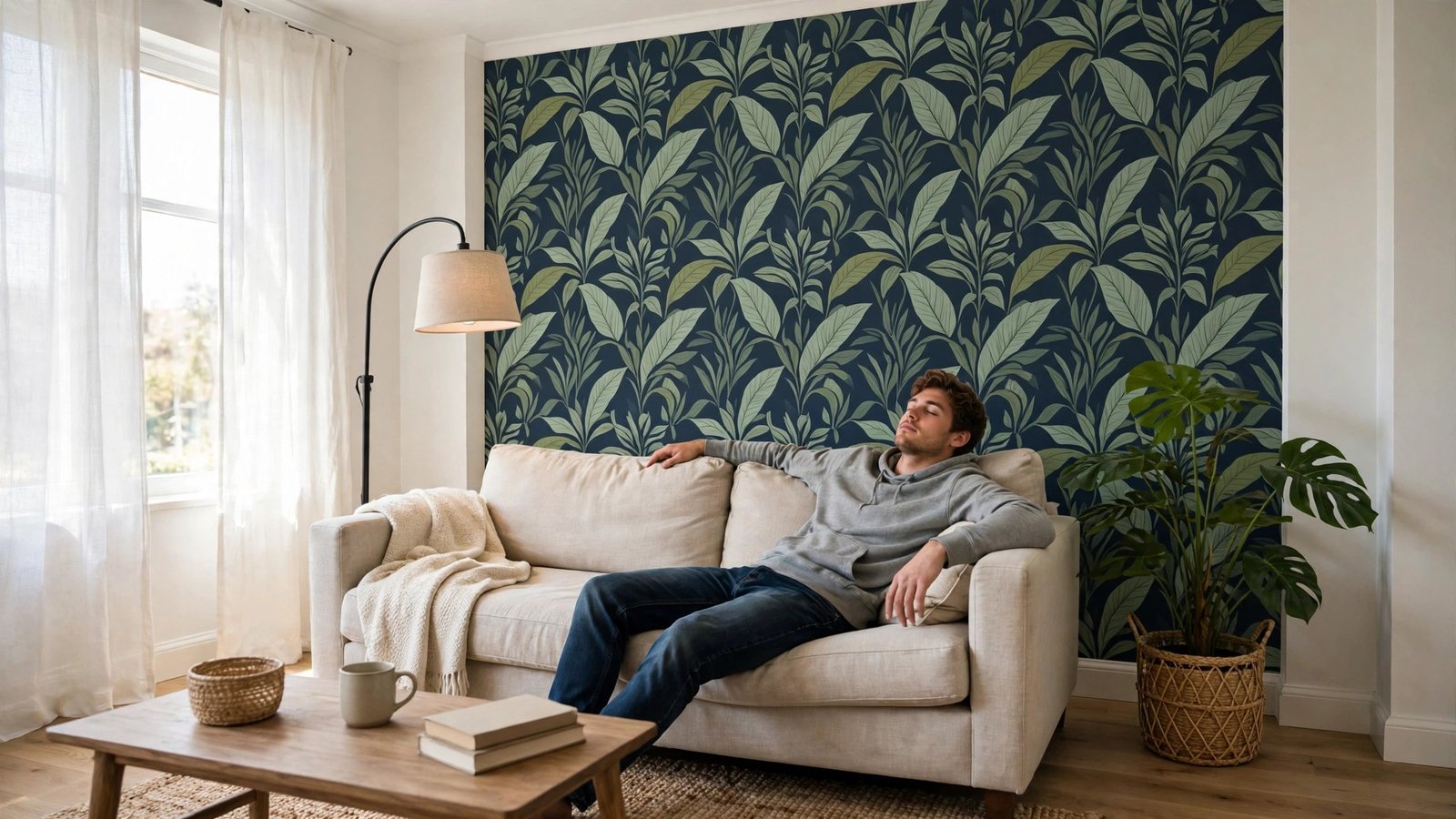
A renter friendly apartment accent wall ideas without paint search usually ends in one of two places: a bold wall that costs part of the deposit, or no wall at all. It does not have to. Pick the wall first, read the paint finish, test the product for a week, and then choose the idea that matches the wall you actually have — curtains or fabric for a textured wall, wallpaper or panels for smooth, well-cured paint, and lighting or shelving when the safest exit matters most. Remove it slowly with gentle heat, photograph the bare wall, and the room goes back to exactly how it was found. Save this guide for move-out day, and share it with a fellow renter who is still staring at a plain white wall.
For more ideas in this pillar, see the site’s Decorating & Small Space Living guides.

Maren started MyFirstLease after a rough first lease taught him everything the internet didn’t. He covers the logistical side of renting — move-in checklists, utilities, and the unglamorous first-week stuff nobody explains — and oversees everything published on the site.