
Learning how to style a small apartment sofa with throws and pillows renters can actually use starts with the sofa you have, not the one in the photos: a loveseat or short two-seater in a tight living room, maybe a hand-me-down or a worn landlord piece. This guide is for a first-time renter in their twenties furnishing a small studio or one-bedroom on a tight budget who wants the living room to look finished without buying a new sofa.
A small sofa is the easiest kind to style: three pillows and one throw are enough, and the whole change can cost less than a takeout order if you thrift the pieces and reuse inserts you already own. The steps run in order — measure, pick a palette, place the pillows, drape the throw, hide the wear, shop on a budget, keep it washable — and you can stop after step three and still see a real difference.
Direct answer: To style a small apartment sofa as a renter, measure the sofa and use three pillows (one large, one medium, one lumbar) plus one folded throw in a two-color palette, choose washable covers you can launder, and cover worn spots with a throw or a lease-approved slipcover — all for about $50–$100 as of 2026.
Executive Summary
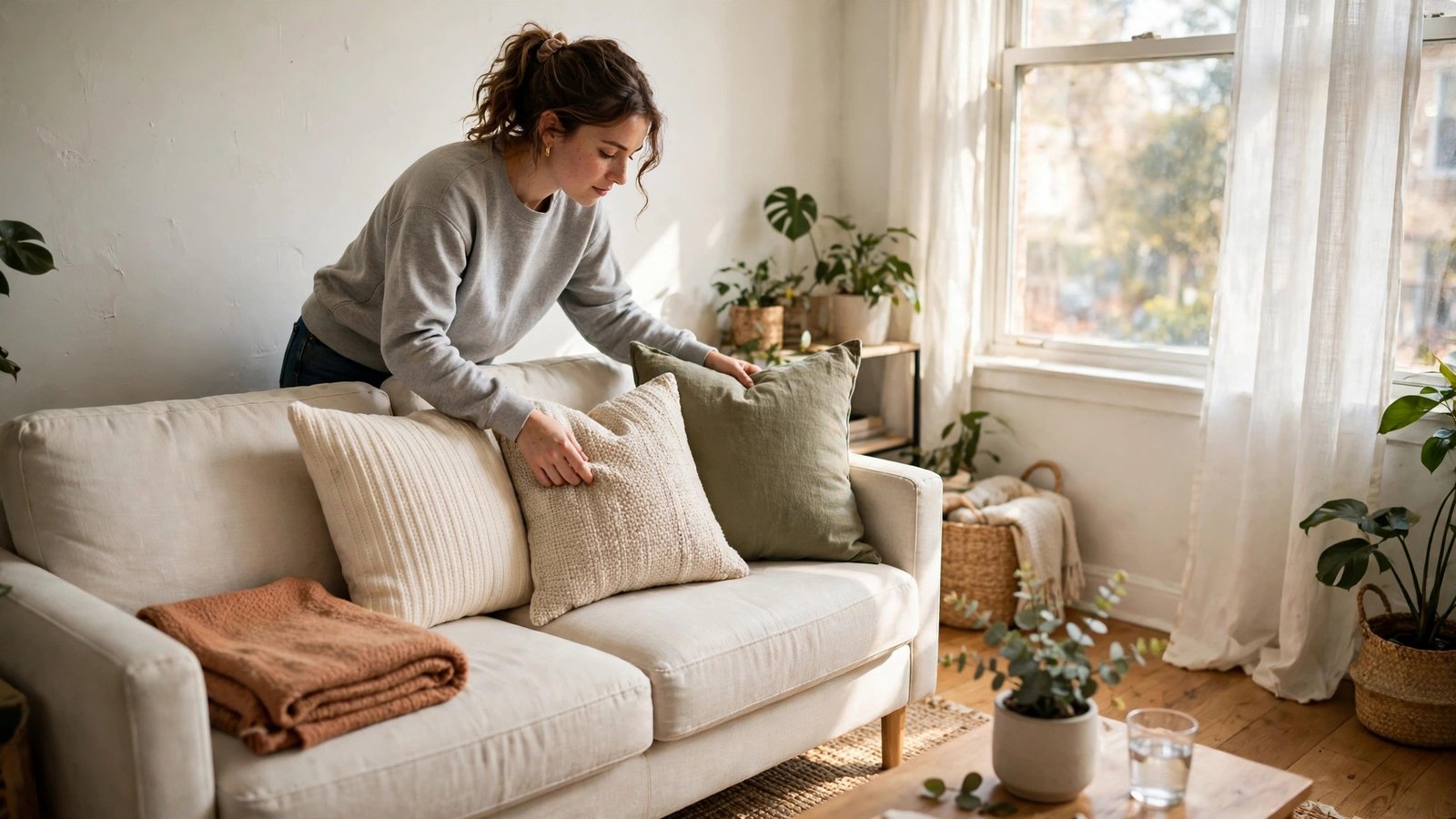
A styled sofa in a small rental is a formula, not a talent. The pieces that matter are the count, the sizes, and the colors — get those three right and the sofa reads as intentional, even if every piece came from a thrift store. This guide covers the order that makes the work easiest: reading your sofa’s actual size and condition, choosing two colors and sticking to them, using the three-pillow formula that fits a loveseat instead of a three-seater, and draping a throw so it stays put through a whole evening of sitting.
From there, it covers the renter-specific parts the generic guides skip: how to style a small apartment sofa with throws and pillows renters can afford by thrifting covers and reusing inserts, how to hide a worn landlord sofa without replacing it or breaking a lease clause, and how to keep everything washable so daily use does not turn a styled sofa into a stained one. It closes with a budget worksheet, a laundry routine, and a quick reset you can do in five minutes before guests arrive. It is part of our Decorating & Small Space Living series, where every guide is built for small rentals and tight budgets.
1. Measure and Read Your Sofa First

Styling starts with the sofa’s real dimensions, because a formula built for a three-seater will swallow a loveseat. Measure the width between the inside of the arms, the seat depth from the front edge to the back cushion, and the arm height. A loveseat usually runs 48–60 inches wide between the arms; a small two-seater runs about 60–72 inches. Write the numbers down before you shop, because a 24-inch pillow that looks right on a deep three-seater will crowd a loveseat and eat the seat you need to sit on.
Next, read the sofa’s condition honestly. Note where the wear actually is: faded arms, a sagging seat cushion, a stain on one cushion, a base color that clashes with everything you own. The wear decides the strategy — a faded arm calls for a throw draped over that arm, a stained seat cushion calls for a pillow placed in front of it, and a sagging cushion calls for a firmer insert underneath rather than more pillows on top. Styling over a problem you have not looked at is how you end up buying five pillows and still disliking the sofa.
Also check what the sofa is made of and how it is owned. If the sofa came with the apartment, the lease may treat it as landlord furniture — some leases forbid removing it, covering it with a slipcover, or altering it, and some charge for damage to it at move-out. Read that clause before buying a slipcover or using anything adhesive near it. If the sofa is yours, you have more freedom, but the same rule applies to anything you place on it: a throw that sheds dye onto light upholstery, or a dark pillow that bleeds color in the wash, can leave a mark you cannot undo. A quick check of the care tag tells you whether the fabric is washable, spot-clean only, or dry-clean only — and that answer shapes every choice that follows.
2. Pick a Two-Color Palette

A small sofa punishes a scattered palette. With only three pillows and one throw to work with, every color has to earn its place, and two colors are enough: one neutral you already live with and one accent you actually like. The neutral is the sofa’s own color, or cream, warm grey, or soft beige if you are covering it. The accent is the color that repeats in the throw and at least one pillow — sage green, dusty blue, warm terracotta, mustard, or a deep olive all work in a small room, because they read as color without shouting across a studio.
Keep the two colors in the same temperature family. A cool grey sofa pairs well with dusty blue or sage; a warm beige sofa pairs well with terracotta, mustard, or olive. Mixing a cool sofa with a hot orange throw, or a warm beige sofa with an icy blue pillow, is the most common reason a styled sofa looks wrong even when the arrangement is right. If you already own one pillow or throw you love, build the palette around it instead of starting from scratch — match the second color to it and let the rest of the room follow.
Write the two colors on a note in your phone before you shop, and check every potential purchase against them. A pillow cover in a third color, however pretty on its own, will fight the other two on a small sofa and make the whole arrangement look accidental. This one habit is also what keeps the budget in check, because it stops the impulse buys that never quite fit anywhere — and in a small apartment, one wrong pillow is a fifth of the whole look.
3. Use the Three-Pillow Formula

A small sofa needs three pillows, not five. The formula is one large square, one medium square, and one lumbar, and it works on a loveseat or a short two-seater because it leaves one full seat free to sit on. Start with a large square, about 18 inches, pushed into one corner and angled slightly toward the center. Set a medium square, about 16 inches, in front of it and slightly toward the middle, so the two overlap by a few inches. Finish with a lumbar, about 12 by 20 inches, low across the opposite end or centered in front of the gap between the two squares.
The order matters more than the exact sizes. Back layer first, middle layer second, lumbar last — and each layer a little smaller than the one behind it, so the eye reads depth instead of a row of same-sized squares. On a loveseat, keep the whole cluster to one side or split it with one pillow at each end and the lumbar in the middle; either way, do not fill both ends with two-pillow stacks, or the sofa becomes a display instead of a seat. If someone has to move three pillows to sit down, there are too many.
Mix texture, not just color. One smooth solid, one woven or knit texture, and one small pattern — a stripe, a subtle geometric, or a tiny print — gives the arrangement depth without adding a third color. Keep the pattern small in scale: a large bold print on a small sofa reads as a poster, while a small pattern reads as texture. And buy covers, not whole pillows, wherever you can: a zippered cover in a washable cotton or linen blend slips over the insert you already own, costs a fraction of a new pillow, and stores flat in a drawer when the season changes. A set of two covers typically costs $15–$30 as of 2026, against $20–$40 for a single new throw pillow.
4. Fold and Drape the Throw

A throw can make a sofa look styled or slumped, and the difference is about thirty seconds of folding. Start by folding the throw lengthwise into thirds, so it becomes a long, neat panel about 18 inches wide instead of a shapeless square. Then lay it over one arm or across one back corner so it falls in a single clean panel, with the fold at the top and the loose end hanging to about mid-cushion. One folded throw in a strong color does the work of three tossed ones, and it stays where you put it.
Place the throw where hands land. The arm you lean on while reading, or the corner where you tuck your feet up, is where a throw gets used — and a throw that is used looks natural, while a throw draped where nobody sits looks staged. If the sofa’s arm is the worn spot, drape the throw over that arm first and let the fold cover the wear; if the back corner is faded, run the panel across that corner instead. The throw is doing two jobs at once — styling and camouflage — and placing it over the worst spot is the point, not a compromise.
Choose a throw you can wash. In a small apartment the sofa throw gets daily use — coffee, snacks, pets, a nap — and a dry-clean-only throw will live in a bag in the closet after the first spill because nobody wants to pay to clean it. Cotton, cotton-blend, and waffle-weave throws go in a normal wash cycle, and a standard 50-by-60-inch throw typically costs $15–$35 as of 2026. Wash it on its own the first time, because a new throw can shed dye onto light upholstery. And keep throws off radiators, baseboard heaters, and heating vents: a draped throw over a heat source is a fire risk, and it also blocks the heat you are paying for.
5. Hide a Worn Landlord Sofa

The most useful sofa styling trick for a renter is not a pillow formula — it is making a sofa you did not choose look like one you did. Start with the throw and pillows you already have: a throw folded over a faded arm, a pillow placed in front of a stained seat cushion, and the lumbar centered where the sag is worst will cover most of what makes a landlord sofa look tired, and none of it touches the sofa itself. Photograph the sofa before you cover anything, so you have a record of the wear that was already there when you moved in.
A slipcover is the next step, and it is the one that needs a lease check first. Some leases treat a landlord-provided sofa as the landlord’s property and forbid covering it, removing it, or altering it — and a tight slipcover can trap moisture or rub the upholstery underneath, which can lead to a damage claim at move-out. If the lease allows it, choose a washable, stretch-style slipcover in a solid neutral, sized to your sofa’s measurements from step one, and wash it before the first use. A slipcover typically costs $40–$120 as of 2026, which makes it the most expensive item in this guide — so try the throw-and-pillow cover-up first and buy a slipcover only if the wear is still visible from the doorway.
What not to do matters as much as what to do. Do not use adhesive hooks, tapes, or sticky products on or around the sofa to hold a throw in place — adhesive residue on upholstery is a deposit problem, and most leases ban adhesives on furniture outright. Do not dye, paint, or re-cover the sofa cushions, and do not throw the landlord’s sofa out or move it to storage without written permission, even if you bought a replacement. The rule for anything that came with the apartment is simple: if you cannot undo it in five minutes with no trace, ask first, in writing, and keep the answer.
6. Thrift and Budget the Pieces

Throws and pillows are among the easiest decor to thrift, and a small sofa needs so few pieces that the whole look can cost less than one new pillow from a home store. Thrift stores, flea markets, and buy-nothing groups are the best sources for throws — a wool or cotton throw in good condition typically costs $3–$10 secondhand, against $15–$35 new as of 2026. Wash anything thrifted before it touches the sofa: a hot wash for cotton, or a gentle cycle and air-dry for wool, and check for stains, smells, and loose seams before you buy, not after.
Pillow covers are the smarter thrift buy than whole pillows. A used pillow insert can hold dust, odors, and flattened filling that no cover will fix, so buy inserts new — a basic 18-inch insert typically costs $8–$15 as of 2026 — and thrift or buy the covers, which are the part anyone sees. Check that a thrifted cover has a working zipper, a washable fabric, and no fading on one side from sun. If you already own pillows in the wrong color, a new cover is the cheapest possible refresh: it changes the whole sofa for the price of one cover.
Use the worksheet below as a starting point, and adjust it to what you already own. Skip any line you do not need, and do not buy a replacement for something you already have in your palette.
| Item | Typical cost (as of 2026) | Notes |
|---|---|---|
| Pillow covers, set of 2 | $15–$30 | Washable cotton or linen blend; reuse inserts |
| One 18-inch insert (if needed) | $8–$15 | Buy new, not thrifted |
| Lumbar pillow or cover | $12–$25 | 12 by 20 inches suits a loveseat |
| Throw, 50 by 60 inches | $15–$35 | Washable cotton or waffle weave |
| Thrifted throw (alternative) | $3–$10 | Wash before first use |
| Slipcover (only if needed) | $40–$120 | Lease check first; washable, stretch style |
| Total, covers + throw | About $50–$100 | Less if you thrift or already own pieces |
A realistic total for the whole project is about $50–$100 as of 2026 if you buy new covers and a throw, and under $30 if you thrift the throw and reuse inserts you already own. The free steps — measuring, choosing the palette, and rearranging pillows you already have — cost nothing and are worth doing before any purchase, because they often show you that one new cover, not five new pillows, is all the sofa needs. For more on furnishing a first place secondhand, the guide to styling thrifted furniture in a small apartment covers the same buy-used-first approach for the rest of the room.
7. Keep It Washable and Liveable

A styled sofa only stays styled if it survives daily life, and in a small apartment the sofa is where life happens — meals, naps, guests, pets, and work-from-home afternoons. Build the laundry routine into the styling from the start: wash pillow covers and the throw every two to four weeks, more often if you eat on the sofa or share it with a pet. Wash covers inside out on a gentle cycle, zip them closed so the zipper does not snag the fabric, and air-dry or tumble-dry low — high heat shrinks cotton covers and can warp a throw’s weave.
Rotate the pieces instead of replacing them. Swap the throw to the other arm once a month so one side does not fade or wear faster than the other, and flip the lumbar end to end so the same edge is not always taking the pressure. Keep one spare cover in a drawer, in your palette, so a spill means a two-minute swap rather than a bare sofa for a week. Store out-of-season covers flat in a labeled bag under the bed or on a closet shelf — they take almost no space, which is the whole point in a small apartment.
Finally, learn the five-minute reset. Before guests arrive, fluff each pillow by holding opposite corners and giving it two sharp shakes, re-fold the throw into its thirds, straighten the lumbar, and check the seat for crumbs or pet hair with a quick lint roll. That is the whole routine, and it is what keeps a small sofa looking styled on a Tuesday night rather than only on the day you bought the pillows. A sofa that is easy to reset is a sofa that stays styled — and a renter who can reset it in five minutes never has to choose between a lived-in sofa and a good-looking one.
FAQ
How many pillows should a small apartment sofa have?
Three: one large square of about 18 inches, one medium square of about 16 inches, and one lumbar of about 12 by 20 inches. On a loveseat, that leaves a full seat free to sit on. Five pillows suit a three-seater, but on a small sofa they turn it into a display and someone has to move them to sit down.
How do I style a loveseat with throws and pillows?
Use the same three-pillow formula, clustered to one side or split with one pillow at each end and the lumbar in the middle. Fold one throw into thirds and drape it over one arm or back corner, in the same two-color palette as the pillows. Keep the arrangement to one side if the loveseat is under 60 inches wide, so the other seat stays clear.
Can I use a slipcover on a landlord-provided sofa?
Only if the lease allows it. Some leases treat landlord furniture as the landlord’s property and forbid covering, removing, or altering it, and a tight slipcover can trap moisture or rub the upholstery. Read the lease clause first, ask in writing if it is unclear, and photograph the sofa’s condition before covering it. A throw and pillows cover most wear without touching the sofa itself.
What fabrics are best for washable throw pillow covers?
Cotton, cotton-linen blends, and canvas-weight cotton are the most practical: they go in a normal wash cycle, hold their shape, and do not show every crease. Avoid dry-clean-only fabrics such as silk and most velvets for a sofa that gets daily use, and wash new covers on their own first in case they shed dye onto light upholstery.
How do I hide stains or wear on a rental sofa?
Place a throw folded in thirds over a faded arm or across a stained seat cushion, and set a pillow in front of the worst spot. Photograph the wear before covering it, so you have a record that it was already there at move-in. For wear that is still visible from the doorway, a lease-approved washable slipcover is the next step — never dye, paint, or re-cover a landlord’s sofa.
Where can I find cheap throws and pillows for a small apartment?
Thrift stores, flea markets, and buy-nothing groups are the best sources for throws, usually $3–$10 secondhand. Buy pillow inserts new and thrift or buy the covers, which are the visible part. A full refresh — two covers, a lumbar, and a throw — typically costs about $50–$100 new as of 2026, or under $30 if you thrift the throw and reuse inserts.
How often should I wash sofa pillow covers and throws?
Every two to four weeks for a sofa that gets daily use, and more often if you eat on it or share it with a pet. Wash covers inside out on a gentle cycle with zippers closed, and air-dry or tumble-dry low. Keeping one spare cover in your palette in a drawer means a spill is a two-minute swap, not a bare sofa.
Conclusion

Learning how to style a small apartment sofa with throws and pillows renters can actually live with comes down to three decisions: three pillows in the right sizes, one folded throw in a two-color palette, and fabrics you can wash without thinking about it. Measure first, cover the wear instead of replacing the sofa, thrift what you can, and check the lease before anything touches a landlord’s furniture. Do it in an afternoon for about $50–$100 as of 2026, keep the five-minute reset in your back pocket, and the smallest sofa in the building will look like the one you chose on purpose. Save this guide and share it with a fellow renter whose sofa could use the same treatment.

Maren started MyFirstLease after a rough first lease taught him everything the internet didn’t. He covers the logistical side of renting — move-in checklists, utilities, and the unglamorous first-week stuff nobody explains — and oversees everything published on the site.