
You’ve been denied an apartment. Maybe it was due to bad credit, a past eviction, or a criminal record. It is an incredibly defeating feeling to hand over an application fee, cross your fingers, and wait, only to receive a standard rejection letter. You feel hopeless—but there’s good news. Finding a safe, comfortable place to live is absolutely possible, and the solution lies in finding second chance apartments.
This comprehensive guide is designed specifically for you. We know that life happens. Medical bills pile up, leases get broken due to uncontrollable circumstances, and past mistakes shouldn’t mean you are locked out of housing forever. If you are struggling with a complex background, you aren’t alone. Today, we are going to walk you through exactly what these apartments are, where to find them, and how to position yourself as an ideal tenant so you can get the keys to your new home.
Quick Answer: What Are Second Chance Apartments?
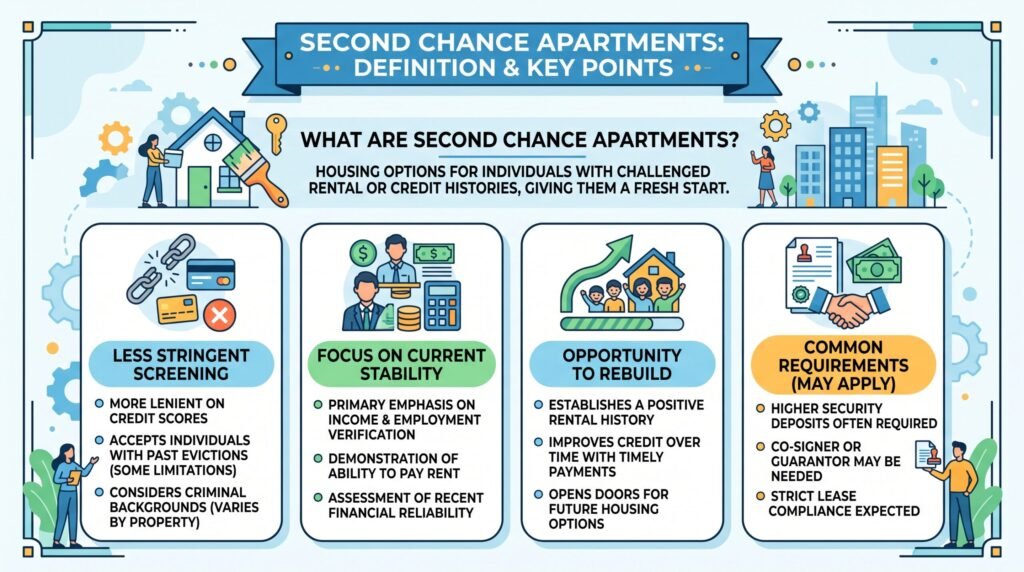
A second chance apartment is a rental property managed by a landlord or property management company willing to accept tenants who do not meet traditional leasing criteria. Unlike standard luxury complexes that demand a pristine 700+ credit score and a spotless background, these properties take a holistic view of your application.
- They accept tenants with evictions, bad credit, broken leases, or criminal records.
- They evaluate risk differently—not just looking at a three-digit credit score, but considering your current income and stability.
- They often require higher deposits or stricter lease terms to mitigate their financial risk.
- They’re found through apartment locators, private landlords, and specialized second chance rental websites.
Think of second chance apartments as the “secured credit card for bad credit” of the rental world—they give you an essential opportunity to rebuild your rental history while providing a roof over your head.
Who Needs a Second Chance Apartment?
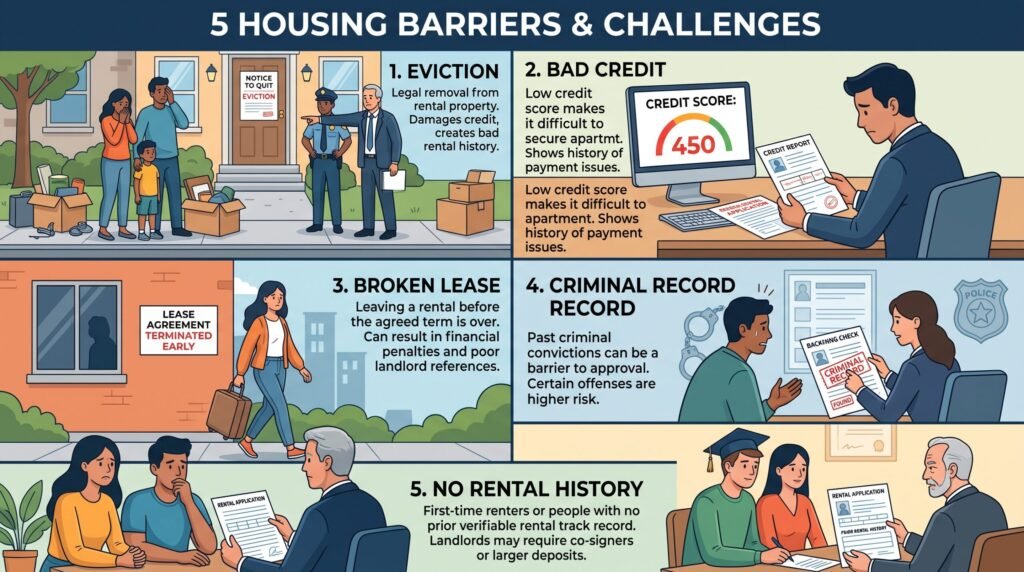
Millions of renters face roadblocks when trying to secure housing. The rental market is highly competitive, and algorithmic screening software often automatically denies anyone with a blemish on their record. If you fall into any of the categories below, you are the ideal candidate for a second chance rental.
| Scenario | Why It Happens |
| Evictions | Most common — whether recent or years old. An eviction can stay on your record for up to seven years, making standard approvals incredibly difficult. |
| Bad Credit | Medical bills, credit card debt, student loans, or identity theft can tank a score overnight. Many bad credit apartments cater specifically to this demographic. |
| Broken Leases | You abandoned a property, moved out due to a domestic situation, or broke a lease early because of job loss, leaving a balance owed to a former landlord. |
| Criminal Records | Felonies or misdemeanors — sometimes expunged. Getting housing after serving time is notoriously hard, but specialized housing programs exist. |
| Foreclosures/Bankruptcies | Lost a home due to financial hardship. Bankruptcies destroy credit scores but simultaneously leave you debt-free, which some landlords actually prefer. |
| No Rental History | First-time renters, young adults, or recently divorced individuals who haven’t built an independent track record. |
You are not alone. Thousands of renters face these exact same hurdles every single day. Life transitions, economic downturns, and personal mistakes happen to everyone. The housing market can feel unforgiving, but there is an entire sub-industry of real estate designed to cater to people exactly in your situation.
How Second Chance Apartments Work
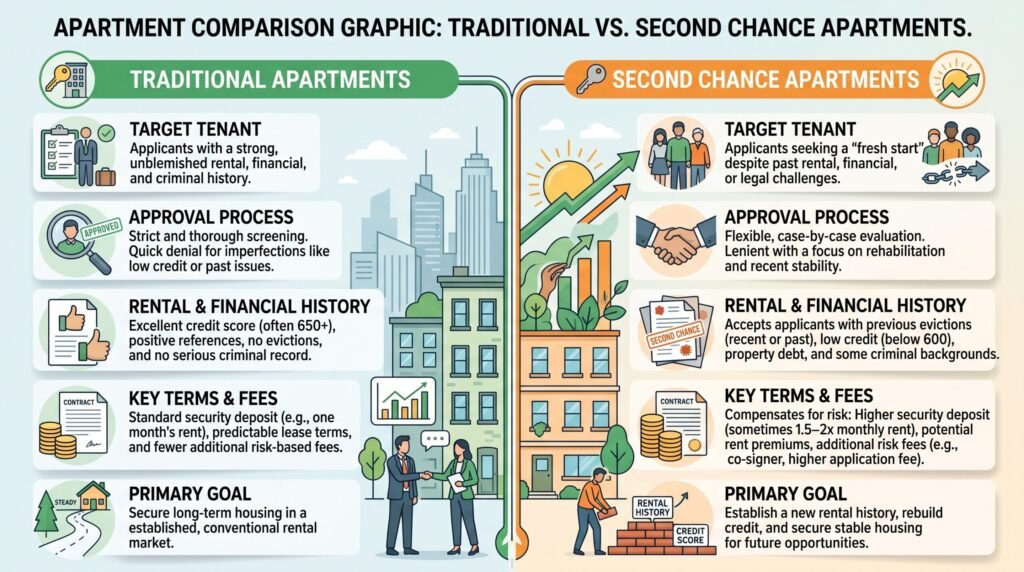
Understanding how second chance rentals operate is the first step toward getting approved. Standard apartment complexes sell their debt to collection agencies and rely heavily on automated screening software. A second chance property relies more on human judgment and risk mitigation.
| Feature | Traditional Apartment | Second Chance Apartment |
| Credit Check | Strict (650+ score required) | More lenient (focused on recent history) |
| Background Check | No criminal record allowed | Case-by-case review (depends on charge/age) |
| Eviction History | Zero tolerance | Often accepted (especially if debt is paid) |
| Security Deposit | 1 month’s rent (or less with good credit) | Often 1 to 2 months’ rent (Risk fee) |
| Application Process | Standard automated system | May require additional manual documentation |
| Lease Terms | Standard 12-month lease | May have stricter terms (e.g., bi-weekly payments) |
What You Can Expect: When you apply for second chance housing rentals, you need to adjust your expectations. Landlords are taking on what the industry considers a “higher risk,” and they compensate for that risk through specific requirements:
- Higher security deposits: You might be asked to pay double the standard deposit. Sometimes this is labeled as a non-refundable “risk fee” or “administrative fee.”
- Stricter payment terms: Some landlords may require rent to be paid bi-weekly to align with your paychecks, ensuring you never fall too far behind.
- More documentation: Be prepared to provide extensive proof of income, character reference letters, and a personal letter of explanation detailing what happened in your past.
- Case-by-case approval: Instead of a computer saying “no,” a property manager will sit down, review your story, look at your current income, and make a human decision.
How to Find Second Chance Apartments

The hardest part of the process is simply knowing where to look. You won’t typically find these forgiving properties by walking into a brand-new, luxury high-rise downtown. You have to be strategic about your search.
1. Apartment Locators / Second Chance Locator Services
| What They Do | How to Find Them |
| Licensed real estate agents with access to second chance properties | Google “second chance apartment locator” + your city |
| Know which buildings are accepting evictions/bad credit | Ask for referrals from local housing counselors |
| Match you with properties that will approve you | Check reviews on Yelp/Google before committing |
Locator services are entirely free for you to use (they get a commission from the apartment complex when you sign a lease). They possess master lists of which corporate complexes have relaxed their criteria for the month. They can save you hundreds of dollars in wasted application fees by only sending you to places where you have a 90% chance of approval.
2. Online Listing Sites
| Platform | Search Tips |
| Craigslist | Search: “second chance,” “bad credit OK,” “private owner.” Beware of scams; never wire money without seeing the unit. |
| Facebook Marketplace | Look for “for rent by owner” and check the seller’s profile for legitimacy. |
| Zillow / Trulia | Filter by “private landlord” instead of property management companies. |
| Specialized Sites | Second chance rental websites that curate listings specifically for high-risk renters. |
Online listings are a goldmine for finding second chance apartments that accept evictions. When browsing these platforms, bypass the listings that feature slick, corporate watermarks. Instead, look for photos that appear to be taken on a smartphone by a regular person.
3. Private Landlords (For-Rent-By-Owner)
| Advantage | How to Find Them |
| More flexible than corporate complexes | Look for “For Rent” yard signs in older, established residential neighborhoods |
| Can make decisions on a case-by-case basis | Ask local real estate agents who manage small portfolios |
| Often more willing to listen to your story | Check local community bulletin boards or newspaper classifieds |
A private landlord is just an individual who owns a second home or a small duplex. They do not have corporate boards dictating strict rules. If you can sit at their kitchen table, shake their hand, and prove that you are currently employed and responsible, they are much more likely to overlook a 500 credit score.
4. Local Property Managers
| Advantage | How to Find Them |
| Some specialize in Class B/C properties (older, blue-collar housing) | Google “property manager” + your city + “second chance” |
| May have existing relationships with second chance properties | Call their office and ask directly about their screening criteria |
Property managers handle rentals for private owners who don’t want to deal with the day-to-day operations. Call them directly and say, “I am looking for a property, but I have an eviction from three years ago. Do you manage any properties that will work with me?” Honesty saves everyone time.
How to Qualify for a Second Chance Apartment
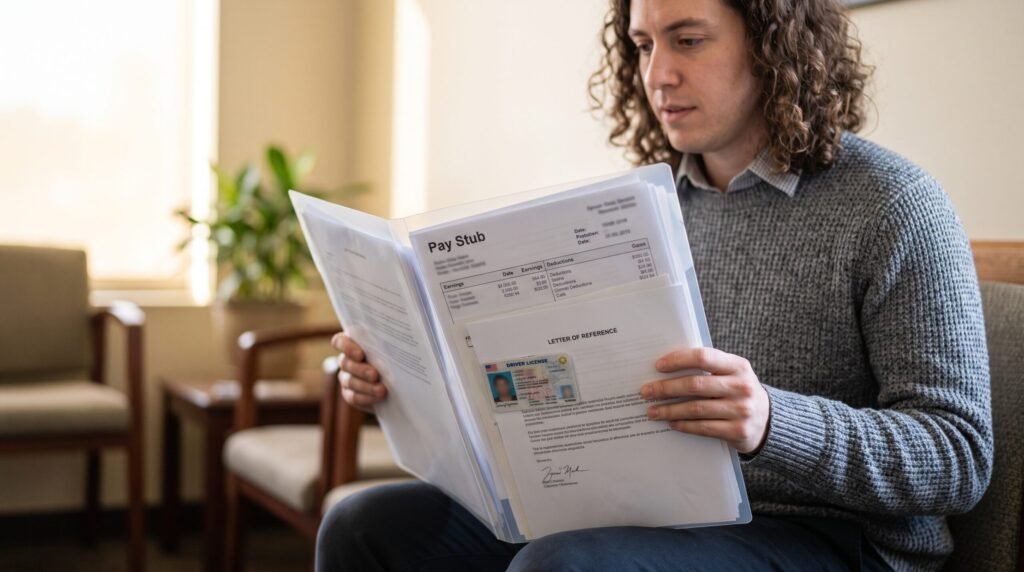
Finding the apartment is only half the battle; qualifying for it is the other. Because your credit or background check isn’t going to win the landlord over, you have to overcompensate in other areas. Here is how you build a bulletproof application.
1. Income Verification
| Requirement | What to Provide |
| The 3x Rule | Most require you to make 3x the monthly rent in gross (pre-tax) income. |
| Proof of Income | Pay stubs (last 4-6 weeks), W-2s, or official bank statements. |
| Job Stability | 6+ months at your current job helps prove you have steady cash flow. |
Cash is king when it comes to second chance housing rentals. If a landlord sees that you have a rock-solid job, they are much more likely to take a risk on your bad credit. If you work for yourself or receive cash tips, make sure you are depositing that money into a bank account so you have a paper trail.
2. Co-Signer or Guarantor
| What It Is | How to Find One |
| Someone who signs the lease with you and shares the legal liability. | A parent, family member, or close financially stable friend. |
| Agrees to pay the rent if you fail to do so. | Must have excellent credit (700+) and stable, verifiable income. |
| Reduces the financial risk for the landlord significantly. | Landlords may specifically require this if you have an active eviction. |
If you cannot find a personal co-signer, there are professional guarantor services (like Rhino or Leap) that act as an institutional co-signer for a monthly fee. This is an excellent workaround for how to rent with eviction on your record.
3. Security Deposit
| What to Expect | Tips |
| Often higher than standard (1 to 2 months’ rent). | Be prepared to pay more upfront; save aggressively before applying. |
| Sometimes called a “risk fee” or “non-refundable admin fee.” | Ask about payment plans (some allow you to split the deposit over 3 months). |
| Refundable (if no damage is done upon move-out). | Document the condition of the apartment meticulously to protect your deposit. |
Having cash in hand gives you incredible negotiating power. If a landlord is hesitant about your broken lease, offering two months of rent upfront as a deposit shows that you have skin in the game.
4. Documentation
| What to Prepare | Why It Matters |
| Driver’s License/ID | Identity verification. |
| Social Security Card | Needed to run the background and credit check. |
| Pay Stubs (3 months) | Tangible proof of your current income and hours worked. |
| Bank Statements (3 months) | Proof of financial stability and responsible spending habits. |
| Reference Letters | Character and employment references to vouch for your reliability. |
Do not show up to an apartment viewing empty-handed. Create a “Renter’s Resume” portfolio. Buy a nice folder, print out all these documents, and hand them to the landlord. It shows incredible professionalism. For a free copy of your credit report so you know exactly what the landlord will see, visit AnnualCreditReport.com.
5. Reference Letters
| Who to Ask | What to Include |
| Employer | Confirmation of your job stability, reliability, wages, and character. |
| Previous Landlord | Rental history, timely payment record, and a note that you left the property clean. |
| Personal Reference | A character reference from a mentor, pastor, or community leader. |
Tips for Renting a Second Chance Apartment

You are stepping into a negotiation. The landlord holds the keys, but you hold the potential to be a fantastic, long-term tenant. Here are actionable tips to tip the scales in your favor.
| Tip | How to Do It |
| 1. Be Honest About Your History | Explain your situation upfront. Don’t let the background check surprise the landlord. If they find out you lied, it’s an automatic denial. |
| 2. Come Prepared | Bring your ID, pay stubs, bank statements, and reference letters to the very first showing. |
| 3. Offer a Higher Deposit | Volunteer to pay double the deposit or offer the first and last month’s rent upfront to show you are serious and financially capable. |
| 4. Bring References | Bring physical, signed letters from your employer, previous landlords, and character references. |
| 5. Write a Letter of Explanation | Type a one-page letter explaining your past eviction or credit issues. Detail what you learned and the steps you’ve taken to fix it. |
| 6. Offer Automatic Payments | Tell the landlord you will set up an auto-draft or direct deposit for the 1st of every month. It eliminates their fear of chasing down rent. |
| 7. Be Flexible | You may not get a luxury apartment with a pool. Consider older buildings, different neighborhoods, or duplexes. |
Your attitude during the viewing matters immensely. Dress professionally, show up on time, and communicate clearly. The landlord is assessing you as a person just as much as they are assessing your credit score.
Common Mistakes to Avoid
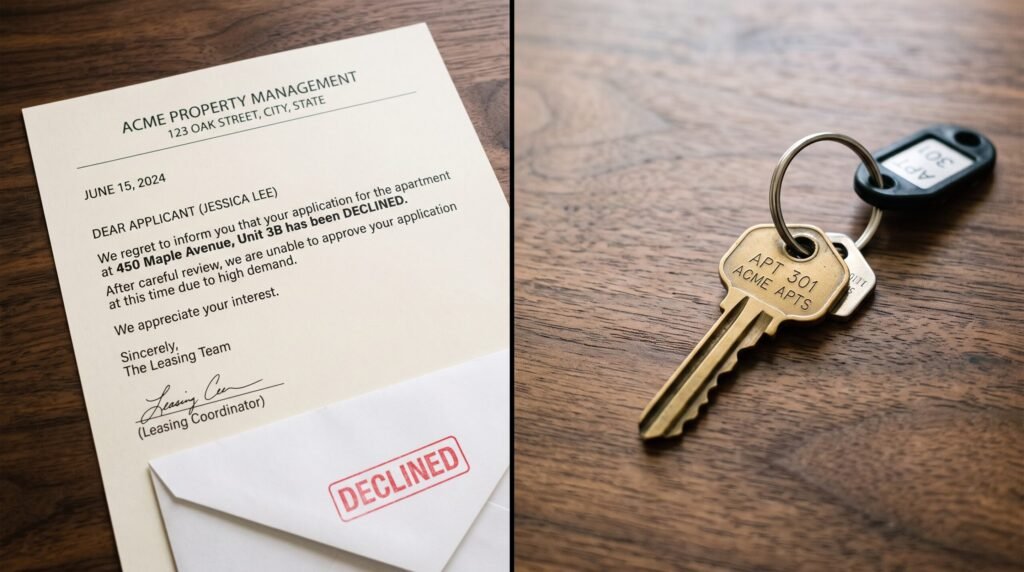
When desperation sets in, renters often make critical errors that push them further away from securing housing. Protect yourself by avoiding these common pitfalls.
| Mistake | Why It’s a Problem |
| Lying about your history | In the digital age, landlords will find out about your eviction or criminal record. Lying ruins any chance of trust, and you will be denied and lose your application fee. |
| Not being prepared | If you have to spend a week gathering pay stubs after viewing the apartment, the landlord will simply move on to the next, more prepared applicant. |
| Only looking at luxury apartments | Brand-new complexes are owned by massive corporations with zero flexibility. Second chance apartments are often in older, Class B or C buildings. |
| Ignoring your credit | Even while looking for an apartment, you should be paying down debts and disputing errors. Start repairing your credit now so you don’t need a second chance apartment next time. |
| Giving up too soon | Rejection hurts, but housing is a numbers game. You might get told “no” ten times before you get a “yes.” Keep applying and keep adjusting your strategy. |
Another major mistake is falling for scams. Never wire money via Western Union, Zelle, or CashApp before physically touring the inside of an apartment and verifying that the person you are speaking with actually owns the property. You can verify property ownership by checking your local county tax assessor’s public website. Also, check out resources from the Department of Housing and Urban Development (HUD) for legitimate housing counseling services in your state.
Frequently Asked Questions (FAQ)
1. What are second chance apartments? Second chance apartments are rental properties that are willing to accept tenants who have negative marks on their background. This includes individuals with bad credit, past evictions, broken leases, or criminal records. They base their approvals on your current ability to pay rather than your past mistakes.
2. How do I find second chance apartments near me? The most effective way to find second chance housing rentals near you is to use a licensed apartment locator in your city. Additionally, you can search Craigslist using keywords like “second chance,” “bad credit OK,” or look for “For Rent” signs in residential neighborhoods to connect directly with private landlords.
3. Is second chance apartments legit? Yes, they are completely legit. However, because this demographic is often desperate for housing, scammers do exist. Always verify the property, insist on an in-person tour, and never pay application fees or deposits via non-traceable wire transfers before signing a legal lease agreement.
4. Can I rent with an eviction on my record? Yes. While it is more difficult, many second chance properties accept evictions. Your chances increase significantly if the eviction is older (over 2-3 years), if you have paid off the debt owed to the previous landlord, or if you can provide a co-signer.
5. Second chance apartments no credit check? While some independent “mom-and-pop” landlords might skip a credit check entirely, most second chance apartments will still run a check. The difference is that they do not base their decision strictly on the credit score; they look to see if you have recent, verifiable income and if you are currently paying your bills.
6. How much deposit for a second chance apartment? Because landlords view applicants with bad credit or evictions as higher risk, you should expect to pay a higher security deposit. Typically, this ranges from one to two full months’ rent, compared to a few hundred dollars for someone with pristine credit.
7. What documents do I need for a second chance apartment? You will need a valid government-issued ID, your Social Security card, at least three months of recent pay stubs, three months of bank statements, reference letters, and a personal letter of explanation detailing your past financial or legal hardships.
8. Can I rent with a broken lease? Yes, you can. Second chance properties frequently accept renters with broken leases. To improve your odds, try to establish a payment plan with your previous landlord to settle the debt. Showing that you are actively paying off a broken lease shows tremendous responsibility to future landlords.
9. What if I have a criminal record? Many properties will still accept you, though it depends heavily on the nature and age of the conviction. Violent felonies are much harder to overcome than non-violent misdemeanors. Be entirely honest upfront, provide context for the situation, and show evidence of your rehabilitation and current stable employment.
10. Second chance apartments that accept evictions? Yes, there are specific properties and landlords that cater to tenants with eviction histories. The key is to bypass massive corporate complexes and focus your search on private landlords, smaller property management companies, and utilizing the services of a local apartment locator who specializes in complex histories.
Conclusion
Second chance apartments offer renters a much-needed fresh start after facing evictions, bad credit, or other debilitating housing challenges. With the right strategy—including leveraging locator services, finding reliable co-signers, and preparing proper documentation—you can absolutely find a safe place to call home. Don’t give up. Be honest, be prepared, and keep looking. The right landlord will give you a second chance.

Maren started MyFirstLease after a rough first lease taught him everything the internet didn’t. He covers the logistical side of renting — move-in checklists, utilities, and the unglamorous first-week stuff nobody explains — and oversees everything published on the site.