Introduction
Learning how to decorate a rental apartment kitchen with no natural light is less about buying more decor and more about borrowing, bouncing, and layering the light you already have. If your kitchen has no windows — or a small north-facing one that never sees direct sun — this guide is for first-time renters who cannot paint, rewire, or renovate, and who still want a kitchen that feels bright enough to cook in happily.
Most windowless-kitchen advice assumes you own the place: paint the walls white, install recessed lights, swap in glass cabinet doors. None of that works in a rental. Every idea below is removable, needs no electrician, and can be undone before move-out — with the lease and deposit risks flagged wherever they matter.
Direct Answer
To decorate a rental kitchen with no natural light, layer plug-in and battery-powered LED lighting, swap in daylight bulbs, use light removable surfaces and reflective decor to bounce light around, keep counters pale and uncluttered, and add a faux-window focal point. Skip paint and rewiring entirely.
Executive Summary
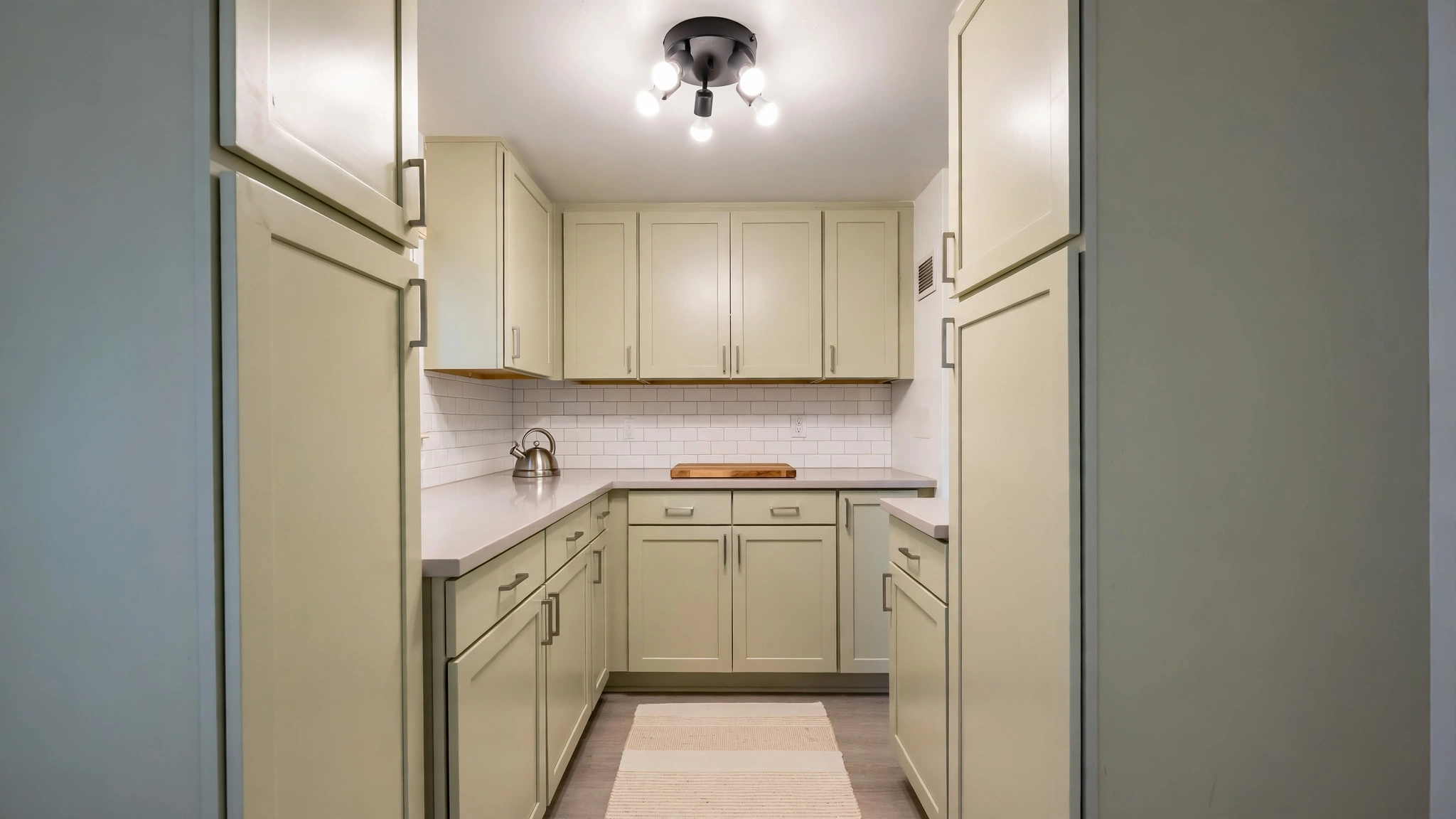
A windowless rental kitchen feels dark for three reasons at once: too little light coming in, too much light being absorbed by dark surfaces, and too much visual clutter breaking up what light there is. This article tackles all three, in that order, without a single permanent change.
You will start by mapping where the darkness actually sits, then build layered lighting from plug-in and battery-powered fixtures, choose the right bulb color, and brighten surfaces with removable materials. From there, mirrors and reflective pieces stretch the light further, pale textiles and dishware keep the palette bright, and a faux window gives your eyes somewhere to rest. A final section turns it all into a budget plan you can do in one weekend, with a move-out checklist so your deposit stays safe.
1. Map the Dark Spots First
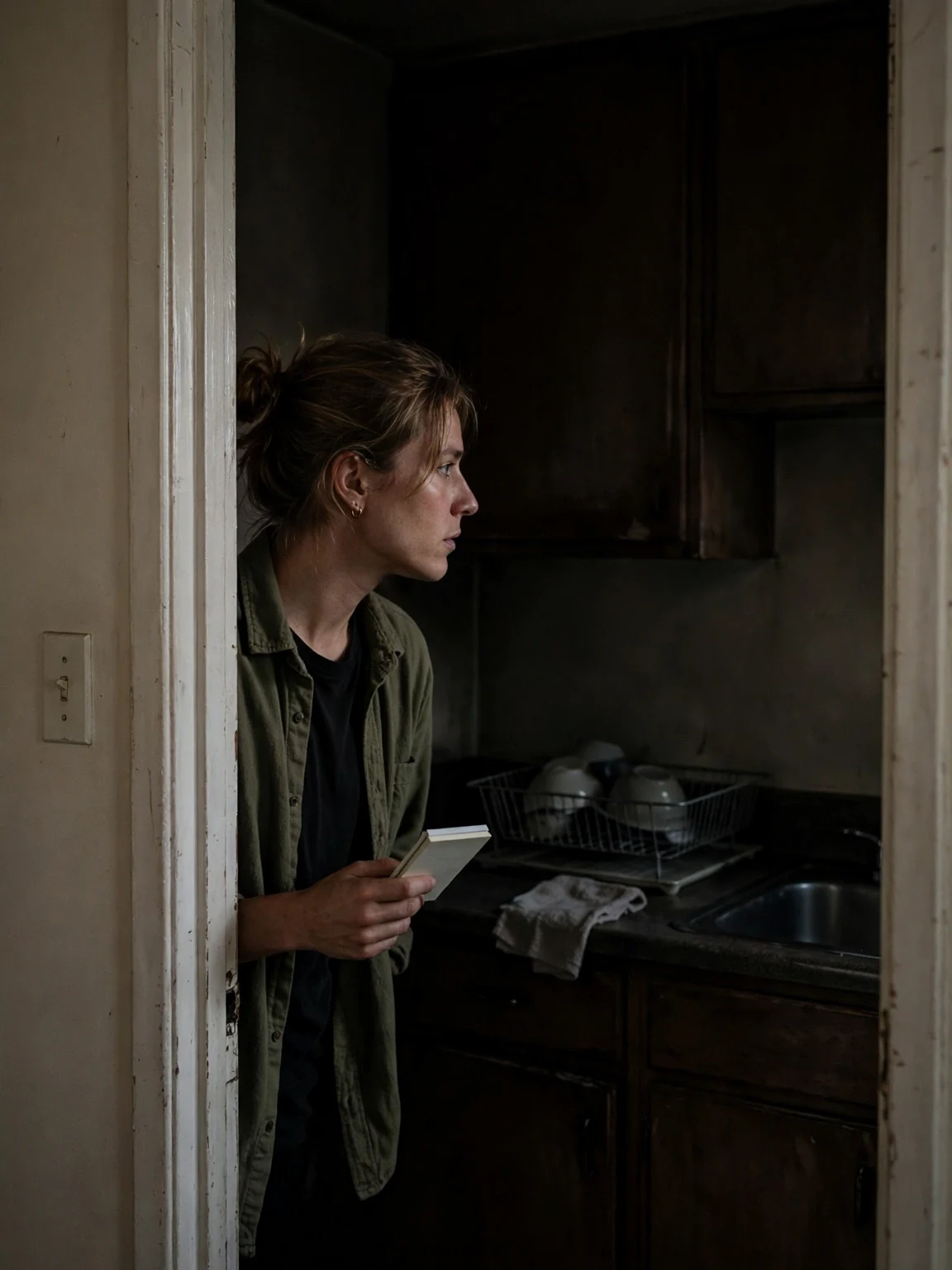
Before buying anything, spend one evening noticing how your kitchen actually behaves. Turn on every light you already have and stand in the doorway. Which corners stay shadowy? Is the counter under the upper cabinets dark even when the ceiling light is on? Does the sink area feel like a cave? Write down the three darkest spots — those are the only places that need fixing, and naming them stops you from overspending on lights for areas that are already fine.
Check what fixtures you already own, too. Many rentals have a single ceiling fixture plus a range-hood light that renters forget exists. Note the bulb type and fitting in each one (take a photo of the bulb base before you shop), and check whether any fixture has a dimmer. Also look at what is absorbing light: dark cabinet fronts, a dark backsplash, a black countertop, or a heavy curtain over the one small window all swallow brightness. You cannot change most of those permanently, but knowing which surfaces are the worst offenders tells you where removable fixes will pay off most.
Finally, check your lease for the two clauses that matter here: anything about altering fixtures or electrical work, and anything about adhesive products on walls and cabinets. Most leases allow plug-in lights and battery lights without a second thought, but some restrict anything screwed or wired in. A five-minute lease check now saves a deposit dispute later.
2. Layer Plug-In and Battery Lighting
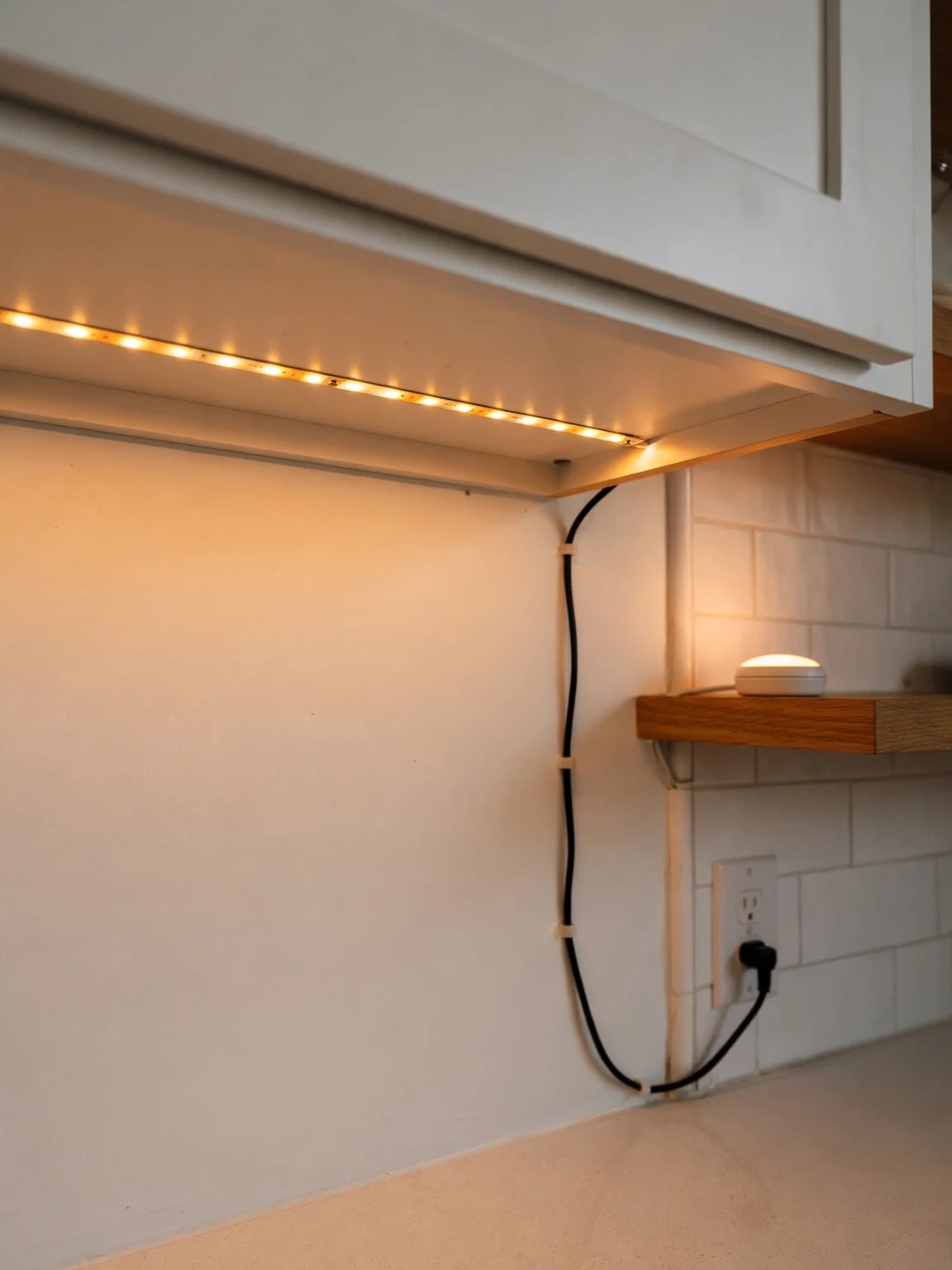
One overhead light cannot brighten a windowless kitchen on its own. What works instead is layering: a little light at ceiling level, a little at counter level, and a little at eye level, so no single dark zone is left to dominate the room.
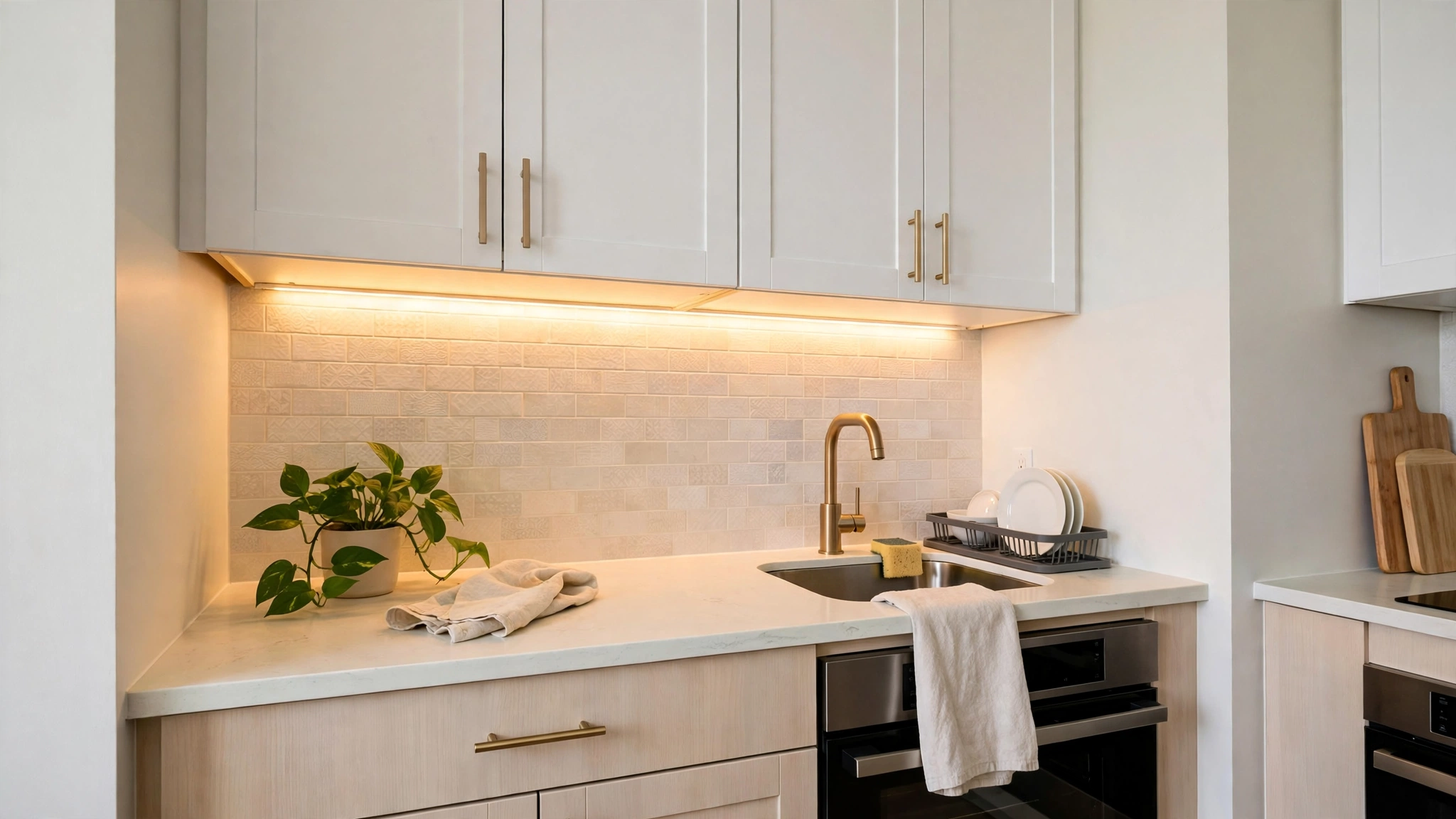
Start at counter level, where the work happens. Battery-powered or plug-in LED strip lights and puck lights mounted under the upper cabinets with adhesive strips or small screws into the cabinet underside (only if your lease allows it — adhesive is the safer default) put light exactly where you chop and read recipes. Look for strips with a remote or a touch switch so you are not fumbling for a button in the dark, and choose a daylight color temperature (covered in the next section). Keep the strip set back from the front edge of the cabinet so the light washes the counter instead of shining in your eyes.
Next, add light at eye level. A plug-in wall sconce on the one stretch of open wall, or a plug-in pendant hung from a ceiling hook with a cord cover, breaks up the flat glare of a single ceiling fixture and makes the room feel layered rather than interrogated. Plug-in fixtures need an outlet within cord reach and a cord that does not cross a walkway or dangle near the stove — route cords along the wall with adhesive cord clips, and never run a cord under a rug or across a sink.
For corners and shelves, small battery-powered puck lights or a rechargeable LED bar can fill a gap that no wired fixture reaches. These are also the easiest to take with you when you move, which makes them a good first purchase for a first apartment. For the wider picture on lighting a rental with no ceiling fixtures at all, see No Ceiling Lights? How to Light Your First Apartment Like a Pro (Renter Edition). One caution: battery lights need recharging or new batteries on a schedule, so do not make them your only task lighting over the stove or sink. Use them as accent and fill light, and keep plug-in or existing wired fixtures doing the heavy work.
A note on electrical safety, kept deliberately modest: stick to plug-in and battery-powered products that are rated for indoor use, follow the manufacturer’s instructions for wattage and placement, and do not modify wiring, splice cords, or install anything hardwired yourself. If a fixture sparks, smells hot, or trips a breaker, unplug it and ask your landlord or a qualified electrician rather than trying to fix it yourself. If your lease requires written permission for any fixture change — even a simple swap — get it in writing before you start.
3. Choose Daylight Bulbs
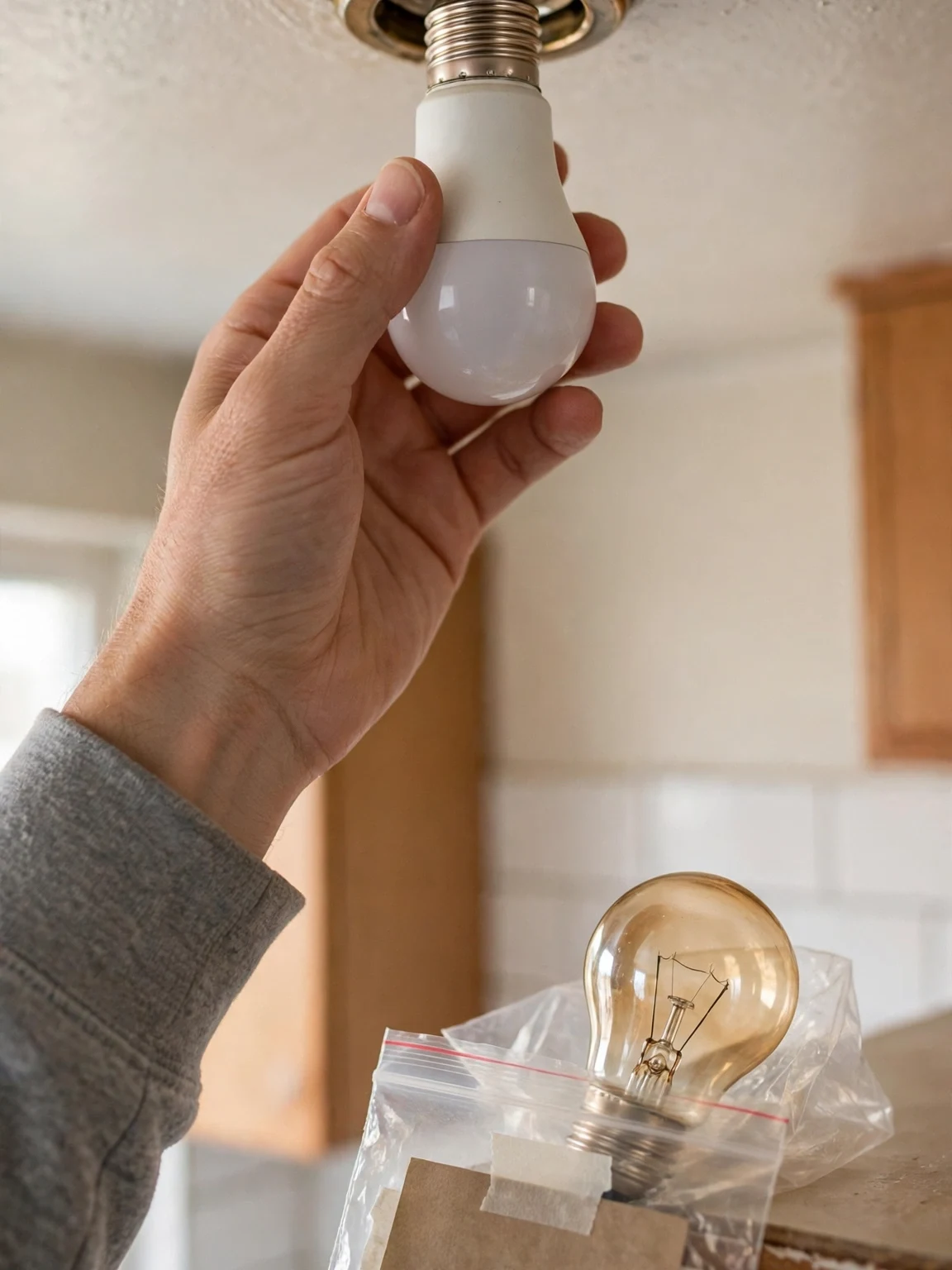
The cheapest brightening upgrade in a windowless kitchen is often a bulb swap. The warm, yellowish bulbs many rentals ship with (usually around 2700K) make a dark kitchen feel dimmer and dingier than it is. Daylight bulbs, generally in the 4000K to 5000K range, read as clean white light that resembles daylight and makes pale surfaces look brighter.
Before you buy, check three things: the fitting type (screw base size), the maximum wattage printed on the fixture, and whether the fixture is enclosed or dimmable. Never exceed the fixture’s rated wattage, and use dimmable bulbs only with a dimmer switch — a non-dimmable LED on a dimmer can flicker or buzz. LED bulbs are the practical choice for most renters: they use less electricity than the old incandescent or halogen bulbs they replace, run cooler, and last longer, which matters in a kitchen where lights stay on for hours. Prices vary by brand and pack size, but a multi-pack of LED bulbs is generally one of the lowest-cost upgrades in this guide, as of 2026.
Swap the bulbs in every kitchen fixture at once, including the range-hood light, so the color stays consistent. Mixed color temperatures — warm over the sink, daylight over the counter — make a small kitchen look patchy and unfinished. Keep the landlord’s original bulbs in a labelled bag so you can put them back at move-out; that small habit protects you if the lease requires the unit to be returned as found.
One more check: if your ceiling fixture has a yellowed or frosted cover that has darkened with age and grease, wipe it clean (with the power off and the fixture cool) or ask your landlord about a replacement cover. A grimy diffuser can block a surprising amount of light, and cleaning it costs nothing.
4. Brighten Surfaces Without Paint
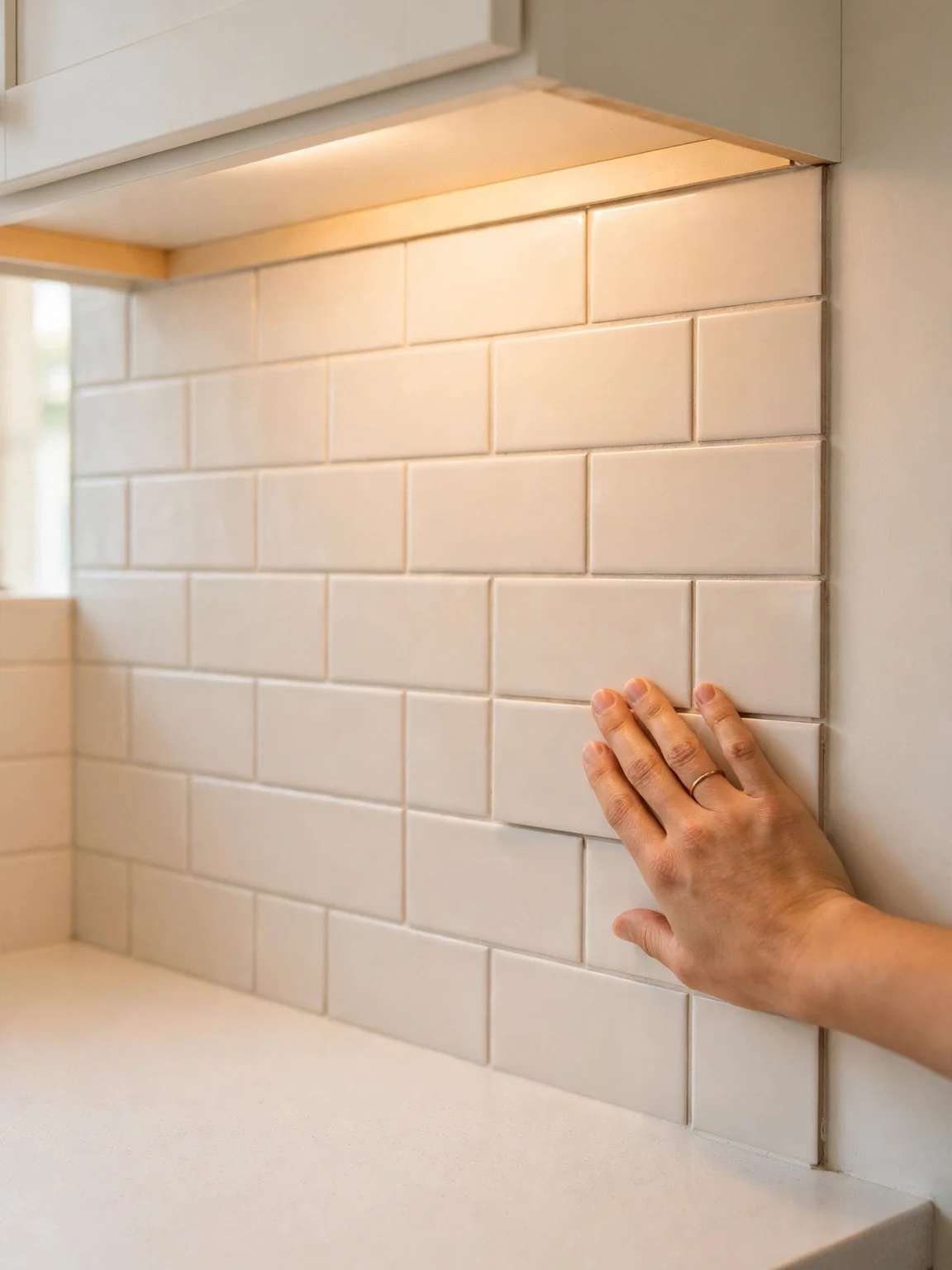
Paint is the standard advice for a dark kitchen, and it is usually off the table for renters. The workaround is to brighten the surfaces you can change without touching a paintbrush: the backsplash, the cabinet fronts, and the countertop edges you actually see.
A peel-and-stick backsplash is the highest-impact removable change in most windowless kitchens. Light-colored tiles — white, pale sage, soft cream, or a light marble-look pattern — reflect far more light than a dark or bare wall, and they sit right where your under-cabinet lights can bounce off them. Measure the area first, buy a little extra for cuts and mistakes, and follow the manufacturer’s surface-prep instructions. The deposit risk here is real and worth naming plainly: cheap adhesive tiles can leave residue or pull paint on removal, especially on textured or already-damaged walls. Test a single tile in a hidden spot, keep the product packaging and instructions, and remove tiles slowly with gentle heat from a hair dryer at move-out, following the manufacturer’s removal guidance.
For cabinet fronts, removable contact paper or cabinet liners in a pale, glossy finish can lift dark wood or dated laminate — but only if your lease allows adhesive on cabinets and only after a hidden-spot test. If adhesive on cabinets feels too risky, skip it: light shelf liners inside glass-front cabinets, pale dish towels hung from cabinet handles, and light-colored storage containers on open shelves deliver much of the same brightening with none of the residue risk. Never apply adhesive to a surface you have not tested, and never use a heat gun or scraper to remove it.
The countertop itself is usually fixed, but a light-colored cutting board left out, a pale tray under the dish soap, or a white or cream utensil crock breaks up a dark expanse and reflects a little light at eye level. These are small moves, but in a kitchen with no windows, the surfaces at eye and counter level are the ones you actually look at — brightening them changes how the whole room feels.
5. Add Mirrors and Reflective Decor
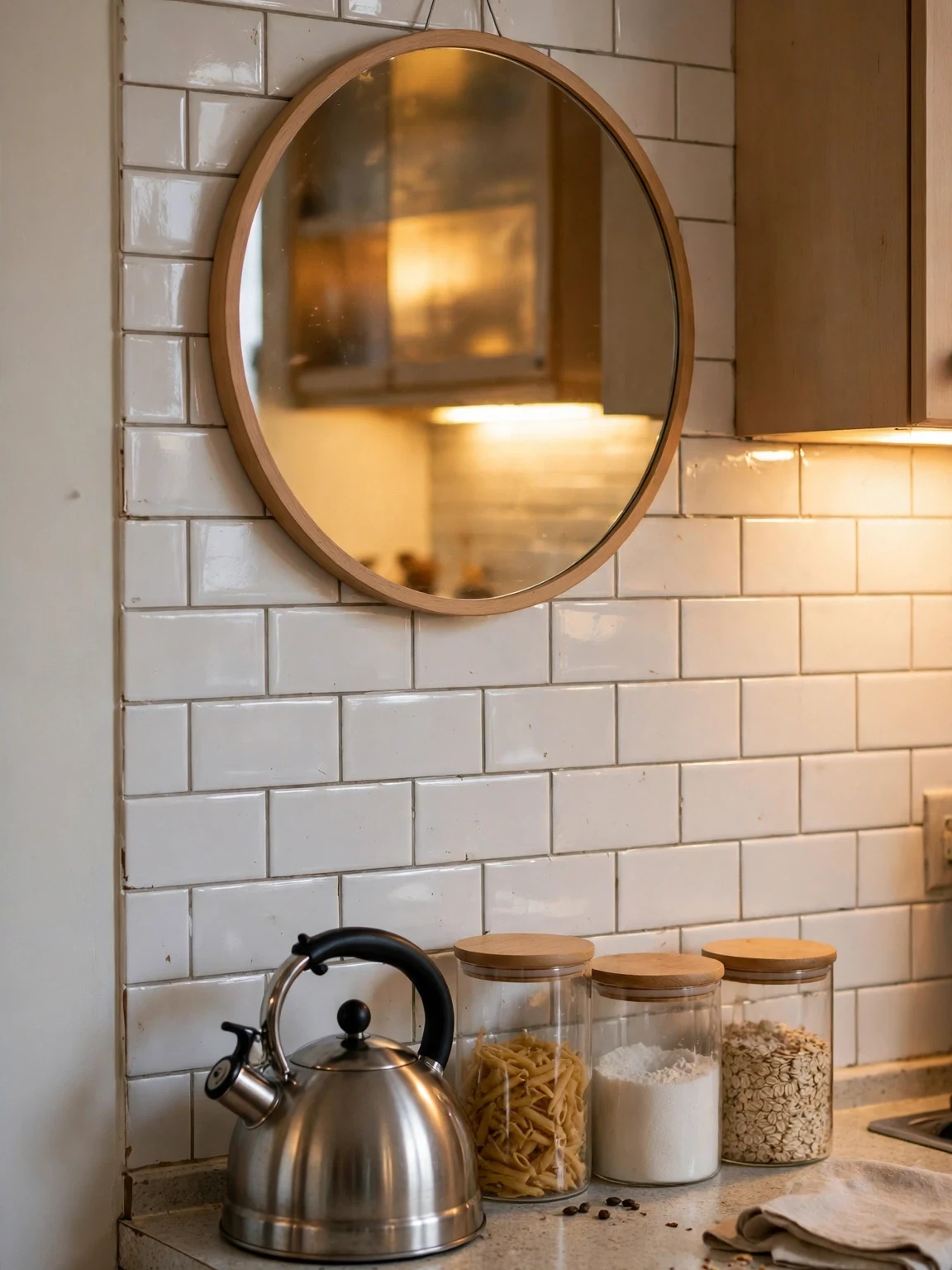
A mirror does not create light, but in a windowless kitchen it can double the light you already have by bouncing it across the room. The trick is placement: hang a mirror where it reflects a light source — opposite or beside an under-cabinet strip, a pendant, or the brightest fixture — rather than where it reflects a dark wall.
A medium-sized mirror with a slim frame on the one open stretch of wall, or a mirrored tray on the counter, is usually enough. A full mirrored backsplash is overkill for a rental and a cleaning burden near a stove. Keep mirrors away from direct splatter zones, and clean them regularly; a greasy mirror in a kitchen absorbs light instead of reflecting it, which defeats the purpose.
Beyond mirrors, look for shine in the objects you already need. A stainless steel kettle, a polished tray, glass canisters, a chrome faucet, and glossy ceramic dishware all throw small reflections around the room. Group two or three reflective pieces near your brightest light source rather than scattering them — a cluster reads as intentional and bounces more light than the same pieces spread across dark corners. The same logic applies in reverse: matte black accessories, dark wood trays, and heavy dark textiles absorb light, so keep them to a minimum in a kitchen with no windows, or move them to a room that has daylight to spare.
Hanging a mirror in a rental needs the same care as any wall decor. Use the method your lease allows — adhesive picture-hanging strips rated for the mirror’s weight, or a small nail or hook if the lease permits it — and check the weight rating before you trust it. A mirror that falls near a stove or sink is a safety problem, not just a decor problem, so do not exceed the rating or hang a heavy mirror on strips meant for a picture frame.
6. Keep Counters Clear and Light
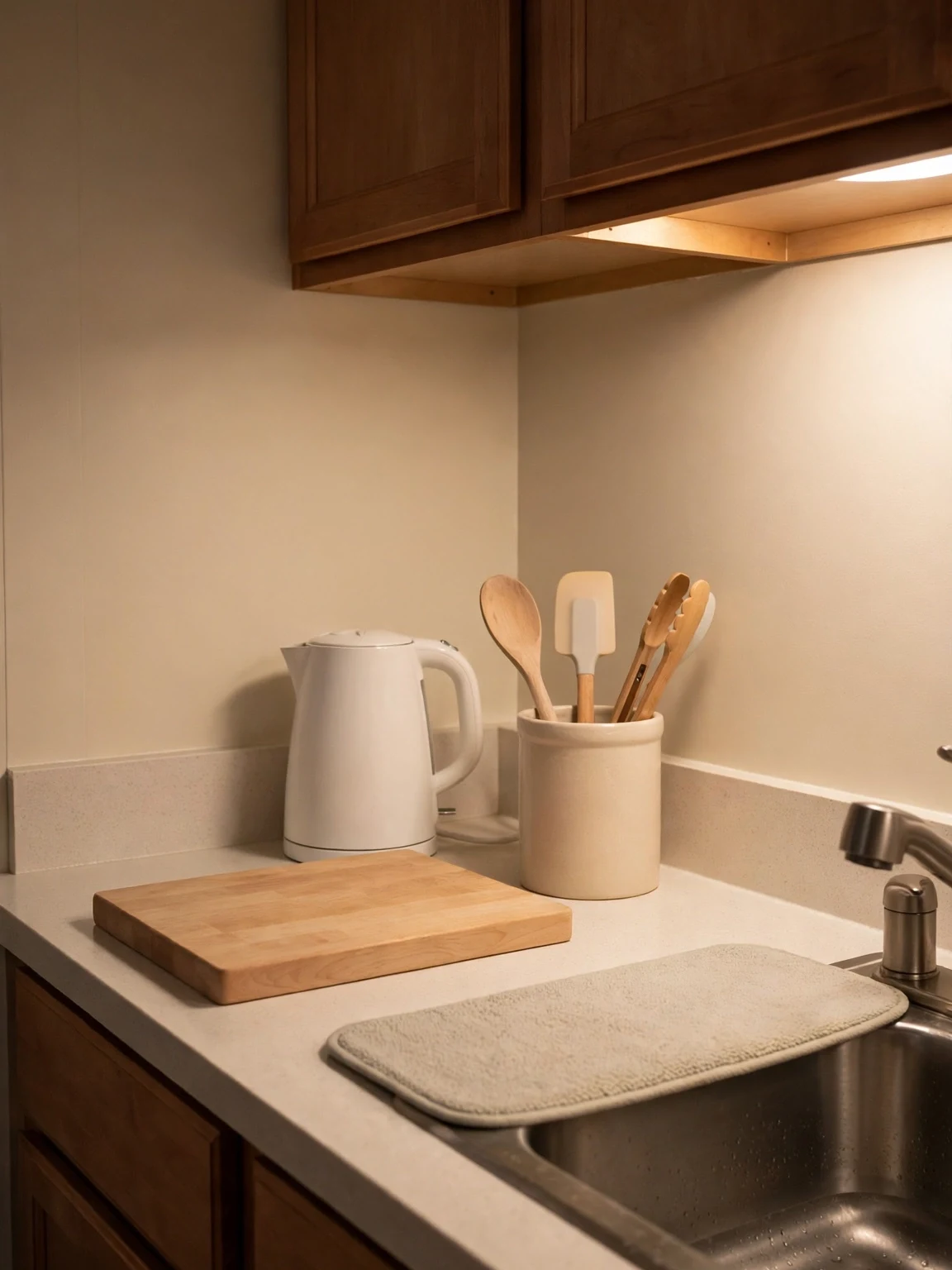
Clutter is a light problem, not just a tidiness problem. Every dark object left on a counter casts a small shadow and breaks up the pale, reflective surface that would otherwise bounce light back into the room. In a kitchen with no windows, an uncluttered counter is one of the fastest free brightening fixes there is.
Start by clearing everything off the counters except the three or four items you genuinely use daily — a kettle, a cutting board, a utensil crock. Move the rest into cabinets or onto a shelf. Then look at what remains and ask whether each piece could be a lighter version of itself: a white or cream utensil crock instead of a black one, a glass soap dispenser instead of a dark plastic bottle, a pale dish-drying mat instead of a dark towel. None of these purchases is expensive on its own, and together they change the countertop from a dark strip into a light one.
Storage choices matter here too. Clear or pale storage containers on an open shelf read as bright and airy; dark, opaque bins read as visual weight. If your kitchen has open shelving, keep the shelf edges light and leave a little breathing room between items rather than packing every inch — the gaps let light through and make the shelves feel less like a wall. For more renter-safe kitchen ideas that need no renovation, see How to Decorate a Rental Apartment Kitchen Without Renovating.
Finally, keep the sink area bright. A pale dish rack, a white or light-colored faucet handle cover if yours is dark and replaceable, and a small battery puck light under the cabinet above the sink can turn the gloomiest corner of a windowless kitchen into a usable one. The sink is where you stand most often, so it deserves its own light and its own clear counter.
7. Bring in Light-Loving Color
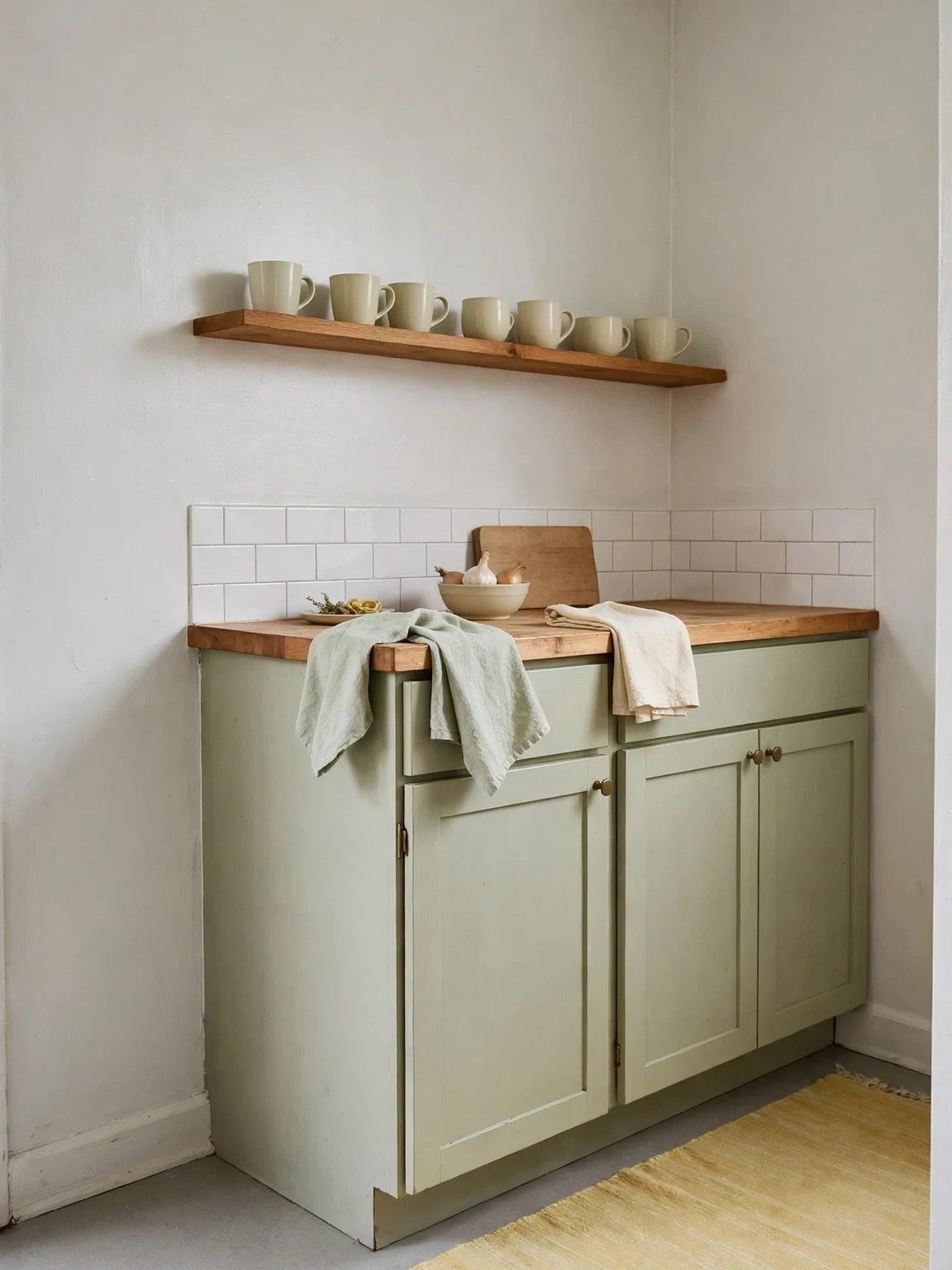
Without paint, color has to arrive through textiles, dishware, and small accessories — and in a dark kitchen, the right colors do real work. Pale, warm whites, soft cream, pale sage, light butter yellow, and powder blue all reflect more light than saturated or dark colors, and they read as cheerful under daylight bulbs rather than washed out.
Start with the textiles you touch every day: dish towels, an oven mitt, a small washable rug or runner in front of the sink. A light-colored runner also protects the floor and adds a stripe of brightness at ground level, where windowless kitchens often feel darkest. Choose washable fabrics — kitchen textiles get stained, and a pale towel you cannot wash quickly becomes a grey one.
Then add color through dishware and small appliances you already own or would buy anyway: a cream kettle, a pale mixing bowl set, light-colored mugs on an open shelf. Keeping these in one or two related pale tones looks intentional; mixing five unrelated brights looks cluttered, and clutter reads as dark. If you love bold color, use it in one small, contained place — a single bright tea towel, a colorful fruit bowl — rather than across every surface.
Avoid the common mistake of reaching for dark, moody accessories because they look sophisticated in a bright, sunlit kitchen photo. In a windowless kitchen, dark accessories absorb the little light you have. Save the moody palette for a room with a window, and let the kitchen stay pale and bright.
8. Fake a Window
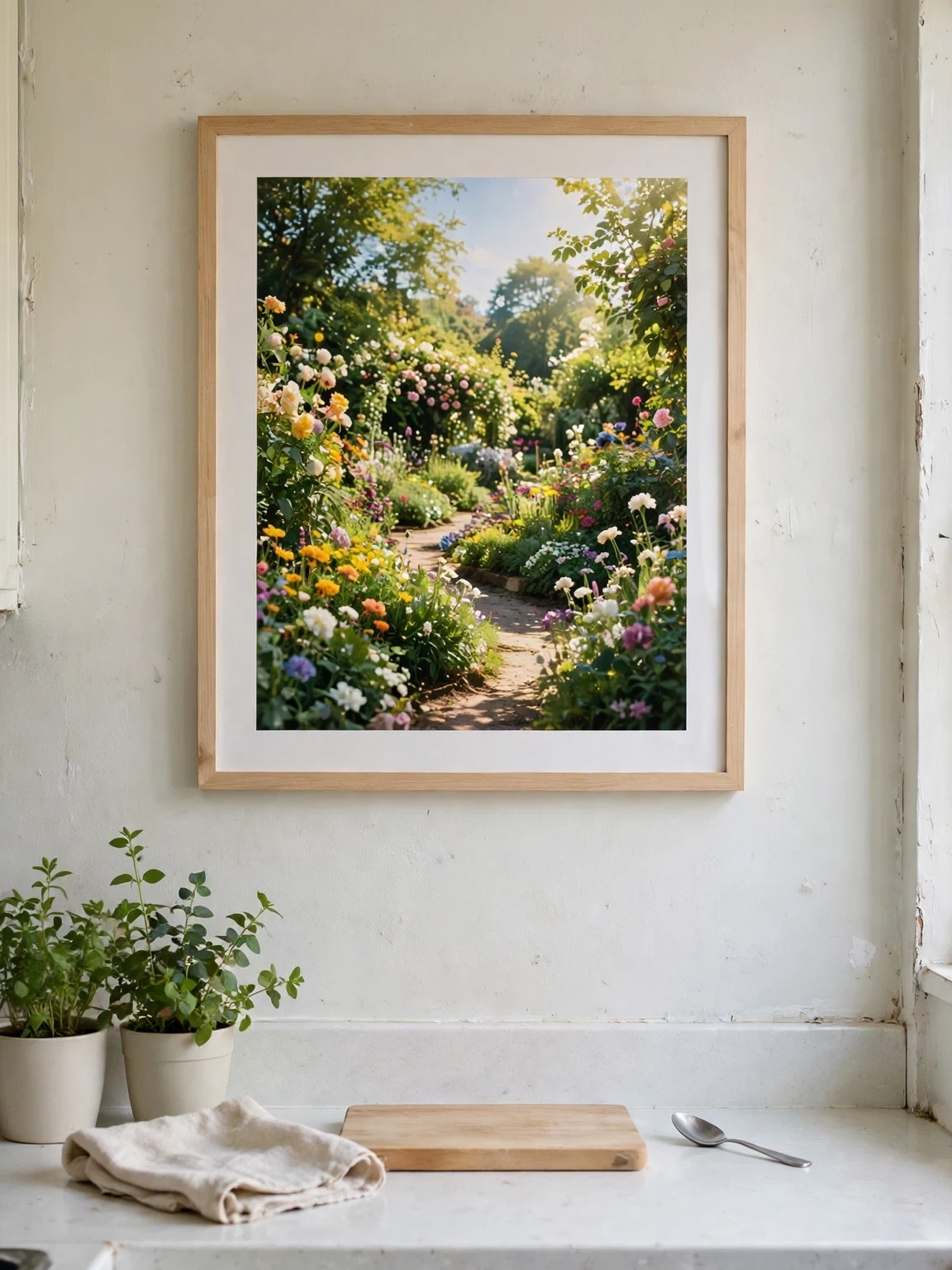
A windowless kitchen can feel closed in even when it is well lit, because there is nowhere for the eye to rest except walls and cabinets. A faux window — a framed piece that reads as a view — gives the room a focal point and a sense of depth that plain walls cannot.
The simplest version is a large framed print of a bright outdoor scene: a sunny garden, a coastline, a light-filled cafe window. Hang it at eye level where a window would naturally sit, ideally on the wall you face while cooking, and keep the frame light-colored so it does not add a dark rectangle to the room. Backlit options exist too — a slim LED light box behind a translucent print can glow like daylight — but a standard framed print is cheaper, lighter, and easier to hang with renter-friendly strips.
A mirror framed like a window, with panes or muntins, is another option, and it does double duty by reflecting light as well as suggesting a view. Whichever version you choose, keep it to one faux window per kitchen. Two competing fake views look like a stage set; one reads as a deliberate focal point.
Scale matters more than price here. A small picture on a large blank wall will look lost and make the wall feel emptier. Measure the wall, and choose a piece that fills roughly two-thirds of its width. If a large framed print is outside your budget, a set of two or three smaller matching prints hung in a row can fill the same space for less, as of 2026.
9. Grow Greenery That Thrives in Low Light
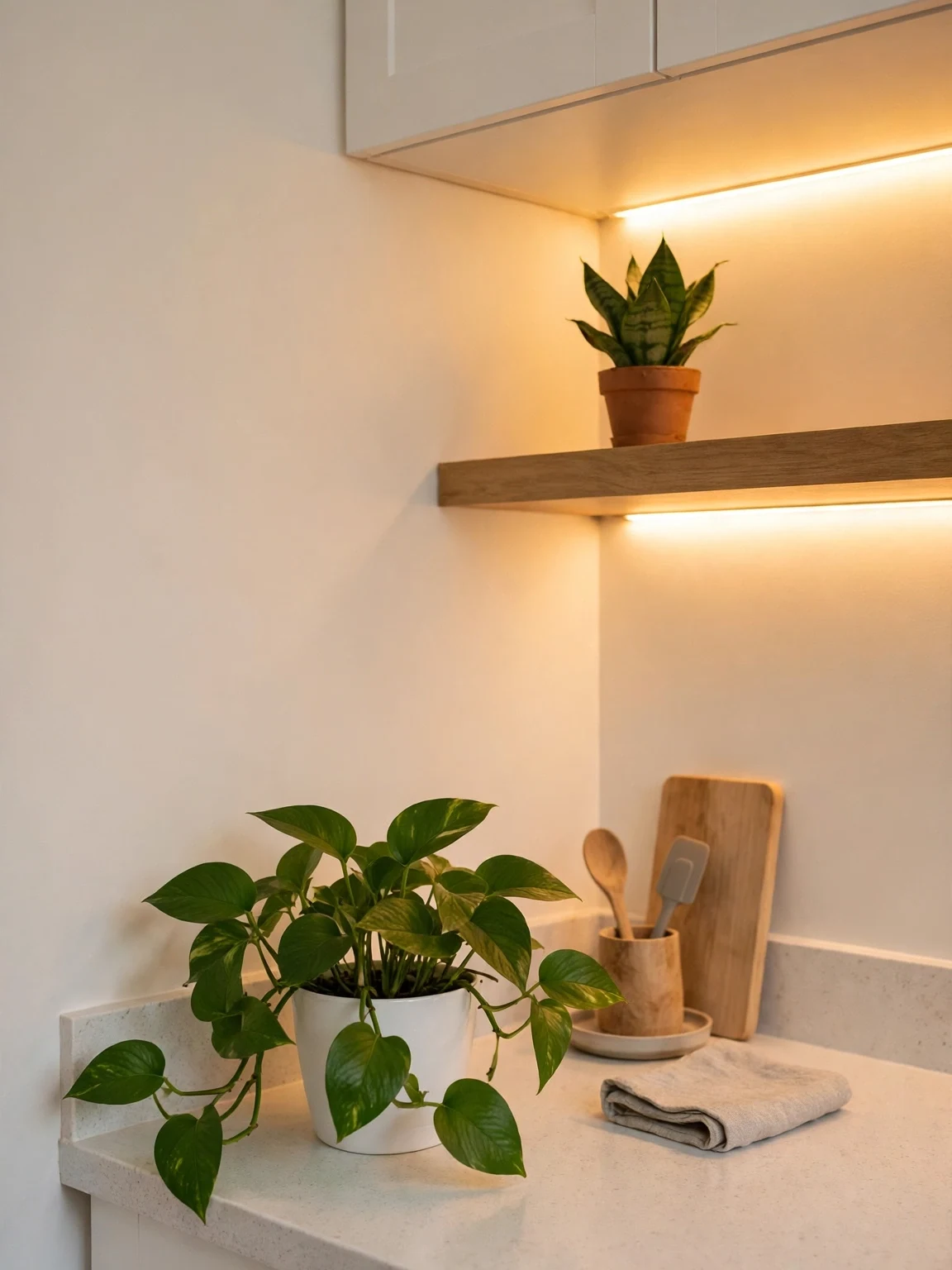
Plants make a windowless kitchen feel alive, but most kitchen herbs and sun-loving houseplants will struggle without natural light. The fix is to choose plants that genuinely tolerate low light, or to accept that some greenery in a dark kitchen will be faux — and to choose the faux kind well.
Low-light-tolerant options that generally do well in a dim kitchen include pothos, snake plants, and ZZ plants, which tolerate low light and irregular watering better than most houseplants. Keep them near your brightest artificial light rather than in the darkest corner, wipe their leaves occasionally so dust does not block what light they get, and do not overwater — low light means slower growth and slower drying soil, so most low-light plants need less water than their labels suggest. If a plant starts to fade, move it to a brighter room for a few weeks to recover rather than buying a replacement.
For herbs and anything you plan to eat, be realistic: a windowless kitchen rarely grows basil or mint well without a dedicated grow light. A small clip-on or countertop grow light can work if you have the counter space and an outlet, but for most first-time renters, buying fresh herbs and keeping one or two hardy decorative plants is the simpler, cheaper path. For a fuller list of plants that survive apartments with no sunlight, see 9 Indoor Plants That Survive Apartments With No Sunlight.
Good-looking faux plants are a legitimate option here, not a compromise to apologize for. Choose ones with varied leaf sizes and a matte finish — shiny, uniform plastic reads as fake from across the room — and keep them out of the direct heat and steam above the stove. A small faux trailing plant on top of a cabinet or a faux herb sprig in a jar on the windowsill-less counter adds the same visual softness as a real plant, with no light or watering needs at all.
10. Build a Low-Cost Brightening Plan
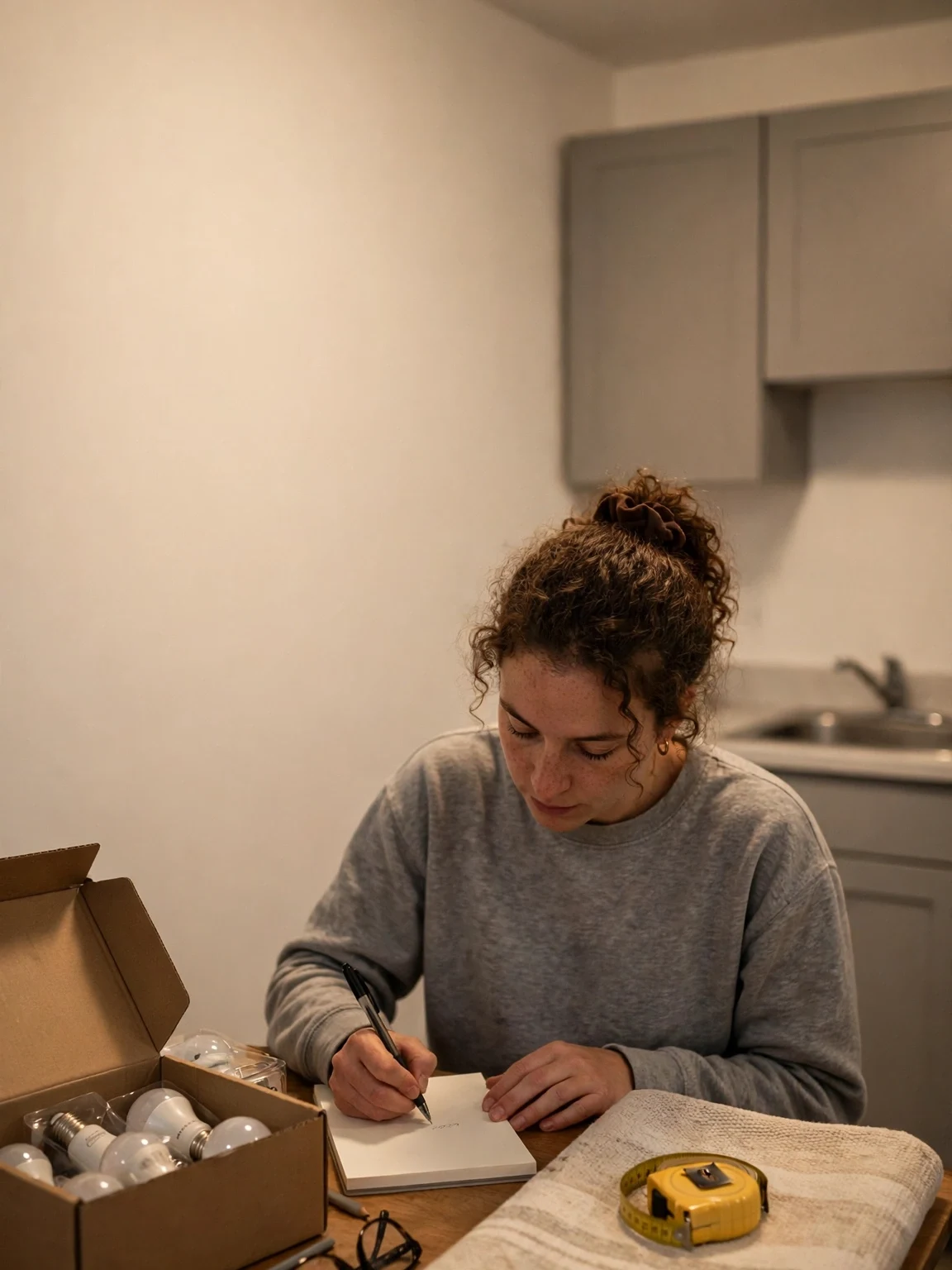
Pulling this together does not require a renovation budget. It requires doing the changes in the right order, so the free and cheap fixes come first and the bigger purchases only happen if the room still needs them. The plan below is written for a first-time renter’s budget, with prices marked as of 2026 and meant to be checked before you buy.
Start with the free tier: clean the light fixtures and diffuser covers, swap in daylight bulbs you may already own, clear the counters, and move dark accessories to another room. Then the low-cost tier, generally the price of a takeaway meal or two per item: a set of battery puck lights or an LED strip for under the cabinets, a light-colored runner, pale dish towels, and a framed print for the faux window. Only then consider the bigger tier: a peel-and-stick backsplash, a plug-in pendant or sconce, a medium mirror, and pale storage containers — and only after the free and low-cost changes have had a week to show you what is still dark.
| Upgrade | Typical cost as of 2026 | Removable? | Best for |
|---|---|---|---|
| Daylight LED bulbs (multi-pack) | Low | Yes — keep originals | Every fixture at once |
| Battery puck lights or LED strip | Low | Yes | Under-cabinet task light |
| Light runner + pale dish towels | Low | Yes | Floor and counter brightness |
| Framed print (faux window) | Low to moderate | Yes | Focal point and depth |
| Peel-and-stick backsplash | Moderate | Yes, with care | Reflecting under-cabinet light |
| Plug-in pendant or sconce | Moderate | Yes | Layered eye-level light |
| Medium wall mirror | Moderate | Yes, if rated strips allow | Bouncing light across the room |
Before move-out, reverse the changes in the opposite order: remove adhesive tiles slowly with gentle heat, take down mirrors and lights, swap the original bulbs back in, and patch any small nail holes only in the way your lease requires. Photograph the kitchen when you move in and again when you move out, so you have a record of the condition you returned it in. That record, plus the original bulbs and fixture covers kept in a labelled bag, is the simplest deposit protection a renter has. More renter-friendly decorating ideas live in the Decorating & Small Space Living collection.
Frequently Asked Questions
Can you make a windowless kitchen look bright without painting?
Yes. Layered plug-in and battery lighting, daylight bulbs, light removable surfaces such as a peel-and-stick backsplash, mirrors, and pale textiles can make a windowless kitchen feel noticeably brighter without any paint. Paint helps, but it is not the only way to add light — reflective surfaces and better bulbs often make a bigger difference than a coat of white paint would.
What is the best lighting for a kitchen with no windows?
A mix of lighting types works best: an overhead fixture for general light, under-cabinet LED strips or puck lights for counter tasks, and a plug-in sconce or pendant for eye-level warmth. Daylight bulbs in the 4000K to 5000K range generally read as the closest to natural light. Avoid relying on a single ceiling fixture, which leaves counters and corners in shadow.
How do I brighten a dark rental kitchen on a budget?
Start with the free fixes — clean the fixtures, clear the counters, and swap in daylight bulbs — then add one under-cabinet LED strip and pale textiles. Those few changes usually cost less than a single larger purchase such as a peel-and-stick backsplash, and they show you whether the bigger purchase is even needed. Prices in this guide are marked as of 2026.
Are LED strip lights safe to use in a rental kitchen?
Plug-in and battery-powered LED strips made for indoor use are generally a low-risk option when they are installed according to the manufacturer’s instructions, kept away from direct heat and water, and not modified or hardwired. Do not install anything that requires wiring changes, and check your lease for rules about adhesive products and fixture changes. If a light feels hot, flickers, or trips a breaker, unplug it and ask your landlord or a qualified electrician.
What colors make a windowless kitchen look brighter?
Pale, warm whites, soft cream, pale sage, light butter yellow, and powder blue reflect more light than dark or saturated colors, and they look cheerful under daylight bulbs. Keep the palette to one or two pale tones plus a single small bold accent, and avoid large dark accessories that absorb the light you have worked to add.
Can I put a mirror in a kitchen with no windows?
Yes, and it often helps. Hang the mirror where it reflects a light source, such as an under-cabinet strip or a pendant, rather than a dark wall, and use a hanging method rated for the mirror’s weight. Keep it away from direct stove splatter and clean it regularly, since a greasy mirror reflects less light.
What plants survive in a kitchen with no natural light?
Pothos, snake plants, and ZZ plants are among the most tolerant of low light and irregular watering, and they are a good fit for a dim kitchen. Herbs such as basil and mint generally need more light than a windowless kitchen provides, so they usually do better with a dedicated grow light or in a brighter room. Good-quality faux plants are also a reasonable choice where real plants would struggle.
Conclusion
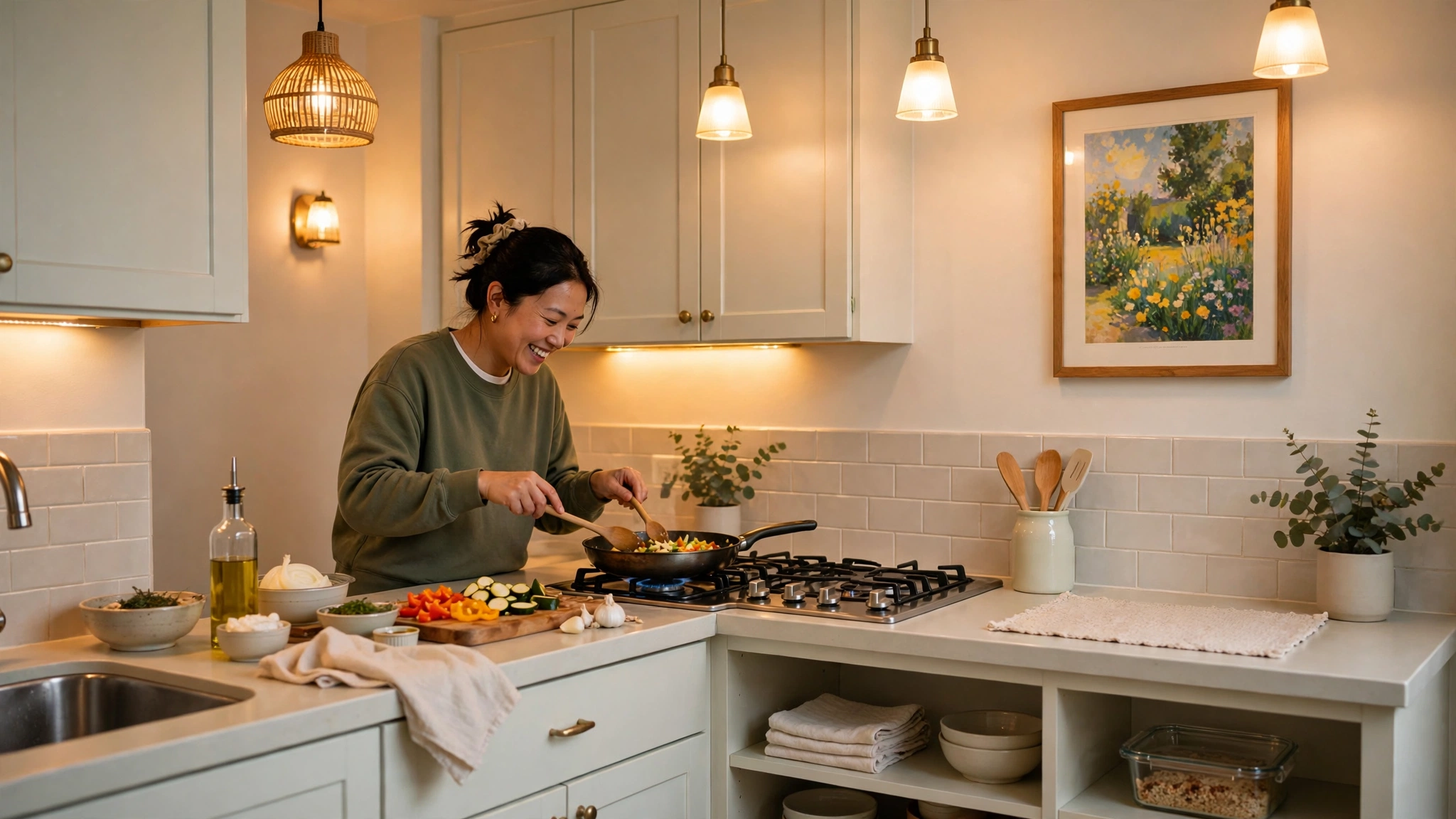
A windowless rental kitchen does not need paint, rewiring, or a renovation to feel bright — it needs the right light in the right places, surfaces that reflect instead of absorb, and a little discipline about clutter. Start with the free fixes, add one layer of light at a time, and let the room tell you what still needs work before you spend more. Learning how to decorate a rental apartment kitchen with no natural light is really about working with the room you have, not the one you wish you had — and with removable, renter-friendly changes, you can hand the kitchen back just as you found it, deposit intact.

Maren started MyFirstLease after a rough first lease taught him everything the internet didn’t. He covers the logistical side of renting — move-in checklists, utilities, and the unglamorous first-week stuff nobody explains — and oversees everything published on the site.