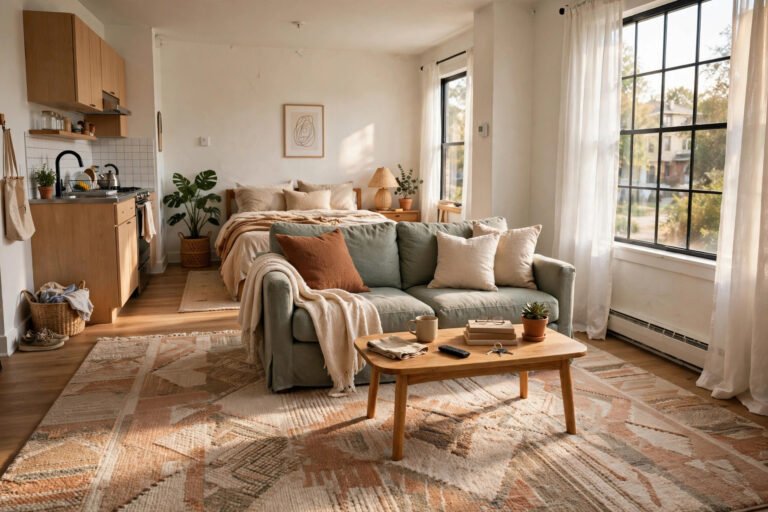
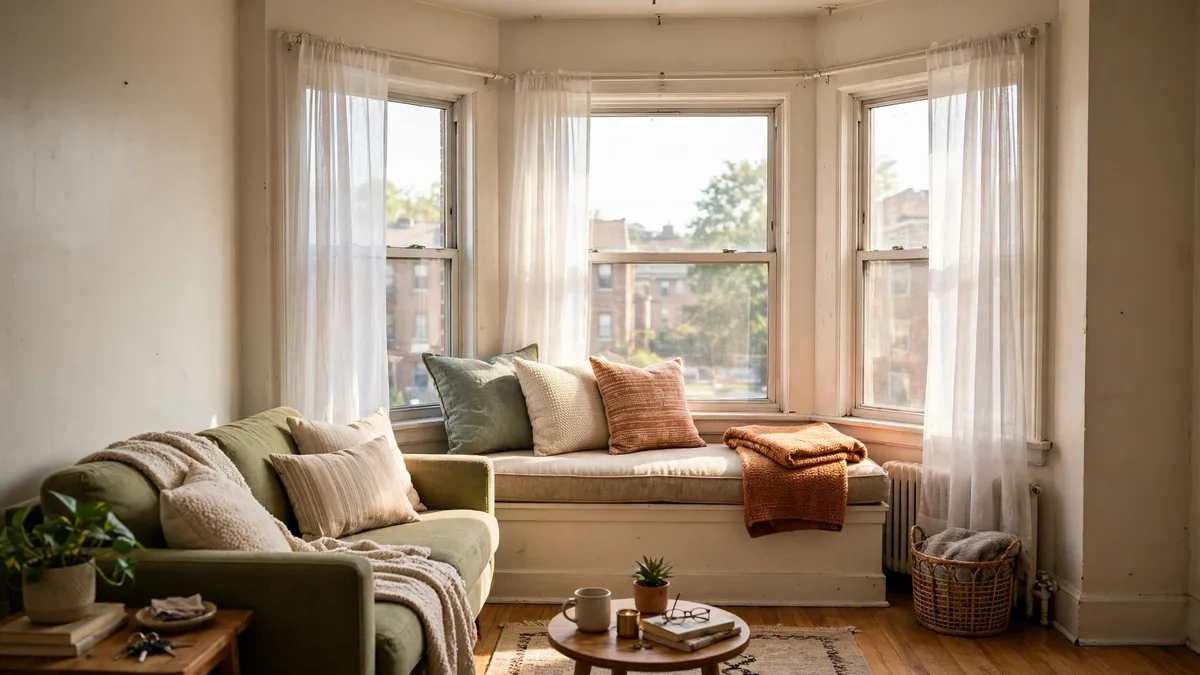
Learning how to decorate a small apartment living room for renters with a bay window starts with one decision: what the nook is actually for. Most bay-window advice assumes you own the place and can build a seat into it, drill curtain rods, and paint the trim. As a renter in an older apartment, none of that is on the table — and the nook still has to earn its floor space.
This guide is written for a first-time renter — a young professional or grad student — in an older apartment with a bay window that feels awkward: too deep for the sofa, too angled for a bookshelf, too sunny to ignore. Everything below is reversible, most of it costs little, and none of it asks the landlord for a renovation. For more reversible projects in the same spirit, browse the Decorating & Small Space Living guides.
Direct answer: To decorate a small apartment living room for renters with a bay window, give the nook one job, then furnish it with freestanding pieces: a low bench or chair, a cushion, and sheers on tension rods. Keep the sill light, hang nothing with screws, and leave the windows and radiator clear.
Executive Summary

A bay window is three windows and a triangle of floor that most floor plans do not know what to do with, which is why it usually ends up empty or piled with boxes. The fix is not a built-in and not a renovation: it is treating the nook as a small room of its own, with one clear purpose, furniture that stands on its own feet, and textiles that tie it back to the rest of the living room.
Below are seven steps, in the order that makes sense to do them: measure the bay, pick one job for the nook, build a seat without built-ins, dress the sill and angled walls, hang curtains without drilling, light the nook and anchor it to the room, and plan the move-out undo. Each step flags the renter constraint honestly — what the lease usually forbids, where adhesive can pull old paint, and what not to load onto a window sill — and every price is a typical range as of 2026.
1. Measure the Bay First

A bay window is not one window; it is usually three panes set at angles, and the angles are where most renter plans go wrong. A bench that fits the center pane can still be too wide for the angled sides, and a curtain rod that spans the front can leave the side panes bare. Measuring first takes twenty minutes and prevents the most common mistake in bay window living room decor for apartments: buying furniture for a rectangle and discovering the nook is a trapezoid.
Take six measurements and write them down before shopping. Measure the width of each pane separately, the depth from the back wall to the front of the sill, the height from the floor to the top of the sill, the height from the sill to the top of the window, the width of the opening where the bay meets the room, and the clearance above any radiator sitting under the window. Photograph the empty nook from the sofa and from the doorway; those two angles are the ones guests actually see.
| Measurement | Why it decides |
|---|---|
| Width of each pane | Bench, cushion, and curtain sizes — the angled panes are usually narrower than the center |
| Depth, back wall to sill edge | Whether a bench, chair, or desk fits without blocking the walkway |
| Floor-to-sill height | Whether the sill works as a seat base or only as a shelf |
| Sill-to-top-of-window height | Curtain length and whether a tension rod fits inside the frame |
| Width of the bay opening | How the nook connects to the room — and what size rug anchors it |
| Radiator clearance | What can safely sit above or in front of the heat source |
While the tape measure is out, check three things that shape the whole plan: whether the windows open inward (which limits what can sit on the sill), where the nearest outlet is (which decides where a lamp can go), and what the lease says about alterations. Most leases treat screws in window frames and trim as damage, so read the alterations clause before buying anything that needs a fixing — it is easier to design around it now than to fill holes later.
2. Give the Nook One Job
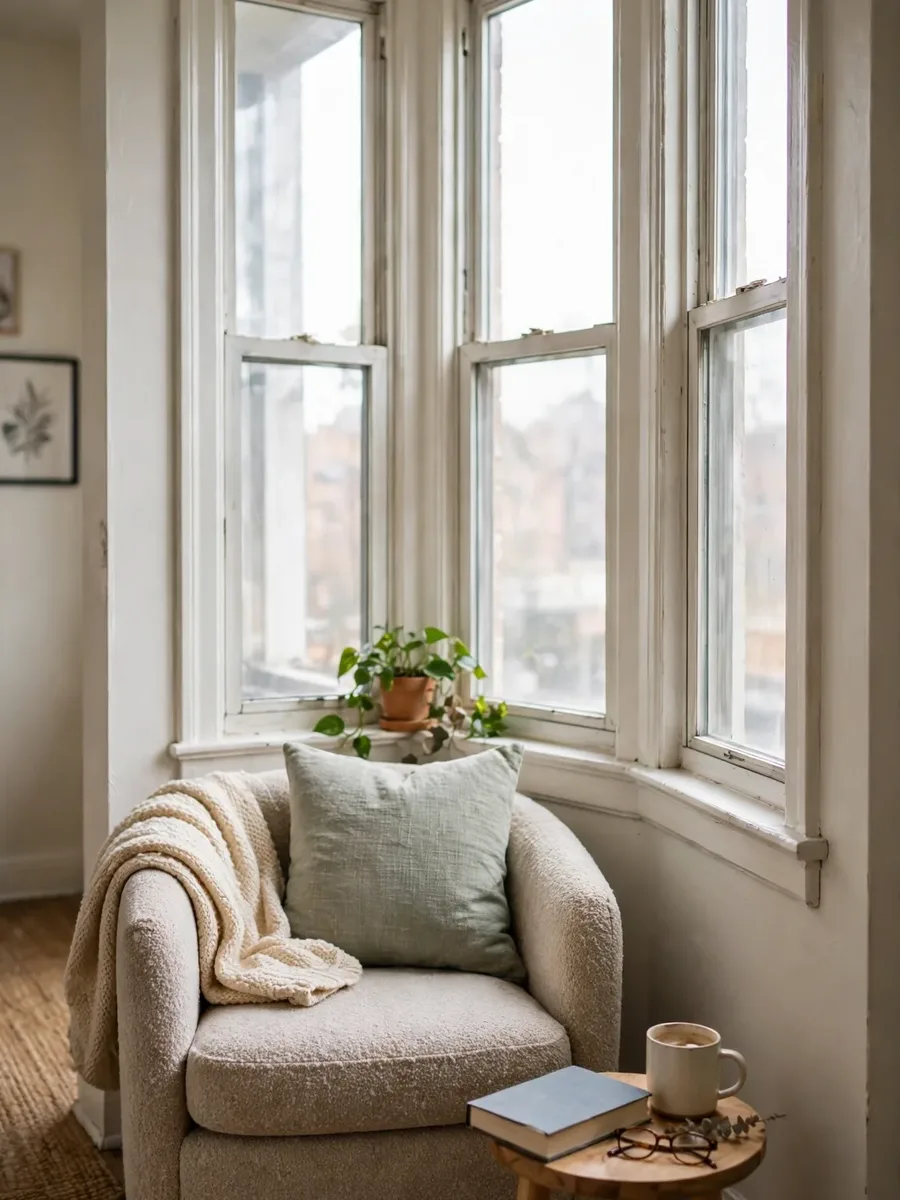
A bay window nook that tries to be a reading corner, a desk, a plant shelf, and a breakfast spot at the same time ends up being none of them — it becomes a cluttered triangle. Pick one job, and let that choice decide everything else. The four jobs that work best in a small living room are a reading corner, a work spot, a plant ledge, or an extra seat for guests, and the right one depends on what the rest of the room is missing.
A reading corner is the easiest win and the best fit for most first-time renters: one comfortable chair or a low bench, a cushion, a small side table, and a lamp. A work spot suits a renter whose living room doubles as an office, but it needs a real chair and a surface at desk height, not a laptop balanced on a cushion. A plant ledge works when the bay gets strong light and the renter already owns plants; it needs almost no furniture, just trays to catch water. An extra seat for guests makes sense in a living room with only a two-seat sofa, but only if the seat is genuinely comfortable — a cushion on a hard sill is not.
The choice also settles the small living room bay window layout. When the nook is a reading corner, the sofa usually works best facing the bay or angled toward it, so the nook reads as part of the seating area rather than a separate zone. When the nook is a work spot, the sofa’s back to the bay gives the desk privacy and keeps video-call backgrounds tidy. Either way, leave one clear walking path through the room that does not cut across the nook; a bay window you have to climb around is a bay window you will stop using. For styling the sofa side of that arrangement, see how to style a small apartment sofa with throws and pillows.
3. Build a Window Seat Without Built-Ins
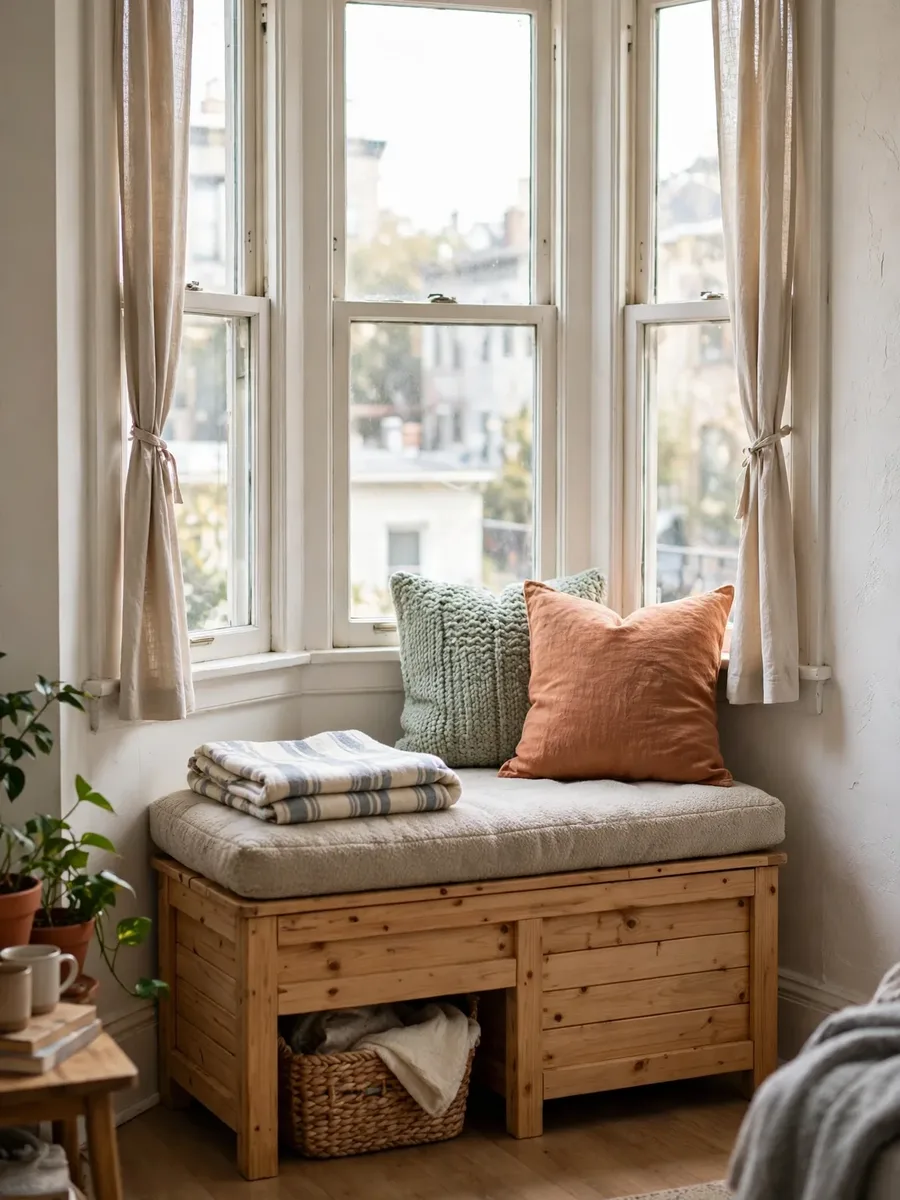
The window seat is the look most bay-window articles sell, and the built-in version is the one renters cannot have. The renter version is a freestanding low bench, and it looks just as intentional when it fits the bay properly — which is why the measurements from step one matter. A low storage bench, roughly $80–$200 as of 2026, is the most useful option: it gives a seat, it hides blankets and books inside, and it leaves with you at move-out.
Fit matters more than style here. The bench should be at least a few inches narrower than the bay’s back wall so it does not wedge against the angled panes, and no deeper than the bay itself, so it does not stick out into the walking path. A bench around 14–18 inches deep usually fits a standard bay; measure rather than guess, since older apartments vary widely. Check the manufacturer’s weight rating before buying, and check it again if two people will sit on it — a bench rated for storage is not automatically rated for seating.
Top the bench with a cushion made for the purpose, roughly $30–$80 as of 2026, in a washable cover if the nook gets direct sun or the bench doubles as a breakfast seat. Two or three pillows in colors pulled from the sofa keep the seat from looking like a waiting-room bench, and a folded throw at one end makes it look used rather than staged. If the budget is tight, a floor cushion and a low storage ottoman can stand in for a bench for a season; the shape is less crisp, but the function is the same.
Do not sit on the sill itself, and do not load it like a shelf. A window sill in an older apartment is trim, not furniture: it was not built to hold a person’s weight, and a cracked sill is exactly the kind of damage a landlord notices at move-out. The sill’s job is a mug, a book, and a small plant — the bench does the sitting.
4. Dress the Sill and the Angled Walls

Once the seat is sorted, the sill and the angled walls are what make the nook look decorated instead of furnished. The sill is a narrow shelf with the best light in the apartment, so treat it like one: a small potted plant, a stack of two or three books, and a mug or a small tray. Keep the total load light, keep everything back from the edge, and leave any window that opens inward clear — a plant that blocks a window from opening will be knocked over, usually onto the bench cushion.
The angled walls are the part of a bay window that defeats most renters, because a frame hung flat on an angled wall looks crooked from the sofa. Two approaches work. The first is leaning: a framed print or a small mirror leaned against the angled wall at a slight tilt, with a non-slip pad underneath, needs no fixing at all and can be moved in seconds. The second is removable adhesive hooks or strips on the flat sections of wall beside the bay, used only for light frames and only after a test spot.
That test spot matters more in an older apartment than in a new one. Paint in pre-1978 buildings may contain lead, and even newer paint that has been layered many times can peel when adhesive is pulled off. Never sand or scrape old window paint to prepare a surface — if paint is flaking or chalky around the bay, leave it alone and tell the landlord. On sound paint, press one adhesive strip on a hidden spot, wait a few days, and remove it slowly before trusting the same product with a frame. Anything heavy, anything glass, and anything above a seat stays off adhesive entirely; leaning pieces and freestanding decor are the safer choice there.
5. Hang Curtains Without Drilling
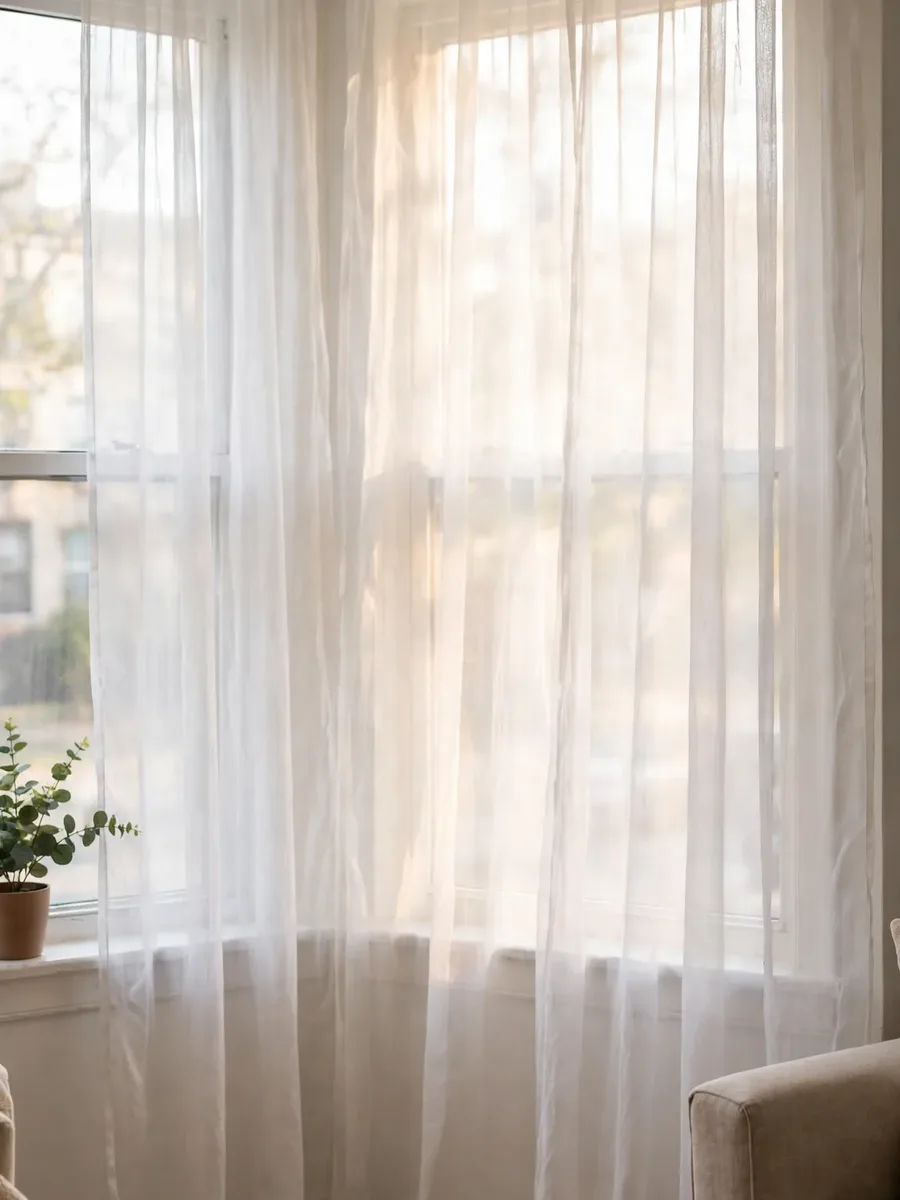
Curtains do more for a bay window than any other single addition: they soften three hard window frames, add privacy at street level, and make the nook feel like a room. They are also the step where renters most often reach for a drill, and the bay window is the worst place to do it — the frames are narrow, the trim is often original, and a misplaced screw in a window frame is difficult to hide.
The no-drill options, ranked by how well they suit a bay, start with tension rods. A tension rod, roughly $10–$25 as of 2026, wedges inside each window frame, so a bay usually needs three: one per pane. That sounds fussy, but it is the method that follows the angles correctly, and each rod only has to hold one light panel. Measure the inside width of each frame before ordering, since the side panes are usually narrower than the center, and choose rods rated for the weight of the curtains — sheers are light; lined blackout panels are not.
The second option is removable adhesive hooks on the wall above the bay, holding a single lightweight rod across the whole opening. This gives a cleaner line from the sofa, but it only works for very light curtains, and the hooks need the same test-spot treatment as the frames in step four: sound paint, a few days’ wait, and no heavy load. A third option, clip rings on a tension rod, lets curtains hang without sewing a rod pocket and makes them easy to take down for washing.
For the curtains themselves, sheer white or ivory panels, roughly $15–$40 per panel as of 2026, are the safest first buy: they diffuse the light, give daytime privacy, and suit a rental because they are cheap to replace. Heavier blackout panels belong on the flat wall behind the sofa, not on a tension rod in the bay. Keep every curtain hem clear of a radiator under the window — fabric resting on a hot radiator is a fire risk, and it also blocks the heat from reaching the room. For more no-drill window ideas that pair with this step, see these renter-friendly apartment window decor ideas with no drilling.
6. Light and Anchor the Nook
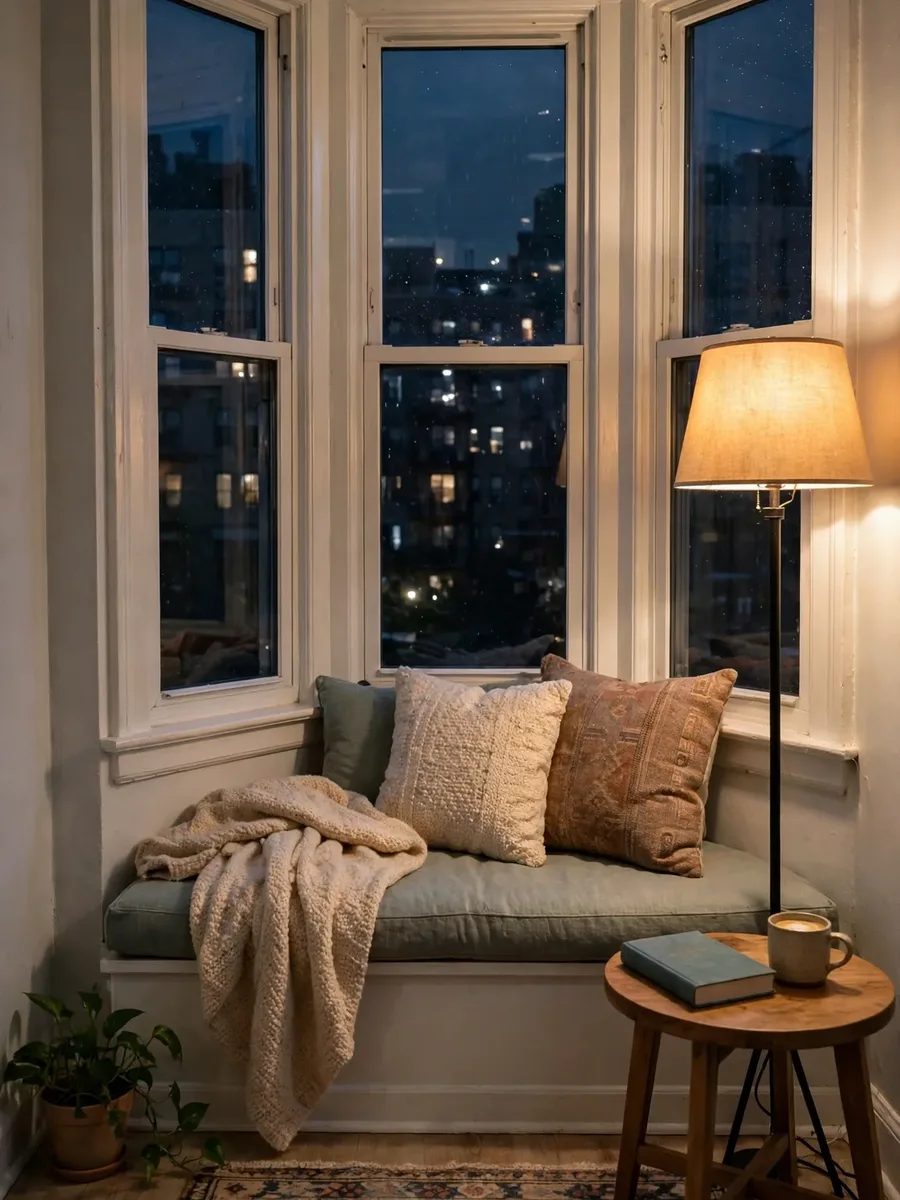
A bay window is bright at noon and dark by five in winter, and a nook with no light after dark stops being used. The fix is a floor lamp, not a ceiling fitting: a slim floor lamp, roughly $40–$100 as of 2026, placed at the edge of the bay where its base sits on the room side, lights the seat without a single fixing and moves with you. A small table lamp on the sill works too, as long as its cord runs behind the bench and not across the walking path.
Battery-operated LED fairy lights are the other renter-friendly option, roughly $10–$20 as of 2026, and they suit a bay window because they can follow the angles: drape them along the top of the center pane with removable adhesive clips, or coil them in a glass jar on the sill. Use LED lights only, never a real flame, in a nook full of cushions, throws, and curtains. Keep cords and battery packs out of sight behind the bench, and keep the lights away from the radiator.
The last piece is the rug. A small rug, roughly $40–$120 as of 2026, placed half under the bench and half in the room, is what connects the nook to the living room visually — without it, the bay reads as a separate alcove. Choose a low-pile, washable rug in a color that repeats something on the sofa, and size it so it extends at least a foot into the room past the bay opening. A rug pad underneath helps stop slipping on hard floors; check that the pad is the non-adhesive kind, since sticky pads can leave residue on rental floors.
7. Plan the Move-Out Undo

The point of a renter bay window is that it disappears cleanly, and that is worth planning from the start rather than the week before move-out. Before buying anything, photograph the empty bay — the sill, the frames, the walls beside it — so there is a record of what it looked like on arrival. Keep the original hardware and packaging for anything that came with the bench or lamp, and keep a small bag with the spare adhesive strips and the curtain rod’s end caps.
When move-out comes, work in reverse. Take the curtains down first, then the cushion and pillows, then the bench, so nothing gets knocked against the glass. Remove adhesive hooks and strips slowly, pulling the tab straight down along the wall rather than outward, and warm a stubborn strip with a hair dryer on low for a few seconds before trying again — heat softens the adhesive and reduces the chance of pulling paint. Wipe the sill and frames with a damp cloth, check for scuffs at bench height, and compare against the move-in photos.
If a strip does pull a flake of paint, do not paint over it yourself. Note it on the move-out checklist and tell the landlord; a small touch-up by the landlord is usually cheaper than a deposit deduction for an unapproved paint repair, and painting over old paint in a pre-1978 apartment can disturb lead paint. The goal is not a perfect wall — it is a nook that goes back to looking like nobody ever decorated it, with the deposit intact.
Frequently Asked Questions
Can I put furniture in a bay window in a rental?
Yes, as long as it is freestanding and fits the bay. A low bench, a chair, or a small desk works; anything that needs screws, brackets, or a built-in does not, unless the landlord agrees in writing. Measure the bay first, keep the windows and radiator clear, and do not sit or stand on the sill itself.
How do I decorate a bay window without drilling?
Use freestanding furniture for the seat, leaning frames for the angled walls, tension rods inside each window frame for curtains, and removable adhesive hooks only for very light items after a test spot on hidden paint. Nothing in this guide needs a screw, a nail, or a bracket.
What curtains work best for a bay window in an apartment?
Sheer white or ivory panels on a tension rod inside each pane are the simplest fit: they follow the bay’s angles, diffuse the light, and cost little. One rod across the whole bay on adhesive hooks works only for very light curtains. Keep hems clear of any radiator under the window.
Can I sit on my bay window sill?
It is best not to. A sill in an older apartment is trim, not a seat, and it was not built to hold a person’s weight; a cracked sill is the kind of damage a landlord notices at move-out. Use a freestanding bench with a cushion for sitting, and keep the sill to light items like a book, a mug, and a small plant.
How do I make a bay window seat without built-ins?
Buy a low freestanding storage bench that fits the bay’s back wall, check the manufacturer’s weight rating, and top it with a washable cushion and two or three pillows in colors from the sofa. A floor cushion and a storage ottoman can stand in for a bench on a tight budget.
What should I put in a bay window nook in a small apartment?
Give the nook one job first: a reading corner, a work spot, a plant ledge, or an extra seat. Then add only what that job needs — a chair or bench, a small table, a lamp, and a rug that ties the nook to the room. A nook with one clear purpose looks intentional; a nook with a bit of everything looks like storage.
Will a tension rod damage my window frame?
A correctly sized tension rod should not damage a sound frame, since it presses rather than screws. Measure the inside width of each frame so the rod fits without forcing, and do not hang heavy lined curtains from it. If the frame paint is flaking or the wood is soft, skip the rod and use adhesive hooks on the wall above the bay instead.
Do I need my landlord’s permission to decorate a bay window?
For freestanding furniture, curtains on tension rods, and leaning decor, usually not — those are not alterations. Anything that fixes into the wall or window frame, including screws, brackets, and some adhesive products on old paint, can count as an alteration under many leases. Check the alterations clause, and ask in writing before fixing anything to the building.
Conclusion
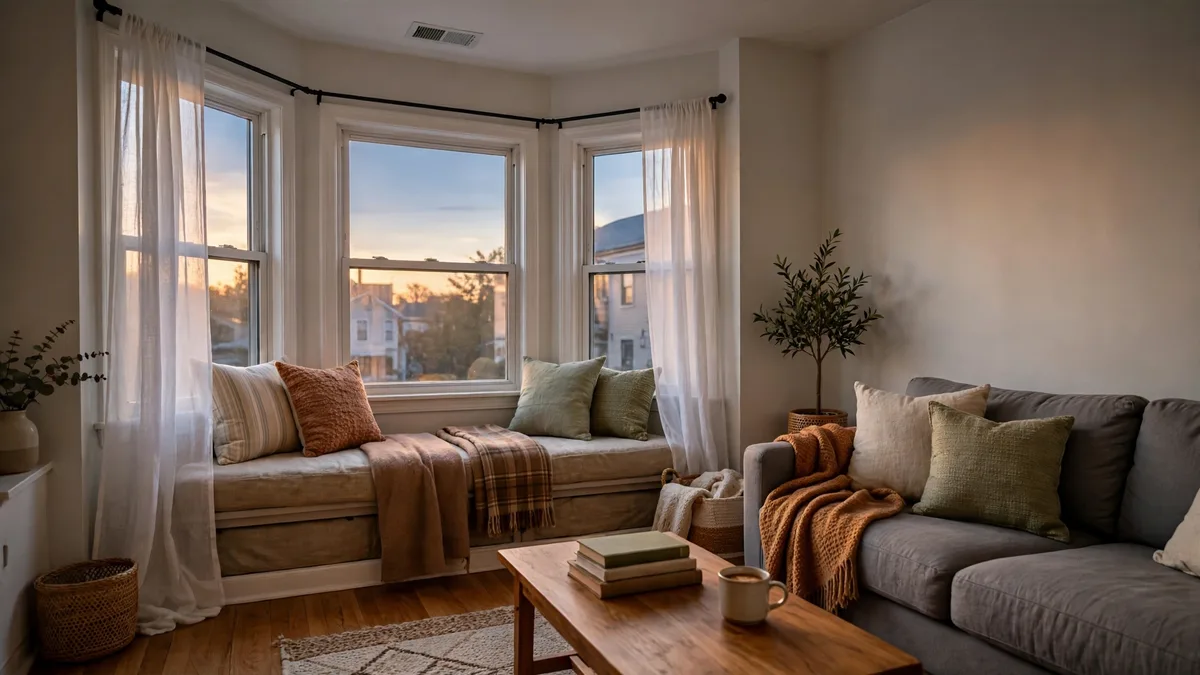
A bay window in a rental is not a problem to solve — it is the best seat in the apartment, once it has a job and furniture that can leave with you. Measure first, choose one use for the nook, and build it from freestanding pieces, soft textiles, and no-drill hangings that come down cleanly. That is how to decorate a small apartment living room for renters with a bay window without spending much or risking the deposit. Start with the tape measure, add one piece at a time, and let the nook earn its keep. If this guide helped, save it for move-in day and share it with the next first-time renter facing an empty bay window.

Maren started MyFirstLease after a rough first lease taught him everything the internet didn’t. He covers the logistical side of renting — move-in checklists, utilities, and the unglamorous first-week stuff nobody explains — and oversees everything published on the site.