

Learning how to store cleaning supplies in a small apartment is one of those renter skills nobody teaches you. Your new studio or one-bedroom has no utility closet, no garage, and maybe one cabinet that isn’t already spoken for — yet the spray bottles keep multiplying on the kitchen counter.
This guide is for first-time renters who are buying their first real set of cleaning supplies and need every item to earn its square inch. It covers where each thing should live — from the broom to the backup sponges — using only renter-safe, no-drill setups, and closes with a first-timer’s starter-kit checklist so you can buy once and stop improvising.
Direct answer: Store cleaning supplies in a small apartment by claiming vertical space first: an under-sink organizer in the kitchen, an over-the-door caddy on a closet or pantry door, adhesive wall grips for the broom and mop, and a slim cart for the bathroom. Keep the kit small — a handful of multi-purpose products handles most apartments.
Summary

A tiny apartment doesn’t need a utility closet — it needs a plan. The strategy is simple: store daily-use items where the work happens (kitchen, bathroom), keep long-handled tools on walls and door backs with damage-free hardware, and banish everything else to a single backstock spot so supplies don’t sprawl across every surface.
Below you’ll find seven sections: the vertical-first strategy, the under-sink setup, door-back caddies, broom-and-mop storage, bathroom overflow, pet-smart habits for the whole plan, and a printable-style starter-kit checklist. Everything here respects a standard lease — nothing gets screwed into a wall or door.
1. Think Vertical First

Floor space is the resource your apartment is short on; vertical surfaces are the resource it still has. Walls, door backs, cabinet-door interiors, the sides of appliances, and the gap between the fridge and the counter are all fair game — and none of them cost a dime of your deposit if you use removable hardware.
Start by splitting your supplies into two groups. The daily kit — all-purpose spray, dish soap, two microfiber cloths, a sponge, a small trash bag stash — lives where you can grab it in seconds. The backstock — extra sponges, refill bottles, the mop bucket, bulk paper towels — lives in one out-of-the-way zone and gets restocked into the daily kit when something runs low. Most first-time renters skip this split and end up with every bottle on the counter; the split is what keeps the apartment looking like a home instead of a supply room.
One more rule before you buy anything: measure the gaps you’re working with. That 4-inch slot between the fridge and the wall, the 6 inches under the bathroom sink, the clearance behind the front door — a tape measure is worth more than any organizer list. Note the numbers in your phone; you’ll need them in the sections below.
2. Claim the Under-Sink Space
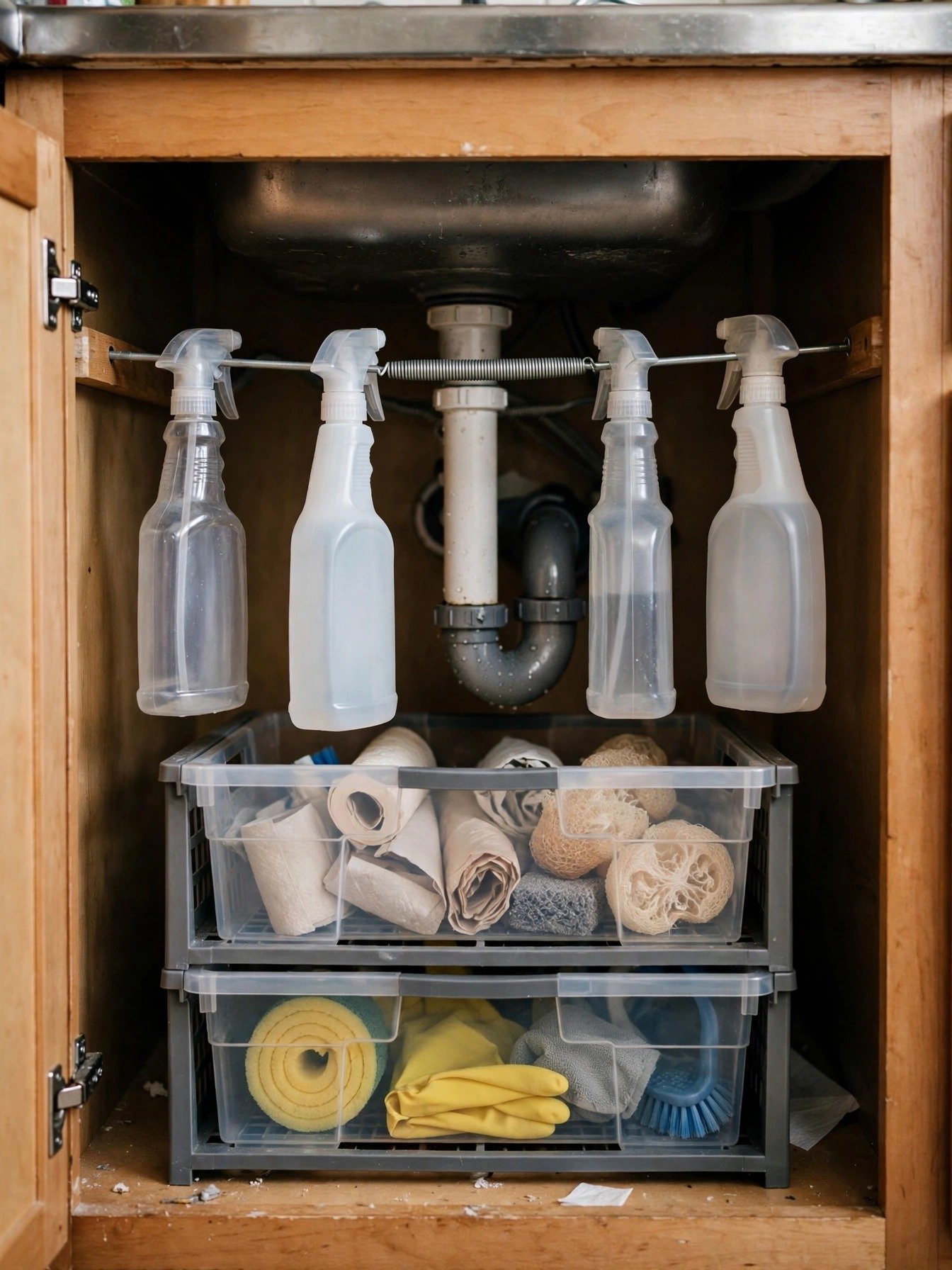
The cabinet under the kitchen sink is the most valuable cleaning real estate in a studio or one-bedroom, and it’s wasted in most rentals. The pipes eat the middle, so the winning move is to build around them: a two-tier stackable bin set on each side of the drain pipe, plus a spring-loaded tension rod mounted across the cabinet to hang spray bottles by their triggers. This under-sink organizer approach turns dead pipe space into two usable levels without a single screw.
Keep only daily-use items here: all-purpose spray, dish soap, a scrub brush, trash bags, and your microfiber cloths. Store spray bottles upright with their labels facing out so you can identify them at a glance, and leave the back of the cabinet for the overflow you rarely touch. A common mistake is cramming in every product you own; when the cabinet is too full to close comfortably, cleaning becomes a chore you avoid, which defeats the purpose.
Two safety habits matter here. Never store products where they could mix — keep bleach-containing cleaners away from ammonia-containing ones, since mixing the two creates harmful fumes. And always keep products in their original labeled containers rather than decanting them into mystery bottles; the label is the first thing you’ll need in a spill or a panicked pet situation (see section 6).
3. Behind Every Door

Door backs are the storage surfaces most renters ignore. An over-door cleaning caddy — the kind that hooks over the top of a door — turns the back of a closet, pantry, or bathroom door into a vertical shelf for spray bottles, sponges, scrub brushes, and dusters. Clear-pocket shoe organizers work surprisingly well for this too, since you can see every bottle without pulling anything out.
Before you hang one, do two checks. First, close the door slowly with the organizer on it: if it scrapes the frame, the organizer is too deep and will chew the paint over time. Second, respect the weight limit on the package — overloaded caddies swing when the door moves and can crack a hollow-core door from the inside out. Light bottles and cloths are fine; the full mop bucket is not.
This setup is also the answer for bathroom-door storage of daily items: a slim caddy on the bathroom door holds the toilet-bowl cleaner, a small scrub brush, and spare sponges within arm’s reach of the work. When you move out, unhook it and the door is untouched — the very definition of deposit-safe.
4. Taming Broom and Mop

Long-handled tools are the hardest category to place in a studio, because nothing is tall and skinny except the broom itself. Leaning a broom in the corner between the fridge and the wall is the default for most first-time renters — and it falls over every three days. The fix is a pair of adhesive grip holders (damage-free tool clips) mounted on the inside of a closet door, a laundry-area wall, or even the side of a tall bookcase.
Storing a broom and mop in a studio gets easier if you choose the tools with storage in mind: a mop with a telescoping or folding handle, a compact broom with a dustpan that clips to the handle, and a collapsible bucket instead of a rigid one. A collapsible bucket flattens to the thickness of a magazine and slides into the same under-sink cabinet as your sprays.
If your apartment has a true dead zone — the side of the fridge, the 6-inch gap next to the washer — a broom clipped there with one grip holder is effectively invisible. And if you have genuinely zero vertical options, a behind-the-door hook set rated for the combined weight works; just confirm the door still latches, since brooms add more weight than bottles.
5. The Bathroom Backstock

The bathroom needs its own small zone because bathroom cleaners shouldn’t live with food-adjacent kitchen supplies. In a typical first apartment the under-bathroom-sink cabinet is shallow, so use it for the daily pair: toilet-bowl cleaner and a tub-and-tile spray, plus a small caddy of sponges. Everything else — refills, extra scrub pads, the plunger — goes vertical.
A slim rolling cart (the kind sized to fit in a 7-inch gap) works between the toilet and the wall or beside the vanity. If there’s no gap at all, a tension-rod shelf inside the cabinet, or a basket hooked on the inside of the cabinet door with adhesive hooks, holds the backstock. The plunger can live behind the toilet if there’s a few inches of clearance, or inside a tall, lidded bin tucked beside the tub — the lid keeps it visually contained, which matters when your bathroom doubles as the guest bathroom.
For renters who want this space to look intentional rather than improvised, our no-drill bathroom storage ideas pair well with this section — the same damage-free hardware that holds a towel bar can hold a cleaning caddy.
6. Pet-Safe Storage Habits

If you share your apartment with a cat or dog, storage stops being just about tidiness. Pets investigate with their mouths, they can bat spray bottles off low shelves, and some will chew through a mop head left on the floor. The habit to build: every cleaning product lives latched, latched-up, or behind a closed door — never on an open low shelf or the bathroom floor.
The under-sink cabinet is fine for pet households only if the door latches shut reliably; many kitchen cabinets swing open with a nudge from a curious cat. If yours doesn’t stay closed, a cheap adhesive childproof latch keeps both toddlers and pets out, and it peels off at move-out. High spots — the top of the bathroom rolling cart, a closed over-door caddy — keep products out of reach for most pets, but a determined chewer may still get creative, so closed storage beats open shelving here.
Keep pods and concentrates out of reach entirely, mop up drips from the mop bucket immediately rather than leaving a full bucket standing, and if your pet ever licks or chews a cleaning product, contact your veterinarian or a poison-control hotline right away rather than waiting to see what happens. These habits don’t make any product “safe” around pets — they make the accidents much less likely.
7. Starter-Kit Checklist

Editor note: this checklist is flagged as a downloadable-candidate — it works as a printable one-page handout or PDF.
Buying cleaning supplies for the first time usually goes one of two ways: you buy nothing and live with dust, or you buy twelve products and store eleven of them on the counter. Aim for the middle. This is the complete first apartment cleaning supplies checklist — every item below handles a real, recurring task in a studio or one-bedroom, grouped so you can shop by chore instead of wandering the aisle.
Floors
- ☐ All-purpose floor cleaner (concentrate if you want to save space)
- ☐ Broom with clip-on dustpan
- ☐ Flat mop with washable pads (skip the string mop — it needs a big bucket)
- ☐ Collapsible bucket
Kitchen
- ☐ Dish soap
- ☐ All-purpose spray (one multi-surface product, not three specialty ones)
- ☐ Sponges (a 3-pack lasts months)
- ☐ Microfiber cloths (4-pack: two for kitchen, two for everything else)
- ☐ Small trash bags sized to your bin
Bathroom
- ☐ Toilet-bowl cleaner
- ☐ Tub-and-tile spray
- ☐ Small scrub brush or old toothbrush for grout lines
- ☐ Plunger
Whole apartment
- ☐ Duster or dry-mopping pads for baseboards and blinds
- ☐ Rubber gloves (one pair, stored with the daily kit)
- ☐ Stain remover for the inevitable spill
- ☐ One lidded storage bin for the backstock, one caddy for the daily kit
That list — about a dozen products and four tools — is the full small apartment cleaning kit essentials set. If a product doesn’t serve a task on this list, it doesn’t need a storage spot either, which is the simplest space-saving rule of all.
FAQ
What is the bare minimum of cleaning supplies for a first apartment?
One all-purpose spray, dish soap, a broom, a flat mop, microfiber cloths, sponges, toilet-bowl cleaner, and a tub-and-tile spray. That eight-item core handles daily life in a studio or one-bedroom; everything else on the checklist above is a convenience, not a necessity.
Where can I store a broom and mop if I have no closet?
Mount two adhesive grip holders on the inside of a pantry door, the side of the fridge, or a laundry-area wall — all damage-free. Choose a folding-handle mop and a compact broom, and the pair takes up about six inches of wall.
Will over-the-door organizers damage my doors?
They can if overloaded or too deep for the frame. Check that the door closes without scraping, stay under the organizer’s weight limit, and keep heavy items (full mop buckets, bulk refills) out of it. Used this way, they unhook at move-out with no trace.
Is it safe to store cleaning products under the kitchen sink?
Yes for most households, with two rules: never store bleach and ammonia products where they could mix (mixing creates harmful fumes), and keep everything in its original labeled containers. If you have pets, add a latch so the cabinet can’t be nudged open.
How do I keep cleaning supplies away from my cat or dog?
Store everything latched, latched-up high, or behind a closed door — never on low open shelves or the floor. Clean up mop-bucket drips immediately, and if your pet ingests or licks a product, call your vet or a poison-control hotline right away.
What’s the difference between a daily kit and backstock?
The daily kit is what you grab in seconds — all-purpose spray, dish soap, cloths, a sponge — and it lives under the sink or on the bathroom door. Backstock is everything else (refills, the mop bucket, bulk paper towels), stored in one out-of-the-way zone and used to replenish the daily kit.
Can adhesive hooks hold heavy spray bottles?
They hold full spray bottles fine when you use hooks rated well above the weight and apply them to clean, dry, flat surfaces. They struggle on textured walls and with loads near their maximum rating — so distribute weight across several hooks rather than trusting one.
Conclusion

You don’t need a utility closet to keep a tiny apartment clean — you need a system. Once you learn how to store cleaning supplies in a small apartment with a vertical-first plan, renter-safe hardware, and a starter kit that fits the actual chores, the supplies stop sprawling and cleaning stops feeling like a logistics problem. Set up the zones once, buy the checklist once, and your studio stays livable for the whole lease. If this guide helped, save it for move-in day or share it with the friend who’s still leaning a broom in the corner.
For more ways to make a small rental work harder, see our Decorating & Small Space Living guides — and if you’re still hauling boxes, our studio moving cost breakdown can help you budget the move itself. (Editor: verify both URLs — category permalink format and movers-cost-studio slug — before publishing.)

Maren started MyFirstLease after a rough first lease taught him everything the internet didn’t. He covers the logistical side of renting — move-in checklists, utilities, and the unglamorous first-week stuff nobody explains — and oversees everything published on the site.