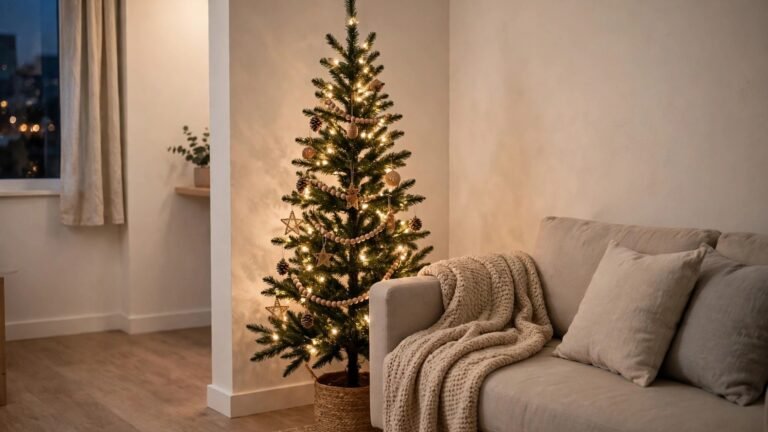

A wall Christmas tree rental setup — meaning a tree designed for a rental home, hung flat against the wall instead of standing on the floor — is the simplest way to get a real Christmas tree look into a studio or micro-apartment with no spare square footage. This guide is written for micro-apartment and studio renters whose only free surface is a blank stretch of wall, and it ranks damage-free hanging methods by wall type and removal risk rather than just showing pretty wall-tree photos.
You will learn which flat-tree styles read as a tree, which adhesive methods hold on painted drywall, plaster, brick, or tile, and how to take everything down in January without losing part of your deposit to wall damage. No nails or drilling are needed for most of these methods — but check your lease’s wall-decoration clause first, since some buildings restrict adhesive products too.
Direct answer: A wall Christmas tree for a rental home is a flat or half-depth tree mounted on the wall with adhesive hooks, strips, or a tension-mounted frame — no nails or screws needed. Felt trees suit smooth painted walls; branch-and-light trees need more hooks. Choose the method by your wall material, and test removal on a hidden spot first.
Executive Summary
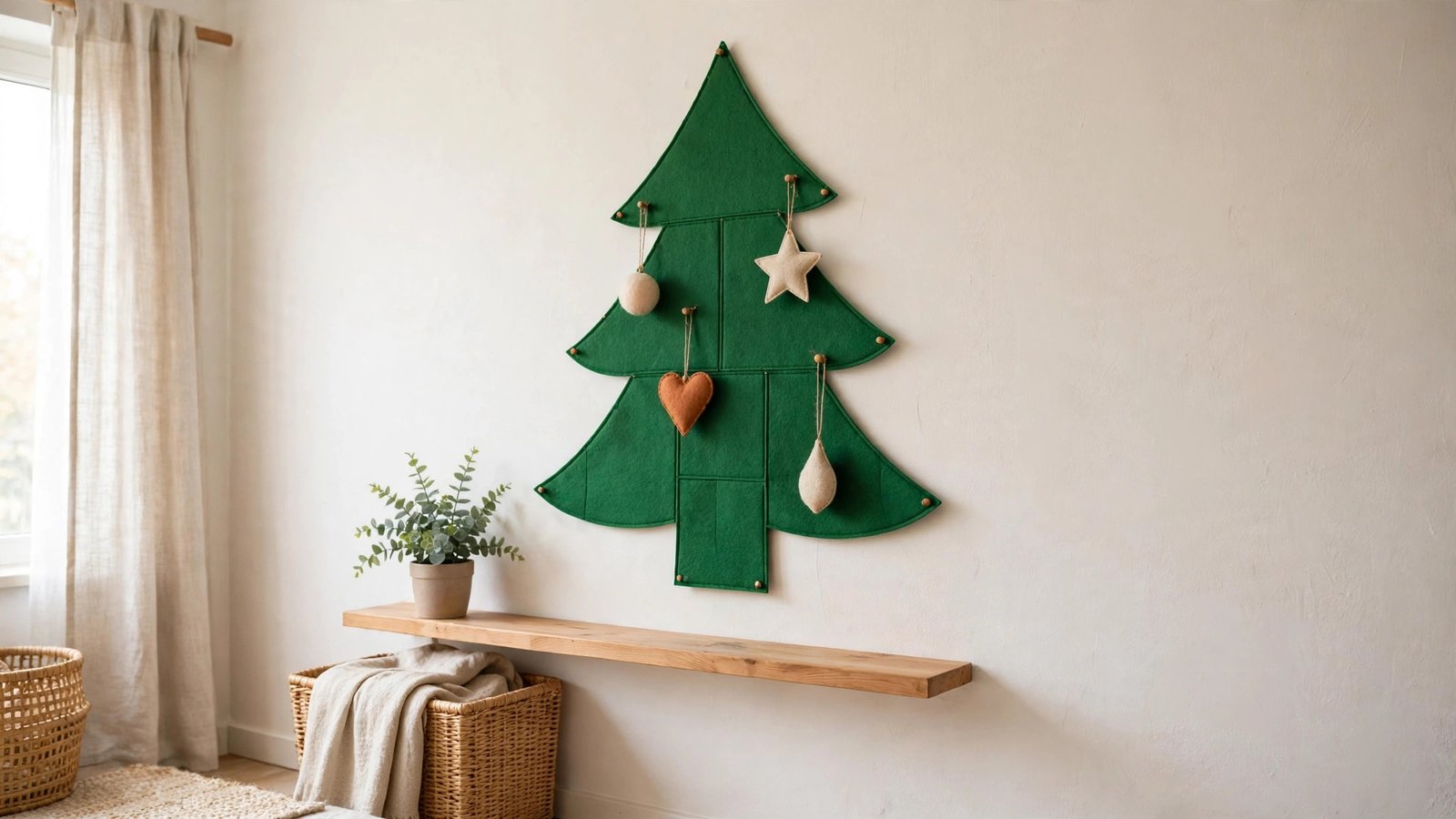
When floor space is zero, the wall is the only real estate left, and a wall tree uses it well. Flat felt trees, fabric tapestries, and branch-and-light arrangements all hang flat, weigh far less than a standing tree, and cost less to store in a small closet come January. The catch is the hanging method: the wrong adhesive on the wrong wall either falls down mid-December or peels paint off in January.
This article walks through the main wall-tree styles, ranks adhesive hanging methods from lowest to highest removal risk, matches each method to common apartment wall types, and covers decorating and storage. By the end, you should be able to pick a style, a hanging method, and a wall — and feel confident the whole thing comes down cleanly.
1. Start With the Wall, Not the Tree
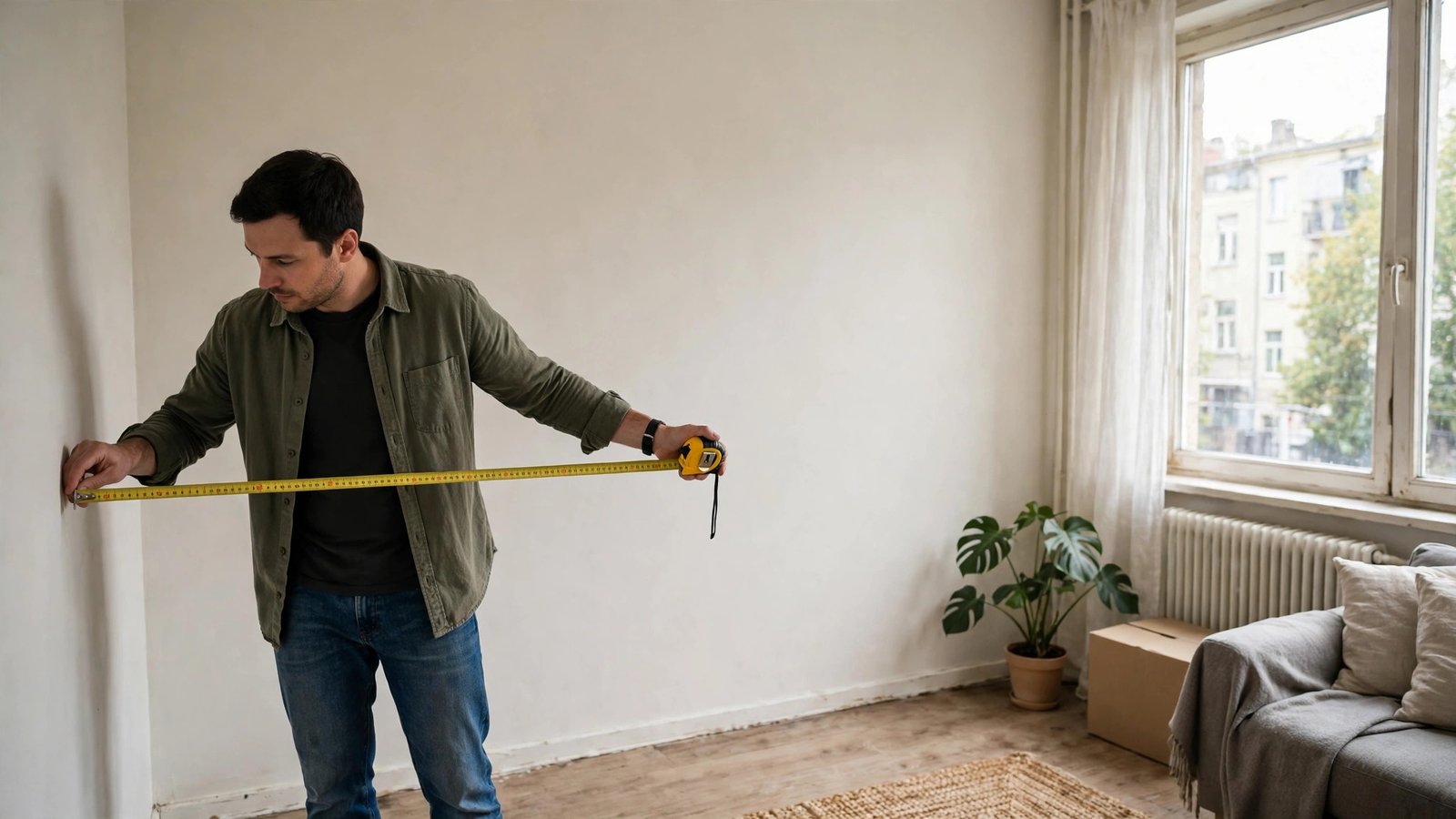
Most wall-tree guides start with the prettiest tree. Start with the wall instead, because the wall decides what will hold, what will damage paint, and how much weight you can hang. Walk your apartment and find the largest uninterrupted stretch of wall — behind a sofa rarely works, since the tree needs to be visible and reachable for decorating. A hallway-adjacent living room wall, the wall beside a bed, or the wall above a low console usually works best.
Measure the space before ordering anything. A wall tree that is wider than the wall looks cramped, and one that hangs too low gets brushed every time someone walks past. Leave at least a few inches of clearance on each side and keep the bottom of the tree above furniture height if the tree sits over a console or radiator cover. Note the wall material too: smooth painted drywall, textured or plaster walls, brick, and tile all behave differently with adhesives, and that difference is the whole ballgame for your deposit.
One more pre-check: look at your lease’s decoration clause. Many leases ban nails and screws but say nothing about removable adhesive products; some ban adhesives on freshly painted walls. If the clause is vague, a quick message to your property manager asking about removable adhesive hooks is worth the two minutes — it is far cheaper than a repaint charge.
2. Flat Felt and Fabric Trees

A felt Christmas tree for an apartment is usually a large felt tree shape, sometimes sold with felt ornaments that stick on with hook-and-loop fasteners, that hangs flat against the wall like a wall hanging. Fabric tapestry trees work the same way: a printed tree on a cloth panel, hung from a rod pocket, a few clips, or adhesive tabs at the top corners.
These are the lightest wall trees available, which makes them the easiest to hang damage-free. A couple of adhesive strips or small adhesive hooks at the top corners are usually enough, and removal risk is low on smooth painted walls. They are also the most forgiving in a tiny space: they sit completely flat, so they never snag a sleeve or block a walkway, and they fold into a drawer or a tote bag for storage.
The trade-off is depth and presence. A felt tree does not catch light the way branches do, and from across the room it can read more like a wall hanging than a tree. It works best in the smallest studios, in homes with small children or pets who might pull on a hanging tree, or as a second tree in a bedroom or hallway. If you want sparkle, add a string of battery-operated fairy lights clipped along the felt outline — the lights do more for the tree look than extra ornaments do.
3. Branch-and-Light Wall Trees

A branch-and-light wall tree is built from real or artificial branches, garland, or a half-frame arranged in a triangle on the wall, then outlined with string lights. Some versions use a simple wooden dowel or a lightweight frame as a skeleton; others are just garland pinned in a zigzag tree shape with lights woven through. This style gives the most convincing tree silhouette of any wall tree, because it has actual depth and shadow.
Weight is the key difference from felt trees. Branches, a frame, and lights weigh more, so this style needs more anchor points — typically a row of adhesive hooks along the top and sides rather than two tabs at the top. Plan the hook layout before you start: mark positions lightly in pencil, hang the frame or top garland first, then build downward so the weight distributes evenly instead of hanging from one point.
This style suits renters who want a tree that photographs like a tree and who have a wall that can take several adhesive hooks. It takes more time to assemble and more care to remove — each hook is a separate removal — but on a suitable wall it comes down cleanly if you follow the adhesive manufacturer’s removal steps rather than yanking. If your wall is freshly painted, rough-textured, or already damaged, start with a felt tree instead and save this style for a sturdier wall.
4. Hanging Methods Ranked by Removal Risk
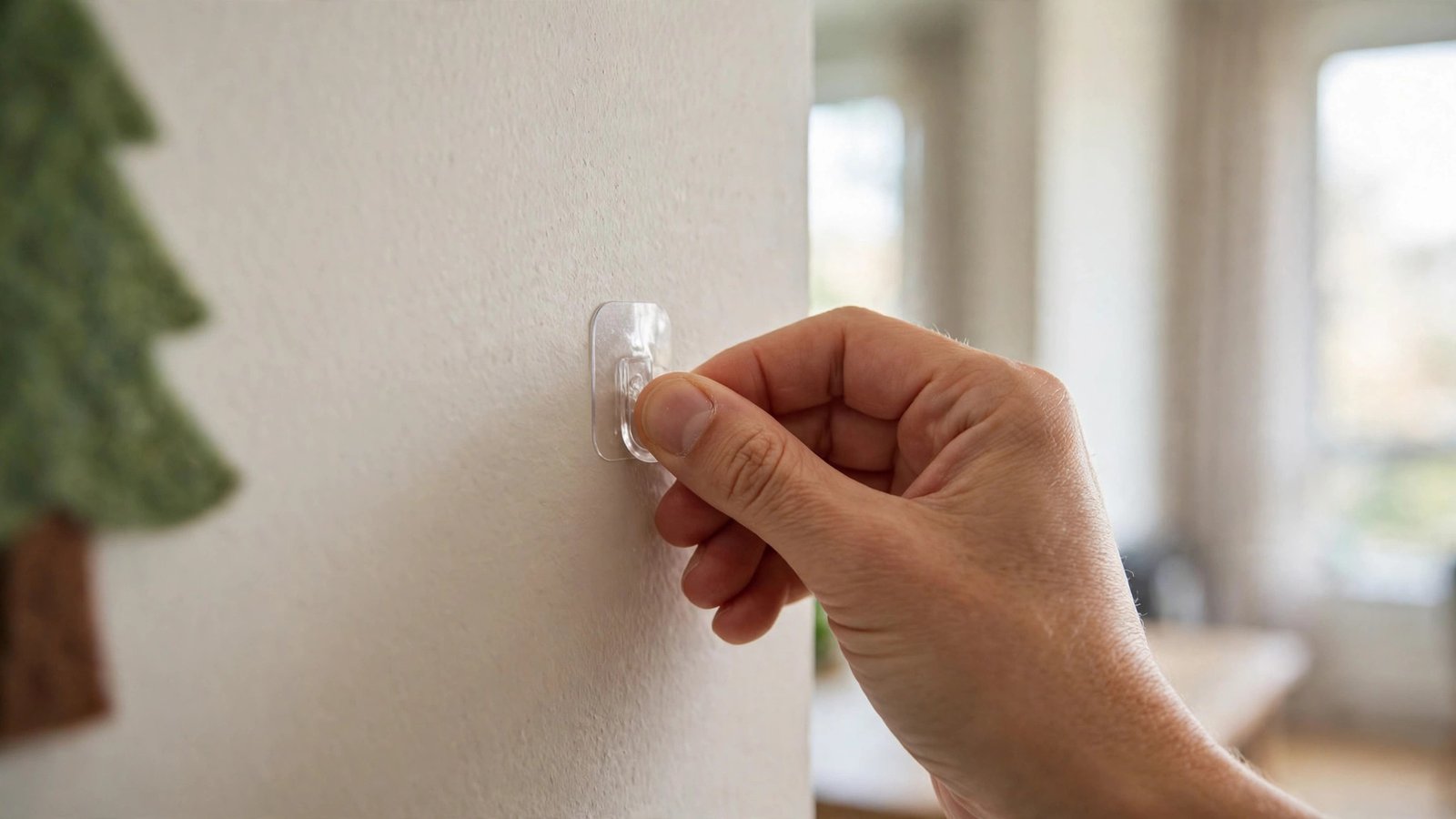
Not all damage-free methods are equally damage-free. The ranking below runs from lowest to highest removal risk on a typical smooth painted drywall wall. Your wall type changes the order — see the next section — but this is the baseline to work from.
| Method | How it holds | Removal risk on smooth painted drywall | Best for |
|---|---|---|---|
| Lean-and-rest (tree panel resting on furniture) | Gravity, with a small adhesive tab or two for stability | Lowest — barely touches the wall | Felt trees over a console or dresser |
| Light adhesive strips (small, low-weight rated) | Foam adhesive, removed by slow pull-tab stretch | Low when removed by the pull tab, not peeled | Felt and fabric trees |
| Adhesive hooks (removable type) | Hook on an adhesive pad, rated by weight | Low to moderate — risk rises with weight and time left up | Branch-and-light trees, garlands |
| Tension-mounted frame or rod | Pressure between floor and ceiling or between two walls | Low on the wall itself, but can scuff ceilings or floors | Narrow spaces with no usable wall |
| Washi or painter’s tape borders | Tape holding a flat panel or light string | Moderate — tape left up for weeks can lift paint | Temporary outlines, light strings |
| Heavy-duty adhesive strips or mounting tape | Thick foam tape rated for heavier loads | Highest — designed for permanent or semi-permanent hold | Avoid in rentals unless the wall is tile or glass |
Three removal habits matter more than the product you pick. First, follow the manufacturer’s removal instructions exactly — most removable adhesives are designed to be stretched slowly off the wall, and peeling them like a sticker is what damages paint. Second, remove adhesives at room temperature; a cold apartment in January makes adhesive brittle and more likely to take paint with it. Third, never stack two adhesives or double up strips to hold a heavier tree — if the weight needs a stronger product, change the tree style or the wall, not the adhesive.
5. Matching the Method to Your Wall Type
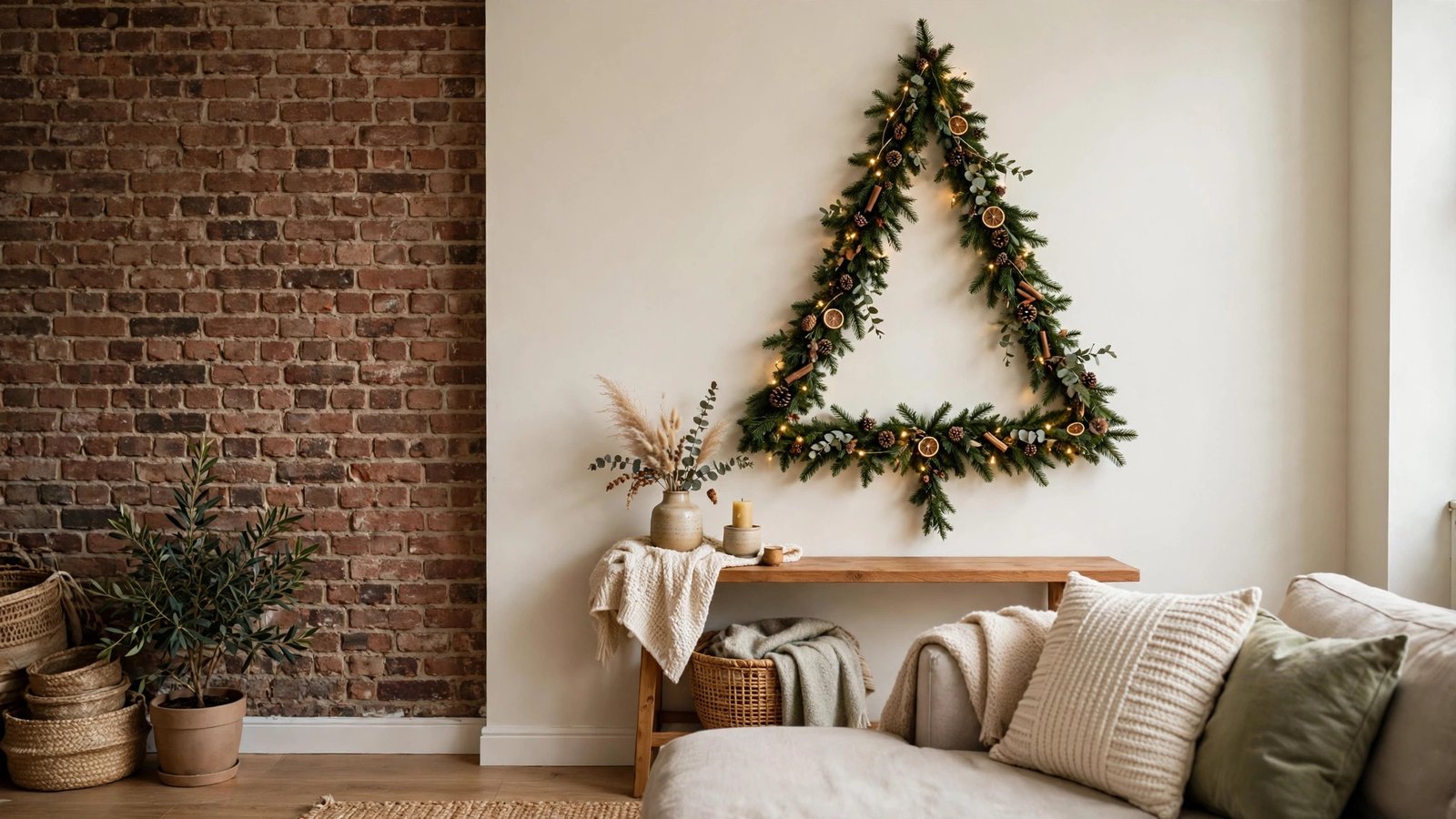
Smooth painted drywall. This is the friendliest wall for adhesive methods. Low-weight adhesive strips and removable hooks both work well, provided the paint is fully cured — paint needs roughly a few weeks to cure, so a freshly painted apartment is a reason to wait or to use a lean-and-rest felt tree. If your walls were painted right before move-in, ask your property manager when the paint went up.
Textured or plaster walls. Adhesive pads need a flat contact area, so heavy texture and rough plaster reduce grip. Light felt trees may still hold with several strips spread across the top, but branch-and-light trees are a gamble — hooks can pop off overnight as the adhesive fails to grip the peaks and valleys. A tension-mounted frame or a tree hung from a picture rail, if your apartment has one, is often the better answer here.
Brick and concrete. Adhesives generally do not bond well to rough, dusty masonry, and heavy-duty tapes that do grip tend to leave residue. A wall tree on brick works best as a lean-and-rest panel on furniture against the brick, or hung from a tension rod spanning a nearby nook. Avoid drilling into brick in a rental — masonry anchors are among the hardest holes to repair invisibly.
Tile, glass, and metal. Smooth, non-porous surfaces are actually excellent for adhesive hooks and suction-style mounts, and removal risk is low because there is no paint to lift. A kitchen or bathroom-adjacent wall, or a glass door panel, can host a small felt tree or a light-string tree with minimal risk. Check that the surface is clean and dry before applying anything, since dust and grease are the main cause of adhesive failure on tile and glass.
Wallpapered walls. Treat wallpaper like paint that is harder to fix: low-weight strips only, and test in a hidden corner first. If the wallpaper is already peeling at the edges, skip adhesives on that wall entirely and use a lean-and-rest or tension option.
6. Decorating So It Reads Like a Tree

A flat tree lives or dies on its outline. The single most effective decorating step is a clear, symmetrical triangle outline in lights or garland — the eye reads a triangle with a trunk as a tree almost automatically, even when there is no depth. Start with the outline, then fill inward, rather than scattering ornaments across a flat panel and hoping a shape emerges.
Keep ornaments light. Heavy glass ornaments pull a felt tree forward and stress adhesive points; lightweight felt, paper, foam, or plastic ornaments are the right scale for a wall tree. On a branch-and-light tree, hang ornaments from the branches or garland itself, not from the wall, so the weight stays on the structure rather than on the adhesive.
A few finishing details punch above their weight. A small trunk shape at the bottom — a wrapped box, a short fabric panel, or a few stacked books — grounds the triangle so it does not float on the wall. A simple star or topper at the peak completes the silhouette. And a tree skirt is unnecessary on a wall tree; a small basket or wrapped box at the base does the same visual job without taking floor space you do not have.
Resist the urge to over-decorate. A wall tree is viewed from a few feet away in a small room, so a dozen well-placed ornaments read better than fifty crowded ones, and fewer ornaments mean less weight on every adhesive point.
7. Taking It Down and Storing It

Plan removal the way you planned hanging: slowly, one anchor at a time, following the adhesive manufacturer’s instructions. Remove ornaments and lights first so nothing pulls on the tree while you work. For pull-tab adhesives, stretch the tab slowly straight down along the wall rather than peeling outward. For hooks, remove the hook from the pad first, then remove the pad by its tab. If a pad resists, warm it gently with a hair dryer on a low setting for a few seconds — heat softens adhesive and lowers the chance of paint lifting.
Inspect the wall in daylight after everything is down. Small marks from adhesive pads often wipe off with a damp cloth; if paint did lift, photograph the spot before you try any touch-up, and check whether your lease requires you to report wall damage or simply repair it. Touch-up paint matched to your apartment’s paint color is usually available from your property manager, and a small, neat touch-up is far cheaper than a repaint charge at move-out.
Storage is where wall trees beat standing trees for small apartments. A felt or fabric tree folds flat into a drawer, a tote bag, or under a bed. A branch-and-light tree breaks down into garland coils and a light string that fit in a single storage bin. Label the bin with the tree style and the hook positions — a quick note about which wall and which method worked saves you the whole decision process next December.
FAQ
Can you hang a wall Christmas tree without nails in a rental?
Yes. Felt and fabric trees hang with low-weight adhesive strips or small adhesive hooks, and branch-and-light trees hang from a series of removable adhesive hooks. No nails or screws are needed, and most methods come down cleanly if you follow the adhesive manufacturer’s removal steps.
What is a flat Christmas tree for a wall?
A flat Christmas tree is a tree designed to sit flush against a wall rather than stand on the floor. Common types are felt tree panels, fabric tapestry trees, and garland or branch arrangements shaped into a triangle on the wall. They take no floor space and weigh far less than a standing tree.
Will adhesive hooks damage apartment walls?
On smooth, fully cured painted drywall, removable adhesive hooks and strips usually come off cleanly when removed by their pull tabs. Risk rises on freshly painted walls, textured or plaster walls, and wallpaper, and when adhesive is peeled off instead of stretched off. Always test in a hidden spot first.
Is a felt Christmas tree a good option for a small apartment?
Yes — felt trees are among the best wall-tree options for a studio or micro-apartment. They are lightweight, sit completely flat, fold away for storage, and hang with the lowest-risk adhesive methods. Their main trade-off is less depth and sparkle than a branch-and-light tree, which fairy lights help offset.
What is the best wall tree for a studio with no floor space at all?
A felt or fabric tree is the safest starting point, since it needs no floor space, weighs the least, and hangs with the lowest-risk methods. If you want a more tree-like look and your wall is smooth painted drywall, a branch-and-light tree on removable adhesive hooks is the next step up.
Can I hang a wall tree on brick or textured walls?
Adhesives grip poorly on rough brick and heavy texture, so hooks may fail or leave residue. On those walls, use a lean-and-rest felt panel on furniture, a tension-mounted frame, or a picture rail if your apartment has one, rather than relying on adhesive pads.
Conclusion

A wall Christmas tree rental home solution does not have to be a compromise — it can be the smartest tree for a small apartment, full stop. Pick the style that matches your wall, rank the hanging method by removal risk rather than by holding power alone, and decorate for the outline first. The result is a tree that looks like a tree, takes no floor space, and comes down in January without a deposit fight.
If this guide helped you choose, save it for next December — and pass it to another renter staring at a blank wall and an empty corner where a tree should be.

Maren started MyFirstLease after a rough first lease taught him everything the internet didn’t. He covers the logistical side of renting — move-in checklists, utilities, and the unglamorous first-week stuff nobody explains — and oversees everything published on the site.