

For a first-time renter decorating a small apartment for a first Christmas in your own place, renter friendly Christmas lights no nails are the difference between a festive December and a deposit dispute in January. Under a strict no-holes lease, nails, screws, and staples are off the table — but that still leaves plenty of ways to hang lights well, if the method matches the surface and the weight.
This guide is written for that exact renter: a small apartment, a strict lease, and no spare wall to patch. It works through weight ratings, surface-by-surface method matching, and a clean January takedown sequence, so the lights look intentional while they are up and leave nothing behind when they come down.
Direct answer: Use adhesive hooks or clips rated well above the strand’s weight, tension rods inside window frames, suction hooks on glass, and over-door or freestanding methods for doors and rails. Match the method to the surface, cure adhesives as directed, keep strands out of walkways, and remove everything in reverse order in January.
Executive Summary

Most no-nail light failures are not product failures — they are matching failures. A hook rated for a light strand on smooth paint will not hold the same strand on textured plaster, and a clip that grips a gutter will not grip a thin apartment balcony rail. The sections below start with the lease clause and the weight rating, because those two checks prevent most damage, then match a method to each surface: painted walls, windows and glass, balconies, doors, and rails.
You will also find practical guardrails throughout, including how to test an adhesive in a hidden spot, how to keep outdoor strands and connections dry, how to route cords so they are not a trip hazard, and how to take everything down in January without pulling paint. The goal is lights that stay up through December and a wall that looks exactly as it did in November when they come down.
1. Check the Lease First

The decorating or alterations clause is the first thing to read, not the last. Some leases ban nails and screws but allow removable adhesives; others restrict anything attached to walls, trim, moulding, or exterior surfaces, including the balcony and the outside of the front door. A product marketed as removable is not automatically permitted, and a hallway or exterior display may be governed by building rules as well as the lease.
Read the clause for three specifics: what it bans, whether it names adhesives or temporary attachments at all, and whether it covers balconies, windows, and common areas. If the wording is unclear, ask the landlord in writing before hanging anything, and keep the reply with the lease paperwork. That short message is also your protection if a later move-out inspection questions a mark: it shows the method was approved, not improvised.
Photograph walls, trim, window frames, and balcony rails before decorating, in daylight, from a few steps back. These before photos take five minutes and make any January comparison straightforward. If a surface already has a scuff or a faded patch, the photo proves it predates the lights.
2. Match Method to Surface
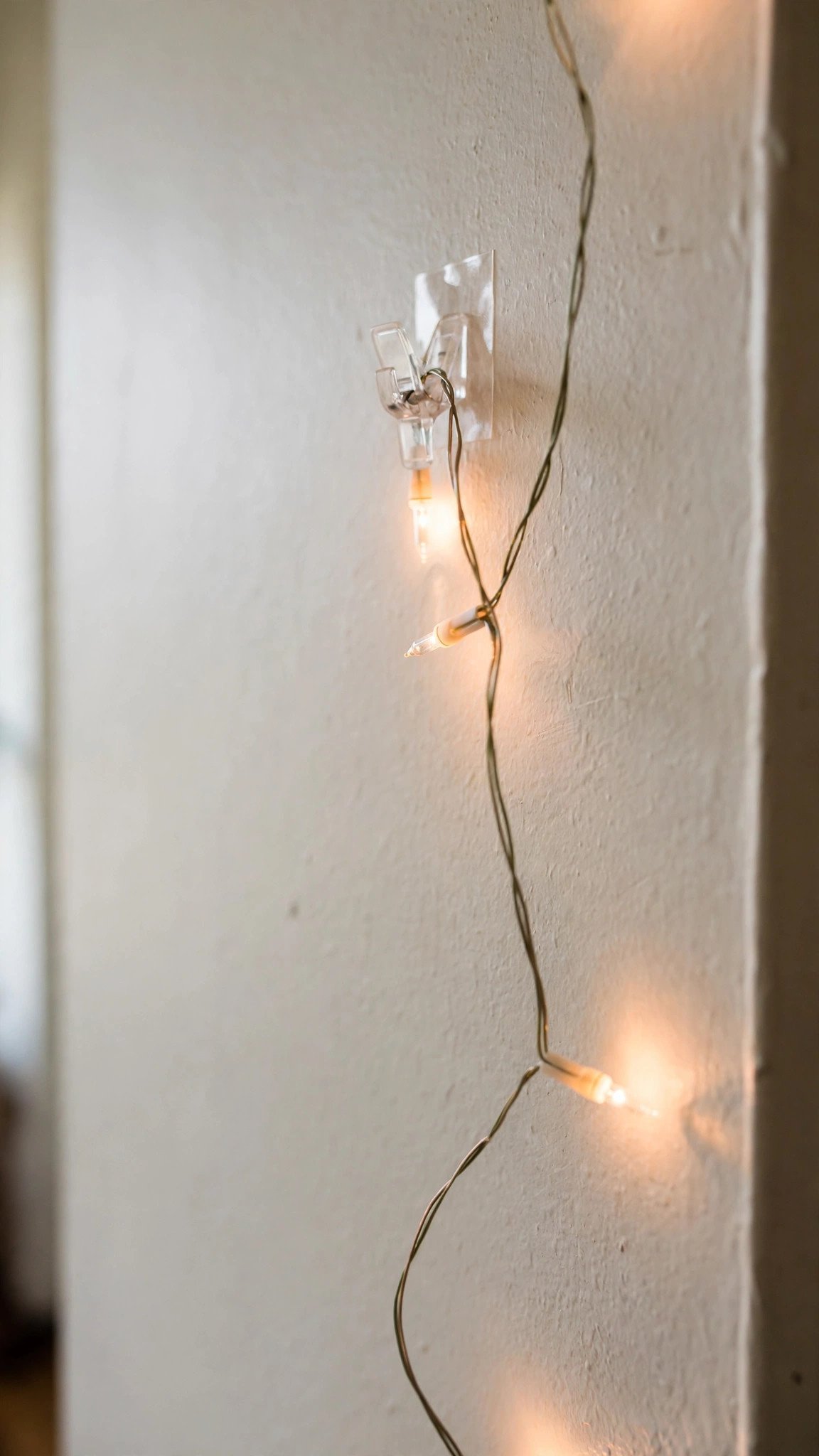
No single no-nail method works everywhere, and choosing by surface is the core skill of this guide. Smooth painted drywall suits adhesive hooks and clips; glass and tile suit suction hooks or adhesive hooks made for non-porous surfaces; window frames suit tension rods; doors suit over-the-door hooks; rails and banisters suit wrapping, clips made for that rail shape, or freestanding displays. Brick, heavily textured plaster, and rough concrete are the hardest surfaces for adhesives, and are often better served by a freestanding or tension-rod approach than by a stronger hook.
Test before committing. Put one hook or clip in a hidden spot — behind a door, low on a wall section hidden by furniture — and leave it under a similar weight for a day. If it holds and removes cleanly there, it is a reasonable candidate for the visible spots. If it slips or lifts paint in the hidden spot, that surface needs a different method, not a bigger hook.
Work surface by surface rather than buying one bulk pack and using it everywhere. A small apartment usually needs only a few methods: adhesive hooks for one wall run, a tension rod for a window, suction hooks for glass, and an over-door hook or rail clips for the entry or balcony. Fewer methods, each matched correctly, hold better than a dozen improvised ones.
3. Read the Weight Rating

Every adhesive hook and clip carries a weight rating on its packaging, and that number is the starting point, not a target. A strand of lights, a garland, and a clip together weigh more than the strand alone, and weight grows when strands are doubled up, draped with ornaments, or pulled taut around a corner. Staying well under the rating leaves margin for that extra weight, for temperature changes near a window, and for the slow creep that can loosen an adhesive over weeks.
Estimate before hanging. Hold the full run — strand, clips, and anything attached to it — in your hand, or weigh it on a kitchen scale if the rating is close. Then divide the load across more hooks rather than fewer: hooks spaced closer together each carry less, and the run sags less. A sagging run is not just untidy; it concentrates weight on the end hooks and increases the chance one pulls free.
Check the rating conditions too. Many ratings assume a clean, smooth, room-temperature surface and a full curing time before loading. A cold window, a dusty wall, or a hook loaded minutes after sticking can all reduce holding power below the printed number. If the packaging gives a temperature range, a surface type, or a cure time, treat those as part of the rating, not fine print.
4. Adhesive Hooks That Hold

Adhesive hooks work best when the preparation is boring and thorough. Clean the spot with a damp cloth, let it dry completely, and avoid cleaning products that leave a residue. Press the hook firmly for the time the packaging states, then wait the full curing time — often an hour or more — before hanging anything. Loading a hook early is the most common reason a run falls down overnight.
Space hooks so the strand rests rather than stretches. For a straight wall run, place hooks close enough that the wire between them dips only slightly; for a swag or scallop, place a hook at each high point and let the wire drape naturally between them. Do not pull the strand taut to reach the next hook — that tension works against the adhesive all month. Where the run turns a corner, add a hook at the corner itself rather than bending the wire sharply around it.
Use clips, not just hooks, where the strand needs to stay put. Adhesive light clips grip the wire and keep spacing even, while a plain hook lets the wire slide and bunch. Keep adhesive hooks off wallpaper, freshly painted walls, and crumbling or flaking paint, where removal is far more likely to lift the surface. If a wall already shows peeling paint, skip adhesives there entirely and use a freestanding or tension-rod display instead.
5. Windows Without Tape Damage

Windows give a big festive return in a small apartment, but tape on frames and glass is one of the fastest routes to residue and paint damage. A tension rod fitted inside the window frame avoids the frame entirely: lights can drape from the rod, hang in vertical drops, or support lightweight ornaments at staggered heights. Measure the frame width before buying, and choose a rod that holds by tension alone, without screws or brackets.
For the glass itself, suction hooks made for smooth surfaces are the safer choice. Clean the glass, press out air as directed, and keep the load light — a single strand or a few lightweight ornaments, not a heavy garland. Suction holds less reliably on cold glass or in direct sun, so check the hooks in the first day and again after a cold night. If a suction hook keeps releasing, that window needs a tension rod or a freestanding display instead.
Keep lights off the window frame’s painted edges and out of the path of curtains. A strand trapped behind a curtain can trap heat against fabric, and a strand taped to a frame will usually leave residue that needs scraping. A tension rod set a few inches inside the frame, with lights hanging free of the curtain, gives the same glow without either risk.
6. Balcony Lights, Renter Safe

A balcony can carry lights without a single hole, provided the method fits the rail and the weather. Rail clips made for the rail’s shape, wrapping a strand loosely around a rail, or a freestanding planter or lantern display all avoid drilling into railings, walls, or balcony floors. Check the lease and building rules first: some buildings restrict balcony displays, exterior attachments, or anything visible from outside, even when it is technically removable.
Use lights rated for outdoor use on a balcony, and keep plugs, connections, and timers sheltered from rain and standing water. Run the cord through the door in a way that does not pinch it in the door frame or leave it where it can be tripped over, and do not run an indoor-rated extension cord outside. If the balcony has no outdoor outlet, a battery-operated strand or a display kept just inside the sliding door is a safer choice than a long cord stretched across a walkway.
Weight matters outdoors more than indoors. Wind moves a loose strand, and that movement works on clips and hooks over time. Keep outdoor runs short, secure them at more points than an indoor run, and check them after the first windy night. Take balcony lights down before a storm if the forecast is severe, rather than trusting clips to hold through it.
7. Doors, Rails, and Frames

Doors and interior rails are useful anchor points precisely because they need no wall attachment at all. An over-the-door hook on the inside face of a door can hold a light wreath or a short strand, and a garland or strand can drape over a banister or a stair rail and be secured with ties or clips that wrap rather than stick. Because nothing is glued or nailed, these methods also remove in seconds in January.
Keep the door’s function intact. A wreath or strand on a door should not block the door from closing, catch on the frame, or hang so low that it brushes the floor and gets stepped on. On a stair rail, keep lights on the side away from the hand grip, so the rail remains usable, and keep cords out of the stair path. A display that forces people to duck or step over a cord is a hazard, however festive it looks.
For door frames themselves, a tension rod across the inside of a doorway or a freestanding frame display can carry lights without touching the trim. Avoid adhesive hooks on door trim and moulding, which is often painted, narrow, and more prone to chipping on removal than a flat wall. If a frame display needs support, a rod or a freestanding piece is usually the cleaner choice.
8. Keep Strings From Sagging

A sagging strand is usually a spacing problem, not a product problem. Hooks placed too far apart let the wire dip, and each dip pulls harder on the neighbouring hooks. Shortening the gap between hooks, adding a hook at each dip, or splitting one long run into two shorter runs with separate power sources usually fixes the sag without any new product.
Route the strand before fixing hooks permanently. Lay the run along the floor in the shape it will take, mark hook positions lightly with a removable marker or a small piece of painter’s tape that will be removed, and check that the plug reaches the outlet without stretching. A run that ends a few inches short of the outlet tempts a stretched cord; a run planned with slack at the plug end avoids it.
Keep cords out of walkways, door swings, and the space in front of heaters and radiators. Where a cord must cross a floor, run it along a wall edge and secure it with a cord cover or a rug edge that does not create a new trip edge. Use a timer or a switched outlet so lights are not left on unattended for long stretches, and check plugs and cords for warmth, fraying, or damage before the season and again midway through December.
9. Damage Traps to Avoid

Several common shortcuts cause most no-nail damage. Clear packing tape, duct tape, and masking tape left on paint for weeks can lift paint or leave residue that needs scraping; they are not substitutes for adhesive hooks. Nails, pins, and staples, even small ones, are holes under most leases, and a pinhole in a prominent wall is still a hole at move-out. Overloading one hook with a garland, a strand, and stockings concentrates weight that the rating never covered.
Heat and time are quieter traps. A strand left pressed against a curtain, a lampshade, or a paper decoration can warm that material, so keep lights clear of fabric and paper and never leave candles and lights competing for the same crowded surface. Adhesives left up far beyond the season can bond more firmly and remove less cleanly, so January removal matters as much as December hanging — a hook removed on schedule is usually a hook removed cleanly.
Finally, avoid hanging weight overhead. Ceilings, heavy garlands above seating, and strands suspended across a room need support the wall methods in this guide are not designed for. If a display needs to hang overhead, a freestanding frame, a tension rod, or a tabletop display is the safer redesign, not a stronger adhesive.
10. January Takedown, Step by Step

Takedown works best in reverse order, and slowly. Start with ornaments and loose decorations, then lights and garlands, then textiles, and leave adhesives until last, when the wall is clear and each hook can be removed with full attention. Working in reverse means nothing is tugging on a hook while you are trying to remove it, and nothing falls on a display you have already packed.
Remove each adhesive exactly as its packaging directs — usually a slow, straight pull on the tab, parallel to the wall, rather than a yank outward. If a tab breaks or a hook resists, warm it gently with a hair dryer on a low setting and try again, rather than forcing it or scraping it off. Check every wall, corner, and trim piece in daylight after removal, and compare with the before photos taken in December.
Pack as you go, strand by strand, winding each strand loosely around a piece of cardboard or a spool so it does not tangle for next year. Label the storage box with the room and the method — for example, “living room window, tension rod” — so next December starts with the method that worked, not a fresh round of guessing. Return swapped textiles and furniture to their usual places, and store hooks and clips that are still in good condition with the lights they belong to.
FAQ
Can I hang Christmas lights in a rental without nails?
Yes. Adhesive hooks and clips on suitable smooth surfaces, tension rods inside window frames, suction hooks on glass, over-the-door hooks, and freestanding displays cover most apartment needs without nails, screws, or holes. Match the method to the surface and stay well under each product’s weight rating.
What are the best adhesive hooks for Christmas lights in a rental?
The best choice is a hook or clip rated well above the weight of the strand it will carry, made for the surface it will stick to — smooth painted walls, or glass and tile for non-porous surfaces. Test one in a hidden spot first, clean the surface, wait the full curing time before loading it, and avoid adhesives on wallpaper, fresh paint, or peeling paint.
How do I hang Christmas lights on a balcony without drilling?
Use rail clips made for the rail’s shape, wrap a strand loosely around the rail, or use a freestanding display. Use lights rated for outdoor use, keep plugs and connections sheltered from rain, and check building and lease rules about balcony displays first. Keep outdoor runs short and well secured, and check them after the first windy night.
How do I remove Christmas lights without wall damage?
Remove decorations first, then take adhesives off last, following each product’s removal instructions — usually a slow, straight pull on the tab rather than a yank. Warm a resisting hook gently with a hair dryer on a low setting and try again. Photograph walls after removal and compare with before photos taken in December.
Will adhesive hooks damage paint in an apartment?
They can if they are overloaded, left up for a very long time, or pulled off incorrectly, and they are riskier on wallpaper, fresh paint, or peeling paint. Test one in a hidden spot, stay well under the weight rating, follow the removal instructions precisely, and remove them on schedule in January.
Can I use a tension rod for Christmas lights in a window?
Yes. A tension rod fitted inside the window frame can support draped lights or lightweight hanging ornaments without touching the frame or the wall. Measure the frame width first, keep the load light, and keep lights clear of curtains and out of the window’s opening path.
What should I check before hanging lights outside my apartment?
Check the lease and building rules for balcony and exterior displays, confirm the lights are rated for outdoor use, and plan how the cord reaches power without crossing a walkway or pinching in a door. Keep plugs and connections dry, and avoid running an indoor-rated extension cord outside.
Lights Up, Walls Intact

No-nail Christmas decorating in a small rental comes down to three habits: read the lease first, match the method to the surface and the weight, and take everything down slowly in January, in reverse order. Get those right, and renter friendly Christmas lights no nails become a seasonal accent rather than a deposit risk — bright through December, and gone without a mark when the new year starts. Photograph your space before you begin, test one hook in a hidden spot, and let a well-matched method do the work a nail used to do. Save this guide for decorating weekend, and start with the lease clause and the weight rating before you hang a single strand.

Maren started MyFirstLease after a rough first lease taught him everything the internet didn’t. He covers the logistical side of renting — move-in checklists, utilities, and the unglamorous first-week stuff nobody explains — and oversees everything published on the site.