
Signing your first housing lease in the United States is an exciting milestone, but navigating the American rental market involves unfamiliar legal structures, financial jargon, and strict documentation standards. For newcomers, understanding how a residential agreement works is essential to securing safe housing, protecting your personal finances, and avoiding costly legal disputes with property management companies or private landlords.
This comprehensive guide breaks down the essential aspects of renting in the US, designed specifically for international professionals, students, and relocating families. From establishing financial eligibility without a standard US credit score to identifying predatory clauses hidden in fine print, these insights provide actionable clarity so you can sign your rental contract with complete confidence.
Executive Summary

Renting an apartment in the United States differs substantially from rental practices in most other countries. The process relies heavily on standardized background screenings, rigid credit verification systems, and formal contracts that place specific legal liabilities on tenants. This guide provides twenty detailed, practical points covering every stage of the leasing lifecycle: preparing acceptable identity and income documentation, navigating financial vetting when you lack a Social Security Number (SSN), understanding mandatory upfront deposits, and deciphering complex lease clauses.
Beyond the initial paperwork, this guide addresses ongoing tenant responsibilities and legal protections under United States federal and state housing laws. You will find actionable advice on utility setups, tenant rights against unlawful eviction or discrimination, security deposit recovery, and move-in inspection protocols. By following these clear, standardized guidelines, immigrants can navigate the US rental ecosystem smoothly while establishing a secure foundation for their new life.
[EDITOR’S PICK: “If there is one non-negotiable step every newcomer must take, it is conducting an exhaustive, photo-documented move-in inspection before unpacking a single box. Many international renters assume normal wear and tear is understood informally, only to lose substantial security deposit funds when moving out due to pre-existing wall scuffs or appliance marks. Documenting every imperfection on day one provides definitive legal protection under US tenancy laws.”]
Key US Lease Terminology and Standard Practices
| Term / Concept | Standard US Practice | What Immigrants Should Watch For |
| Security Deposit | Usually equal to 1–2 months’ rent, held in escrow. | State laws cap deposits; deductions must be itemized in writing upon move-out. |
| Credit Verification | Landlords run FICO scores via Equifax, Experian, or TransUnion. | Alternative screening (bank statements, foreign credit via specialized services, ITIN) must often be requested. |
| Joint & Several Liability | All roommates are collectively and individually responsible for 100% of rent. | If a roommate stops paying, the landlord can legally demand the full rent amount from you. |
| Renter’s Insurance | Required by most corporate landlords ($100k liability minimum). | Landlord property insurance covers only the building structure, never your personal belongings. |
| Lease Term | Standard 12-month fixed contract; auto-converts or ends. | Notice of non-renewal (often 30–60 days) is strictly enforced even at the natural end date. |
1. Understanding Legal Terminology

A US residential lease is a legally binding contract that outlines the rights and obligations of both the property owner (landlord or lessor) and the occupant (tenant or lessee). While overseas rental transactions are sometimes settled through informal verbal agreements or simple memorandums of understanding, American property law treats every written clause in a housing lease as strictly enforceable in civil court.
Familiarize yourself with foundational terms commonly found in standard contracts:
- Lessee / Tenant: The individual(s) authorized to occupy the premises and legally responsible for paying rent.
- Lessor / Landlord: The property owner, property management company, or authorized leasing agent.
- Premises: The physical apartment, condo, or house, including assigned storage units, parking stalls, and private patios.
- Term: The exact duration of the agreement, including the specific start date (commencement) and end date (expiration).
- Default: A failure to uphold any part of the agreement, such as non-payment of rent or unauthorized subletting, which can trigger legal eviction proceedings.
Before signing, review every page thoroughly. Never sign an agreement containing blank fields or sections that state terms will be “determined later.” Every financial and behavioral obligation must be fully specified in writing.

In the United States, landlords routinely run credit checks through major credit bureaus (Experian, TransUnion, Equifax) to assess an applicant’s reliability. Because credit history does not automatically transfer across international borders, newly arrived immigrants typically have no US credit score (often referred to as a “thin file” or “no credit file”).
To satisfy a landlord’s vetting process without a domestic credit history:
- Provide Proof of Employment and Income: Submit a formal employment offer letter on corporate letterhead stating your job title, start date, and gross annual salary.
- Submit Bank Statements: Provide certified statements from your US bank account, or translated statements from international accounts demonstrating sufficient liquidity (often 3 to 6 months of living expenses).
- Use an Individual Taxpayer Identification Number (ITIN): If you do not yet possess a Social Security Number (SSN), ask the leasing office if their screening portal accepts an ITIN or passport number for identity verification.
- Leverage Specialized International Credit Scoring: Some modern property management platforms partner with cross-border credit verification services that translate credit histories from select countries into US equivalents.
Be aware that having no credit history is fundamentally different from having bad credit. Clearly communicate your status as a recent international relocation early in the conversation so the leasing agent can apply their designated alternative screening criteria.
3. Upfront Financial Obligations

The initial financial layout required to secure an apartment in the United States goes beyond the first month’s rent. Property owners require multiple upfront payments before handing over the keys.
+-----------------------------------------------------------------------+
|                       TYPICAL MOVE-IN COST STACK                      |
+-----------------------------------------------------------------------+
|  [Application Fee]   $30 - $75 per adult (Non-refundable screening)   |
|  [Administration Fee]$100 - $300 (One-time processing fee)            |
|  [First Month's Rent]Full month or prorated amount based on move-in   |
|  [Security Deposit]  Equivalent to 1 to 2 months' rent (Refundable)   |
|  [Last Month's Rent] Optional depending on state law & credit status  |
|  [Pet Fee / Deposit] $200 - $500 initial + $25 - $75 monthly pet rent |
+-----------------------------------------------------------------------+
Plan your initial capital allocation accordingly. In competitive metropolitan markets, standard move-in costs frequently equal two to three times the monthly rent amount.
4. Understanding Co-Signers and Guarantors

If an applicant does not meet standard income thresholds (usually earning gross income equal to 3 times the monthly rent) or lacks a domestic credit profile, landlords may require a lease guarantor or co-signer. A guarantor is a third party who legally agrees to pay the rent and any associated damages if the tenant defaults.
Individual vs. Institutional Guarantors
- Individual Guarantors: Most landlords mandate that individual co-signers reside within the United States, earn 4 to 5 times the monthly rent, and maintain a high domestic credit score. For recent immigrants without local family, finding a qualifying individual co-signer is often difficult.
- Institutional Guarantor Services: Many rental communities accept third-party surety companies. Under this model, the tenant pays an upfront, non-refundable fee (typically 50% to 100% of one month’s rent) to an approved commercial guarantor company, which acts as the legal guarantor on the lease.
When researching apartments, inquire directly whether the property accepts institutional guarantor companies if you anticipate needing co-signer support.
5. Security Deposit Regulations

A security deposit functions as financial collateral to protect the landlord against unpaid rent, property damage beyond normal wear and tear, or breach of contract. State and municipal laws govern how these funds must be handled, and regulations vary significantly by jurisdiction.
Key Legal Protections for Tenants
- Escrow Accounts: In many states, landlords are legally required to hold tenant security deposits in a dedicated, interest-bearing escrow account separate from their personal or operating business funds.
- Statutory Limits: Multiple states place strict caps on security deposits, restricting them to one or two months of rent.
- Return Deadlines: Landlords must return the remaining deposit within a legally defined window after move-out (ranging from 14 to 60 days depending on state statutes).
- Itemized Deductions: Landlords cannot arbitrarily withhold deposit money. They must provide an itemized, written statement listing every specific repair, accompanied by receipts or standard labor costs, showing why funds were deducted.
Never pay a security deposit in physical cash without an immediate, signed, physical receipt specifying the amount, date, and purpose of the payment.
6. Joint and Several Liability

When renting an apartment with roommates, partners, or colleagues, US leases almost universally contain a “Joint and Several Liability” clause. Understanding this legal construct is critical for anyone entering a shared housing arrangement.
Under joint and several liability, all signatories are treated as a single legal entity regarding financial and contractual obligations:
- If one roommate fails to pay their portion of the monthly rent, the landlord has the legal right to demand the full remaining balance from the other tenants.
- If one tenant damages the property or violates community rules, all tenants named on the agreement can be held financially liable or face eviction proceedings.
- If a roommate moves out early without being formally released by the landlord, the remaining occupants remain fully responsible for the entire lease amount.
If you choose to live with roommates, ensure you have strong interpersonal trust and consider drafting a separate, written roommate agreement outlining internal payment schedules, room assignments, and chore distributions.
7. Duration and Renewal Structures

Lease agreements in the US generally operate under one of two primary structural arrangements: fixed-term or periodic tenancies.
+------------------------------------+------------------------------------+
|         FIXED-TERM LEASE           |       MONTH-TO-MONTH LEASE         |
+------------------------------------+------------------------------------+
| Defined period (typically 12 mos)  | Renews automatically every 30 days |
| Rent rate is locked for full term  | Landlord can adjust rent with notice|
| Substantial fees for early break   | Greater flexibility to relocate    |
| Predictable housing costs          | Often carries higher monthly rent  |
+------------------------------------+------------------------------------+
Notice of Non-Renewal Requirements
A widespread misunderstanding among first-time US renters is assuming that a fixed-term lease naturally terminates on its end date without any communication. In the US, almost all fixed-term leases contain a clause requiring tenants to provide a written Notice of Intent to Vacate 30, 60, or even 90 days before the contract expires. Failing to provide this formal written notice in time can result in automatic renewal into a month-to-month lease at a significantly higher rate, or the forfeiture of your security deposit.
8. Rent Payment Workflows

US property management companies utilize structured, digital billing workflows for rental collection, moving away from paper checks or informal cash transfers.
Common Payment Channels
- Online Tenant Portals (ACH Transfer): Linking your US checking account directly to the management company’s online portal is the standard method. Direct bank transfers (ACH) usually carry zero or minimal transaction fees.
- Credit/Debit Card Payments: While convenient, portal payments via credit or debit cards often incur processing surcharges ranging from 2.5% to 3.5% per transaction.
- Cashier’s Checks / Money Orders: For your initial move-in costs, landlords frequently require certified funds (a cashier’s check purchased at your bank or a money order purchased at a post office/retailer) rather than a personal check, as certified funds cannot bounce.
Always review the lease terms regarding Grace Periods and Late Fees. In many states, rent is due on the first day of the month, with a grace period extending until the third or fifth day. If payment is received after the grace period expires, standardized late fees (either a fixed dollar fee or a percentage of the monthly rent) are automatically charged.
9. Renter’s Insurance Standards

A common point of confusion for international arrivals is the distinction between the landlord’s building insurance and renter’s insurance (HO-4 insurance). The landlord’s commercial policy covers only the physical structure of the building (roof, structural walls, common pipes). It provides zero financial coverage for a tenant’s personal property or individual liability.
Most corporate properties in the United States require tenants to purchase an active renter’s insurance policy prior to picking up their keys, specifying minimum liability thresholds (typically $100,000 in personal liability coverage) and naming the property management company as an “Interested Party” or “Additional Certificate Holder.”
Renter’s insurance generally covers three primary categories:
- Personal Property Protection: Reimburses you if your furniture, electronics, or clothing are damaged by covered perils such as fire, smoke, burst plumbing pipes, or theft.
- Personal Liability: Covers legal defense and medical expenses if a guest is injured inside your rented apartment.
- Loss of Use (Additional Living Expenses): Covers hotel bills, food costs, and temporary lodging if your apartment becomes uninhabitable due to a covered disaster like a fire or major pipe burst.
Renter’s insurance is generally affordable, typically costing between $12 and $25 per month depending on location and coverage limits.
10. Document Execution and Verification

When finalizing a lease agreement, understanding proper document execution standards prevents procedural delays and ensures the legal validity of the agreement.
In modern property management, the majority of lease agreements are signed digitally using encrypted electronic signature platforms. However, in private rentals, sublease arrangements, or international property dealings, physical document signing remains common.
+--------------------------------------------------------------------+
|                 NOTARY AUTHENTICATION WORKFLOW                      |
+--------------------------------------------------------------------+
| 1. Unsigned Document Presented to Commissioned Public Notary       |
| 2. Signer Proves Identity (Valid Passport, State ID, Driver's Lic) |
| 3. Document Signed in Direct Physical Presence of the Notary       |
| 4. Notary Applies Official Seal, Signature, and Commission Number   |
| 5. Transaction Recorded in Official Public Notary Journal          |
+--------------------------------------------------------------------+
When reviewing physical lease paperwork or related formal housing documents:
- Ensure that any official legal forms requiring notarization (such as specific guarantor forms or financial affidavits) are signed directly in front of a licensed notary public.
- Review standard examples of certified paperwork; a proper notarization includes the notary’s official commission name, state of commission, expiration date, and an embossed or ink-based notary seal.
- Keep high-resolution digital copies and clear photos of all executed agreements, including every addendum and signature page, securely stored in cloud storage for quick reference.
11. Maintenance and Repair Protocols

A residential lease explicitly divides maintenance duties between the landlord and the tenant. Understanding who is responsible for specific repairs ensures you do not incur improper charges or leave critical issues unresolved.
Landlord Responsibilities (Implied Warranty of Habitability)
Under US common law and statutory housing codes, landlords are legally obligated to maintain the property in a livable condition. This legal principle, known as the Implied Warranty of Habitability, requires the property owner to maintain:
- Structural integrity (weatherproof walls, roofs, windows, secure doors).
- Working plumbing systems, including running hot and cold water.
- Operational heating facilities (and air conditioning where mandated by local statutes).
- Safe electrical systems meeting local building codes.
- Sanitary common areas free from rodent or insect infestations.
Tenant Maintenance Responsibilities
Tenants are responsible for routine cleanliness and standard household upkeep, including:
- Replacing standard light bulbs and air filters.
- Promptly reporting leaks, plumbing drips, or electrical failures through formal maintenance portals.
- Preventing mold growth by utilizing ventilation fans in bathrooms and kitchens.
- Disposing of trash according to municipal and building guidelines.
- Repairing any damage caused directly by the tenant, household members, or visiting guests.
Always submit repair requests in writing through your landlord’s official portal to create a documented, time-stamped paper trail of maintenance issues.
12. Utility Setup and Metering
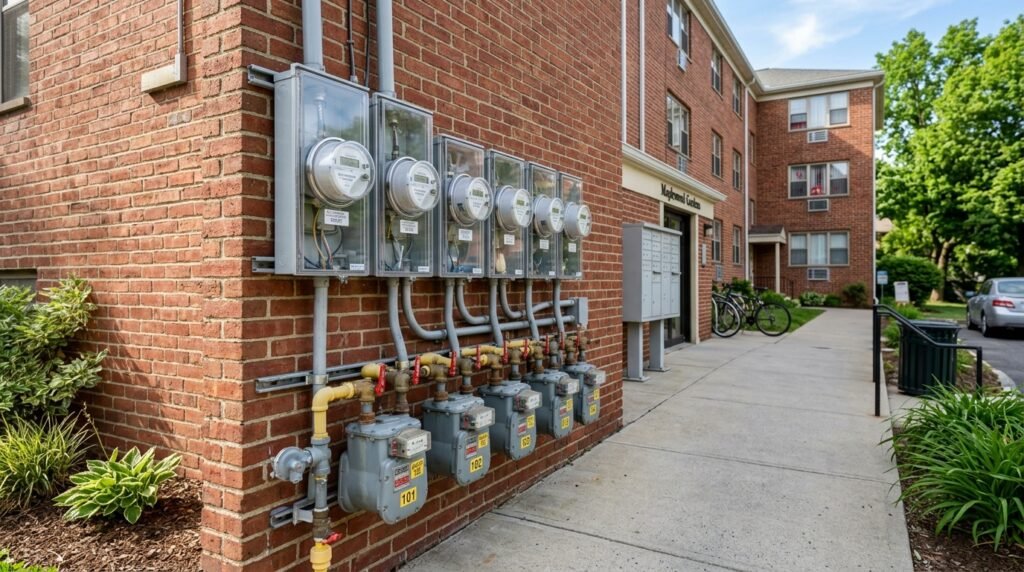
Do not assume that monthly rent covers all utility services. In the United States, utility structures vary widely depending on the age, architecture, and management style of the building.
+------------------+--------------------------------------------------+
| UTILITY TYPE     | COMMON BILLING ARRANGEMENT                       |
+------------------+--------------------------------------------------+
| Electricity      | Individually metered; tenant sets up direct acct |
| Natural Gas      | Individually metered or included in baseline rent|
| Water / Sewer    | Sub-metered or billed via RUBS allocation        |
| Trash Collection | Often paid by landlord or billed as a flat fee   |
| High-Speed Web   | Tenant selects and pays private service provider |
+------------------+--------------------------------------------------+
Understanding RUBS (Ratio Utility Billing System)
In older buildings lacking individual meters for every unit, landlords often use RUBS. Under this system, the entire building’s utility bill is divided among tenants using a mathematical formula based on the square footage of the apartment, the number of occupants, or a combination of both. When reviewing a lease, confirm whether utilities are sub-metered (measuring your actual personal consumption) or calculated through RUBS.
13. Establishing Home Connectivity

High-speed internet access is critical for remote employment, international communications, and entertainment. In the US, internet service is rarely pre-activated by the landlord; tenants must establish an account with a local Internet Service Provider (ISP).
When setting up your home network in a newly leased apartment:
- Check Provider Exclusivity: Ask the leasing office which ISPs service the property (e.g., fiber-optic networks vs. standard cable or 5G fixed wireless).
- Optimize Router Placement: Position your wireless router in a central, elevated location away from thick concrete walls, large appliances, or metallic shelving to ensure consistent signal coverage throughout all rooms.
- Implement Security Protocols: Change default administrative passwords on your ISP gateway, create a strong WPA3-secured Wi-Fi network name, and establish a separate guest network for visitors.
- Hardware Ownership vs. Rental Fees: Providers typically charge a recurring monthly rental fee ($10 to $15) for modem/router units. Purchasing an approved, compatible modem and router outright can save over $120 per year in recurring equipment fees.
Taking time to configure your network correctly during move-in week ensures dependable, secure connectivity for work and personal communications.
14. Guest Policies and Occupancy Rules

Most US residential agreements place specific restrictions on how long non-tenants can stay in the apartment. These restrictions exist to prevent unauthorized subletting and ensure compliance with local municipal occupancy codes.
Standard lease contracts typically define a guest as anyone staying on the premises for more than a specific number of consecutive nights (commonly 7 to 14 days) or a total number of days within a calendar year (e.g., 30 days). If a visitor remains beyond these thresholds without prior written consent from management, the landlord may deem that person an unauthorized occupant. This can trigger formal lease violations or require the visitor to undergo standard background checks and be added as a co-tenant.
If you anticipate hosting visiting family members from abroad for extended periods (such as parents visiting for two or three months), inform the property management team in advance to request a formal guest authorization letter or short-term visitor addendum.
15. Pet Regulations and Additional Fees

If you plan to bring or adopt a pet, the details of your lease contract require careful inspection. In the US, properties generally classify themselves as pet-friendly or non-pet-friendly, and living with an unapproved animal constitutes a direct breach of contract.
+--------------------------------------------------------------------+
|                     COMMON US PET FEE STRUCTURE                    |
+--------------------------------------------------------------------+
| 1. Pet Deposit: $200 - $500 (Refundable deposit for animal damage) |
| 2. Pet Fee:     $150 - $400 (One-time, non-refundable charge)      |
| 3. Pet Rent:    $25 - $75 per month (Recurring monthly surcharge)  |
+--------------------------------------------------------------------+
Breed and Weight Restrictions
Even pet-friendly communities frequently maintain strict guidelines regarding animal size and specific dog breeds (such as Pit Bulls, Rottweilers, German Shepherds, or Dobermans), often driven by the property’s commercial liability insurance requirements. Ensure your specific pet meets the weight and breed criteria outlined in the lease’s pet addendum before submitting your application.
Note: Legitimate Service Animals and Emotional Support Animals (ESAs) documented under US federal Fair Housing guidelines are exempt from standard pet fees and breed restrictions, though proper verification documentation must be formally submitted.
16. Early Lease Termination Clauses

Life circumstances can change unexpectedly due to employment relocations, family emergencies, or visa adjustments. Terminating a US lease prior to its contracted end date can result in heavy financial penalties if not handled correctly according to the lease terms.
Common Early Termination Frameworks
- Liquidated Damages / Early Buyout Clause: Many modern agreements include an explicit early termination option. This typically requires providing 30 to 60 days of advance written notice and paying an early termination fee equivalent to 2 months of rent.
- Duty to Mitigate Damages: In many US states, if a tenant breaks a lease without a buyout clause, the landlord has a statutory legal duty to make reasonable efforts to re-rent the property to a new tenant. The departing tenant remains financially responsible for the monthly rent only until a qualified replacement tenant moves in.
- Subletting and Lease Assignment: Check whether your agreement permits subletting (renting the apartment to another party) or lease assignment (transferring the contract to a new renter). Most leases strictly prohibit subletting without prior written consent from the landlord.
Never vacate an apartment and stop paying rent without a signed written agreement resolving the lease. Doing so can lead to civil judgments, debt collections, and severe damage to your emerging US credit score.
17. Fair Housing Rights

The US federal Fair Housing Act protects renters from discrimination based on race, color, national origin, religion, sex (including gender identity and sexual orientation), familial status (having children), or disability. State and municipal laws frequently add protections for source of income (such as housing vouchers) and immigration status.
Under federal law, landlords cannot:
- Refuse to rent to you simply because you are an immigrant or hold a foreign passport.
- Set different rental terms, charge higher security deposits, or require stricter credit thresholds solely based on your national origin.
- Steer you toward specific buildings or floors designated for international residents.
- Ask invasive questions regarding your national background, religious practices, or ancestry.
If you suspect you are experiencing unlawful discrimination during the application or leasing process, you can file a formal complaint with the US Department of Housing and Urban Development (HUD) or consult a local legal aid housing clinic.
18. Move-In Inspection Best Practices

The move-in inspection is your single most effective tool for protecting your security deposit. When you first receive the keys, do not begin moving furniture into the space immediately. Take time to document the exact condition of the unit.
+--------------------------------------------------------------------+
|                  MOVE-IN INSPECTION ACTION PLAN                    |
+--------------------------------------------------------------------+
| [ ] Test every electrical outlet and light switch                  |
| [ ] Check faucets, drains, and flush toilets for leaks/pressure    |
| [ ] Inspect stove burners, oven heating, and refrigerator temps    |
| [ ] Look for carpet stains, wood scratches, and tile cracks        |
| [ ] Test window locks, blinds, and exterior door deadbolts         |
| [ ] Take wide-angle photos and 4K video of every single room       |
| [ ] Submit signed Condition Checklist to landlord within 48 hours  |
+--------------------------------------------------------------------+
Maintain a duplicate copy of the completed and signed condition checklist, alongside timestamped digital photos, in a secure folder. When you eventually move out, these records serve as definitive evidence proving that pre-existing flaws were not caused during your tenancy.
19. Global vs. US Real Estate Differences

For immigrants accustomed to international real estate practices, American leasing norms present distinct functional differences. International residential transactions, especially in luxury markets, often operate on long-term multi-year tenancies, informal deposit returns, or tenant-managed internal modifications.
In the United States:
- Modifications are Strictly Regulated: You cannot paint walls, install new light fixtures, or drill extensive holes for wall mounts without written landlord approval. All alterations must typically be restored to their original condition prior to move-out.
- Formal Communication Channels: Verbal agreements with maintenance staff or building managers carry little legal weight. Every request, repair notice, or dispute must be documented in writing (via email or official portal systems).
- Subletting Restrictions: In many international cities, informal subletting during vacations is standard practice. In the US, listing your apartment on short-term rental platforms (like Airbnb) without explicit authorization is widely classified as a severe lease violation that can lead to immediate eviction.
Recognizing these cultural and procedural distinctions helps ensure a trouble-free rental experience across all types of US residential properties.
20. Essential Pre-Signing Review Checklist

Before affixing your signature to your first American lease agreement, execute a systematic final review of every page, addendum, and financial term.
+--------------------------------------------------------------------+
|                   PRE-SIGNING VERIFICATION CHECKLIST               |
+--------------------------------------------------------------------+
| [ ] Exact spelling of legal names matching passports/visas         |
| [ ] Correct rental unit number, storage unit, and parking space    |
| [ ] Accurate monthly rent figure and documented payment due dates  |
| [ ] Itemized security deposit and pet fee amounts clearly stated   |
| [ ] Explicit start (commencement) and end (expiration) dates       |
| [ ] Required advance notice period for move-out (30 vs 60 days)    |
| [ ] Clear breakdown of landlord-paid vs tenant-paid utilities      |
| [ ] All promised repairs or adjustments documented in an addendum  |
+--------------------------------------------------------------------+
Taking time to perform this final verification guarantees that both parties share an identical understanding of the contract, preventing misunderstandings and ensuring a smooth transition into your new home.
Frequently Asked Questions

Can I sign a US lease without a Social Security Number (SSN)?
Yes. Landlords cannot legally require an SSN as the only acceptable form of identification. International students and professionals can provide a valid passport, visa documents, Form I-20 or DS-2019, an Individual Taxpayer Identification Number (ITIN), or an official employer offer letter to verify identity and income.
What happens if I need to move back to my home country before my lease ends?
If you must relocate internationally before your lease expires, review your contract’s early termination clause immediately. You will typically be required to provide 30 to 60 days of written notice and pay an early termination fee (usually equivalent to two months of rent). Never abandon a lease without settling your balance, as landlords can forward unpaid debts to international collections and report defaults that affect future US visa or credit applications.
Can a landlord increase my rent whenever they want?
During a fixed-term lease (such as a standard 12-month agreement), the landlord cannot increase your rent unless an explicit clause in the contract permits mid-lease adjustments. Once the fixed term expires and converts to a month-to-month agreement, landlords can raise the rent by providing advance written notice (typically 30 to 60 days), subject to local and state rent control regulations.
What is the difference between an application fee and an administrative fee?
An application fee (typically $30 to $75 per adult) covers the direct cost of running background, eviction, and credit screening reports and is non-refundable. An administrative fee (ranging from $100 to $300) covers the internal overhead of drafting lease documents and preparing the apartment unit. In some instances, administrative fees are refundable if your application is formally denied.
How do I get my security deposit back after moving out?
To maximize your deposit return, complete a thorough move-out cleaning, patch small nail holes if permitted, restore any modified fixtures, and participate in a final walk-through inspection with the property manager. Ensure you provide your landlord with a formal forwarding address in writing so they can mail your itemized statement and refund check within the statutory deadline.
Are verbal agreements with the landlord legally binding?
While some verbal contracts can theoretically hold legal weight, almost all written US lease agreements contain an “Integration Clause” or “Entire Agreement Clause.” This clause explicitly states that the written contract supersedes all prior verbal statements, promises, or negotiations. If a leasing agent promises you free parking, new carpet, or a flexible move-out date, ensure that promise is written directly into the lease addendum before signing.
Conclusion

Securing your first housing lease in the United States requires navigating unfamiliar leasing terminology, understanding the mechanics of security deposits, and following structured tenant protocols. By carefully reviewing every clause, establishing clear communication with your property manager, and diligently documenting the condition of your home from day one, you can protect your rights and finances throughout your tenancy. If you found this guide helpful for your relocation journey, save this page for reference during your apartment search or share it with others preparing for their first US move.

Maren started MyFirstLease after a rough first lease taught him everything the internet didn’t. He covers the logistical side of renting — move-in checklists, utilities, and the unglamorous first-week stuff nobody explains — and oversees everything published on the site.