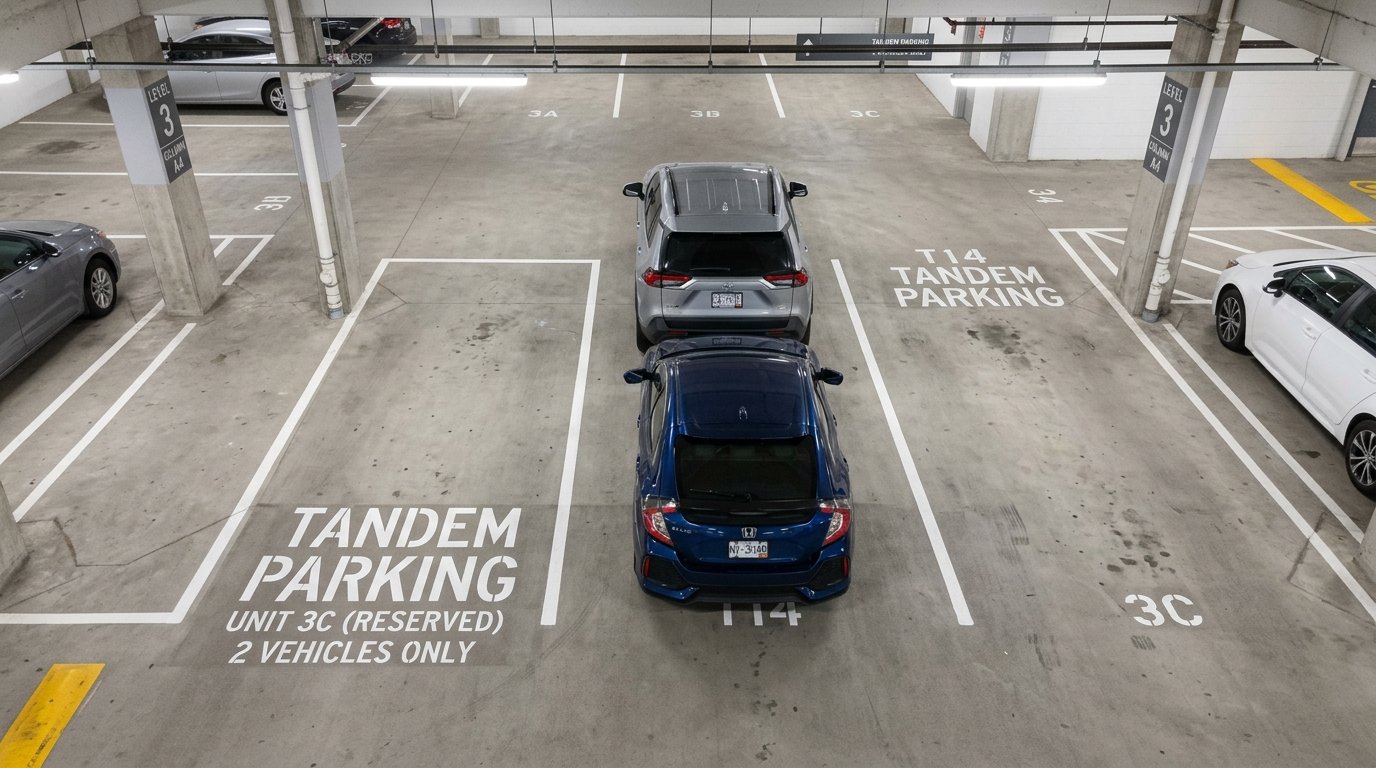
You’re scrolling through apartment listings, excited about a new place, and you see “tandem parking included”—what does that actually mean? Is it a good thing that will save you money? Or a nightmare waiting to happen on your very first morning commuting to work?
The problem is that most first-time renters don’t know what is tandem parking, and they often end up frustrated when they realize one car physically blocks the other. Without the right communication and setup, a great parking perk can quickly turn into a daily headache.
This guide explains exactly what tandem parking is, the real-world pros and cons for renters, how to manage it without ruining your relationship with your roommate, and what specific questions to ask your landlord before signing a lease.
Let’s start with the short answer, then dive into the details.
Quick Answer: What is Tandem Parking?
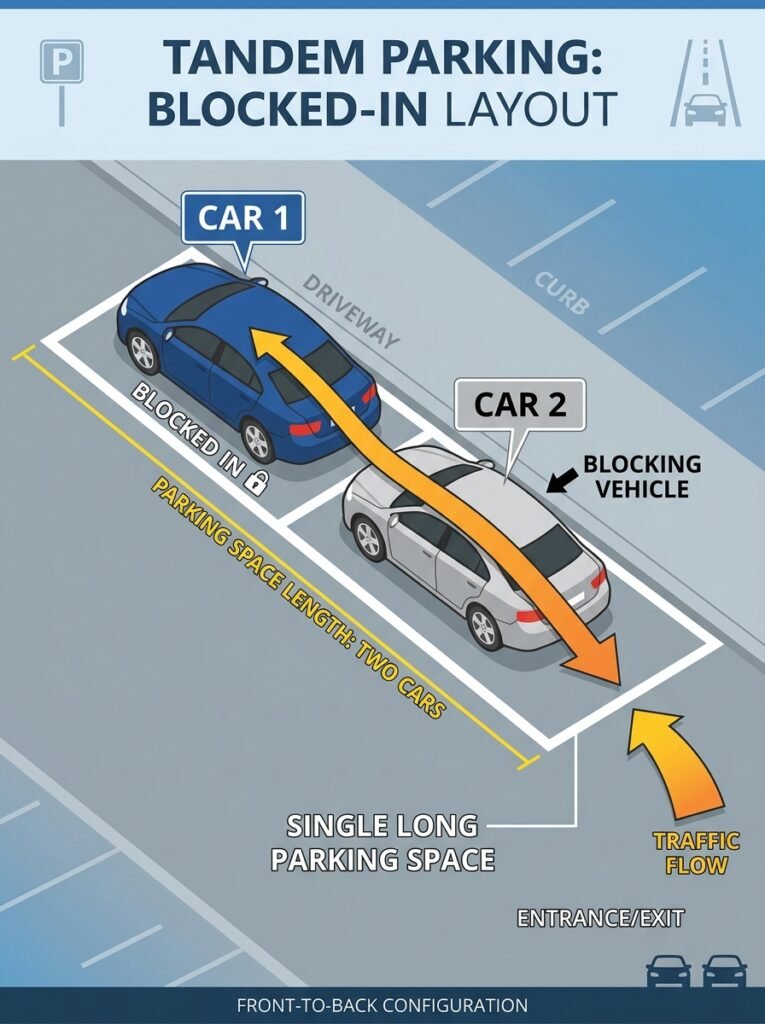
Tandem parking is a parking setup where two (or more) cars park in a single, elongated spot—one directly behind the other. Because of this layout, the first car to park is “blocked in” by the car behind it. If the person parked in the front needs to leave, the person parked in the back must move their car out of the way first.
Think of it like a standard residential driveway that fits exactly two cars. The car parked closest to the garage door cannot leave for work until the car parked closest to the street backs out.
While it might sound inconvenient at first glance, tandem parking is a highly common solution in densely populated cities, historic neighborhoods, and modern apartment complexes where square footage is at a premium.
Key Features of Tandem Parking:
- Two cars fit in one long space: It maximizes limited real estate in tight urban lots.
- Saves space in crowded apartment buildings: Allows landlords to offer parking to more tenants.
- Often cheaper than two separate spots: A budget-friendly perk for multi-car households.
- One car blocks the other in: The primary drawback that requires daily management.
- Requires coordination between drivers: Constant communication is non-negotiable for this setup to work.
Tandem Parking Visual Guide (What It Looks Like)
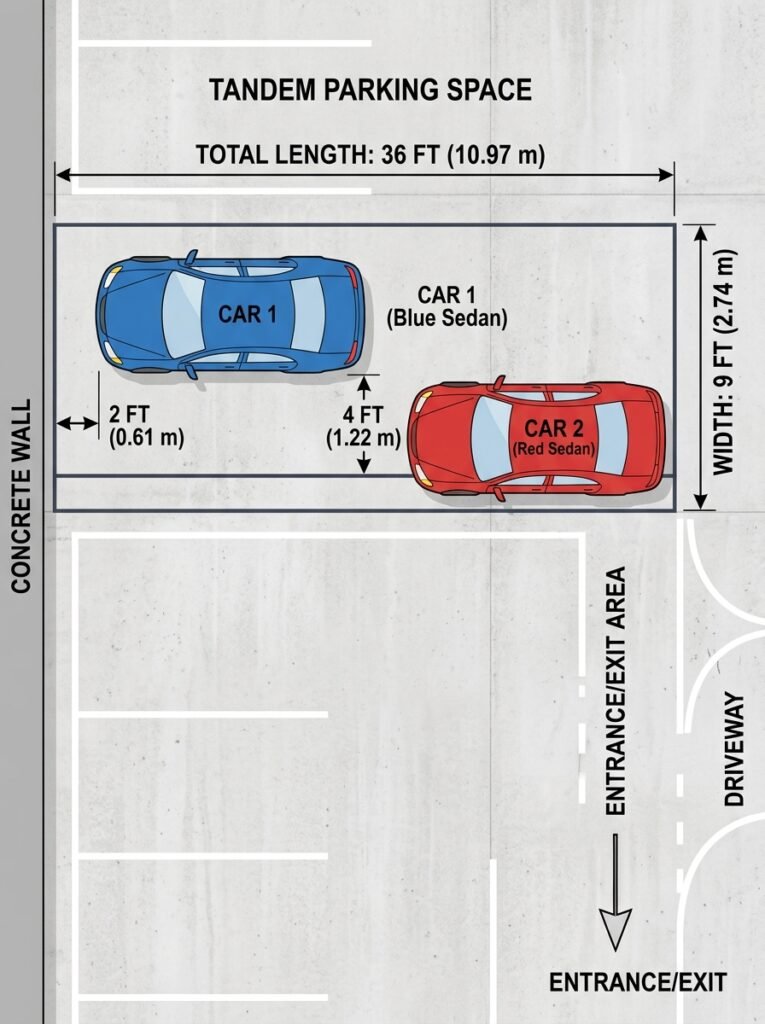
If you are touring an apartment complex, you can usually spot a tandem parking space immediately. Instead of the standard rectangular box meant for a single sedan, a tandem space looks like a painted runway.
Typically, these spaces are standard width but double the length. You will often see them tucked against structural walls in underground parking garages, or running alongside the edges of outdoor parking lots. In many luxury apartment buildings, tandem spaces are designated by numbers (e.g., “Spot 42A and 42B”), indicating that the long stripe of concrete belongs entirely to one apartment unit.
Pro Tip: Look closely at apartment listing photos before you even tour the unit. If you see cars stacked in a line rather than side-by-side, that’s tandem parking.
| Element | Description |
| Dimensions | Typically 9 feet wide x 36 feet long (fits 2 standard vehicles) |
| Layout | Cars are parked in a straight line, front-to-back within a single painted lane |
| Access | The rear car parks first (closest to the wall); the front car parks last |
| Location | Highly common in apartment garages, townhouses, and compact city lots |
Pros and Cons of Tandem Parking (For Renters)
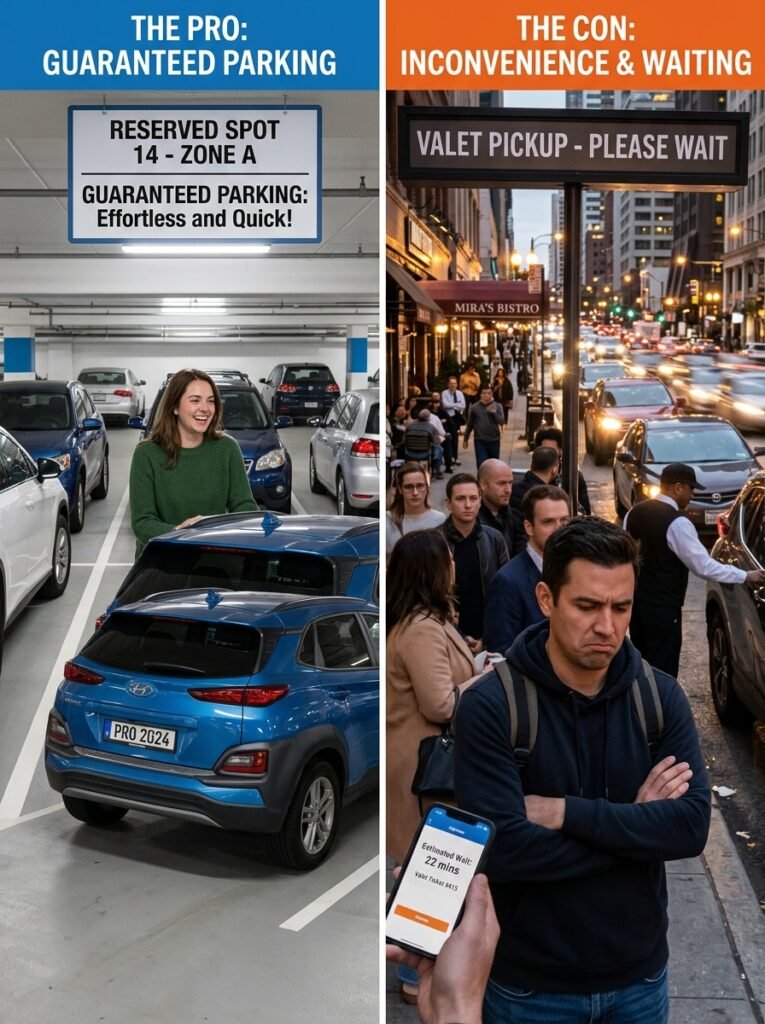
Before you write off tandem parking as a hassle, it is important to weigh the benefits against the drawbacks. For many renters, the financial savings far outweigh the mild inconvenience of having to shuffle cars around.
The Pros
The biggest advantage of tandem parking is cost. In major metropolitan areas like Los Angeles, New York, or Chicago, a single unassigned parking space can easily cost $200 to $400 per month. Renting two independent spaces could cost a household close to a thousand dollars just for parking. Tandem spaces are frequently offered at a heavily discounted rate—or sometimes included for free with the unit—because the landlord recognizes the inherent inconvenience.
Furthermore, tandem parking is guaranteed parking. If you work late shifts or enjoy going out on weekends, coming home to a guaranteed, off-street parking spot is an incredible luxury compared to circling the block for 45 minutes fighting for street parking.
| Pro | Why It Matters |
| Saves Money | Often significantly cheaper than renting two separate parking spots. |
| Saves Space | Allows apartment buildings to offer dedicated parking in crowded, high-density cities. |
| Guaranteed Parking | You never have to fight for street parking or worry about street-sweeping tickets. |
| Extra Security | Your car is often kept off the street in a secured garage or gated lot. |
| Two Spots for One Price | If you have two cars, it is the most cost-effective arrangement for a single household. |
The Cons
The primary downside is obvious: the blockade. If you are blocked in and your roommate is asleep, in the shower, or away from their phone, you are effectively stranded. This requires a level of coordination that can test even the best of friendships.
There is also the damage risk. Because you are constantly maneuvering around another vehicle in a tight space, the likelihood of minor fender benders, scratched paint, or bumped bumpers increases significantly. If you aren’t comfortable reversing or parallel parking, managing a tandem space daily can be stressful.
| Con | Why It Matters |
| One Car Blocks the Other | The car behind must move first, which can be highly inconvenient during busy mornings. |
| Requires Coordination | You need constant, reliable communication with your roommate or partner. |
| Hard to Leave in a Hurry | If the other person isn’t home and has the keys, you are physically stuck. |
| Potential for Disputes | Morning delays and daily frustration can easily lead to roommate arguments. |
| Damage Risk | Cars are parked close together in tight lots, increasing the risk of dings and scratches. |
Is Tandem Parking Right for You? (Decision Flowchart)
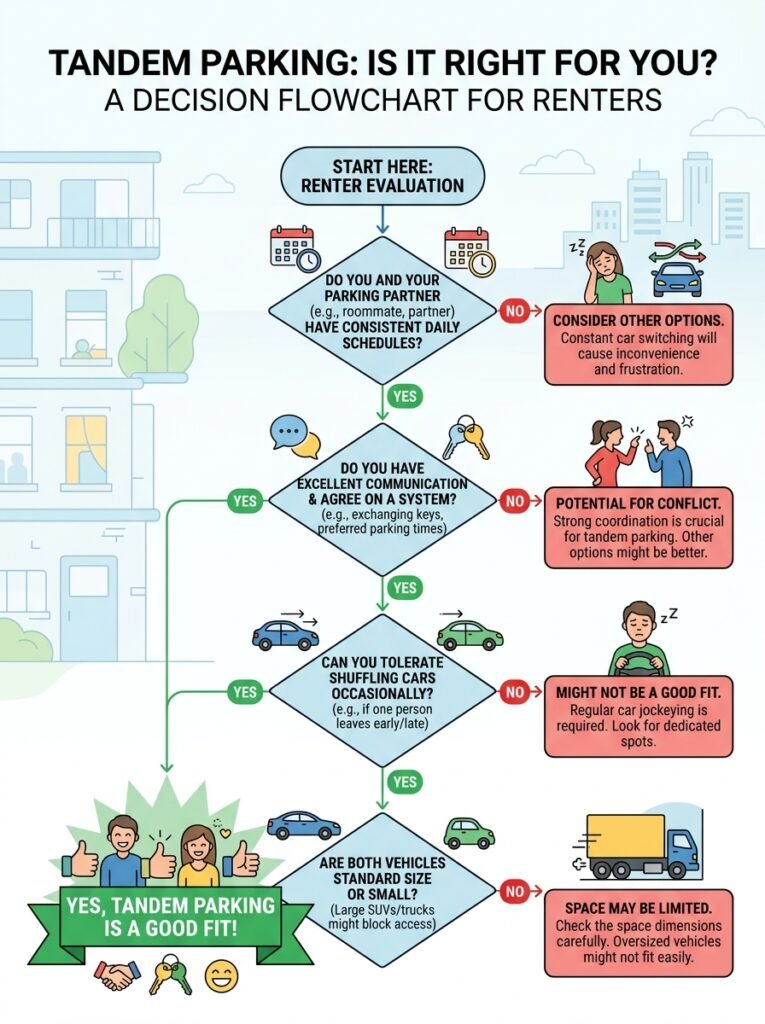
Tandem parking is heavily dependent on lifestyle. If you live alone and own two cars (perhaps a daily commuter and a weekend sports car), tandem parking is an absolute dream. You simply park the weekend car in the back and the daily driver in the front. No coordination needed.
Couples also tend to handle tandem parking well, especially if they share keys and are comfortable moving each other’s vehicles. Roommates, however, need to be brutally honest about their schedules and communication habits before agreeing to share a spot.
Use this decision matrix to figure out if your household can handle a tandem spot:
| Question | If Yes → | If No → |
| Do you and your roommate work similar hours? | Tandem parking will work well. | You’ll need to coordinate daily. |
| Do you own two cars? | Tandem is a highly cost-effective option. | You may not need the spot at all. |
| Are you good at communicating? | You’ll handle tandem parking just fine. | Consider independent street parking. |
| Do you need to drive often? | You will need to coordinate car shuffling. | You are perfectly fine with tandem. |
| Is parking expensive in your city? | Tandem is a great financial compromise. | Look for apartments with standard spots. |
Pro Tip: The “Golden Rule” of tandem parking is schedule alignment. If you both leave for work at 8:00 AM and return at 5:30 PM, tandem parking is incredibly easy. You simply leave at the same time. It only becomes a problem when one person works a 9-to-5 and the other works a night shift.
How to Manage Tandem Parking (10 Tips for Renters)
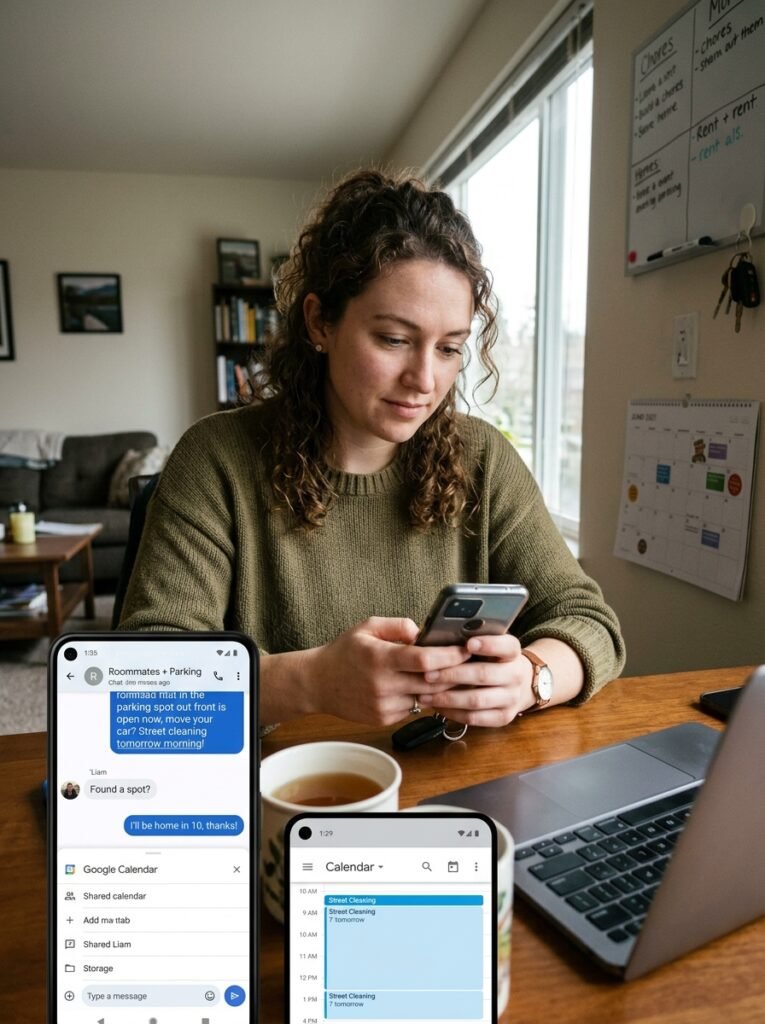
If you’ve decided to sign the lease and take the tandem spot, success comes down to systems. You cannot wing it. Hoping your roommate will magically be awake to move their car at 6:00 AM is a recipe for disaster.
Implement these ten strategies from day one to ensure a smooth, conflict-free parking experience:
| Tip | How to Do It |
| 1. Know Each Other’s Schedules | Share work hours, social events, and weekend travel plans days in advance. |
| 2. Create a Shared Calendar | Use Google Calendar or Apple Calendar to specifically track when each person needs their car. |
| 3. Set Up a Group Chat | Create a chat (WhatsApp, Telegram, iMessage) dedicated strictly to real-time parking updates. |
| 4. Agree on Parking Order | Decide firmly: the person who leaves earliest parks in the back (closest to the exit). |
| 5. Keep Spare Keys | If you trust your roommate, keep a spare key on a hook so they can move your car independently. |
| 6. Plan for Emergencies | Discuss exactly what to do if someone needs to leave unexpectedly for a medical emergency. |
| 7. Establish Communication Rules | Agree to respond within 5-10 minutes to any parking-related text messages. |
| 8. Be Flexible | Life happens—meetings run late, traffic builds up. Adjust to delays without getting angry. |
| 9. Label Your Keys | Keep keys labeled (e.g., “Honda” and “Toyota”) and accessible by the front door for quick swaps. |
| 10. Use Parking Apps | Utilize community apps (e.g., Parkade) if your apartment building supports digital spot management. |
What to Ask Your Landlord About Tandem Parking (Checklist)

Never assume anything about an apartment’s parking situation. Landlords have vastly different rules regarding how spots are assigned, maintained, and enforced.
For instance, if your roommate is out of town and a random neighbor parks in the back half of your tandem spot, what do you do? Can you tow them? Will the landlord handle it? You need these answers before you sign the lease.
Here are the critical questions you must ask your property manager:
| Question | Why It’s Important |
| “Is the parking covered or uncovered?” | Covered parking protects your vehicle from hail, snow, bird droppings, and sun damage. |
| “How is the parking assigned?” | Ensures you know exactly which physical spot belongs to your unit to avoid neighbor disputes. |
| “Is there a parking fee?” | Many buildings charge a separate monthly fee for parking; you must budget for this. |
| “Who is responsible for maintenance?” | Clarifies who handles winter snow removal, garage sweepings, and lighting repairs. |
| “Are there security cameras?” | Determines the safety of your vehicles overnight in case of a break-in or hit-and-run. |
| “What happens if a stranger parks in my spot?” | You need to know the exact protocol for towing a rogue vehicle without getting penalized yourself. |
| “Is there street parking available?” | Provides a necessary backup option for guests or times when the tandem shuffle is simply too inconvenient. |
Tandem Parking vs. Other Parking Types (Comparison)
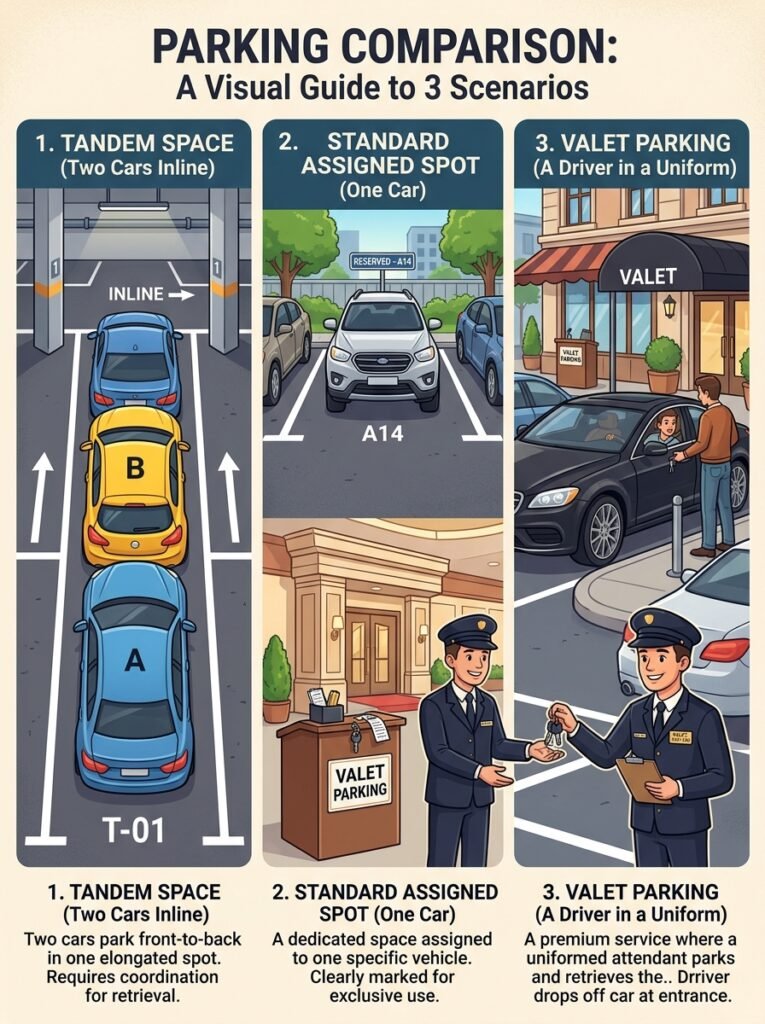
If you are touring multiple buildings, you will likely encounter different types of parking setups. Understanding the cost-to-convenience ratio of each can help you make the best decision for your budget.
Standard assigned parking is the most convenient for the average renter, but it often comes at a premium. Valet parking, common in luxury high-rises, removes the stress of parking entirely but limits your access to your vehicle and costs significantly more. Tandem parking sits squarely in the middle: high space efficiency, lower cost, but lower convenience.
| Feature | Tandem Parking | Assigned Parking | Valet Parking | Unassigned Parking |
| Cost | $$\vert{}$$$\vert{}$$$$$\vert{}$ | |||
| Convenience | Medium | High | Very High | Low |
| Space Efficiency | High | Low | Medium | Medium |
| Availability | Common in cities | Common in suburbs | High-end buildings | Low |
| Requires Coordination | Yes | No | No | No |
| Best For | Budget-conscious renters with 2 cars | Families with 1 car | Luxury renters | Flexible renters |
Tandem Parking vs. Covered vs. Garage (Comparison)
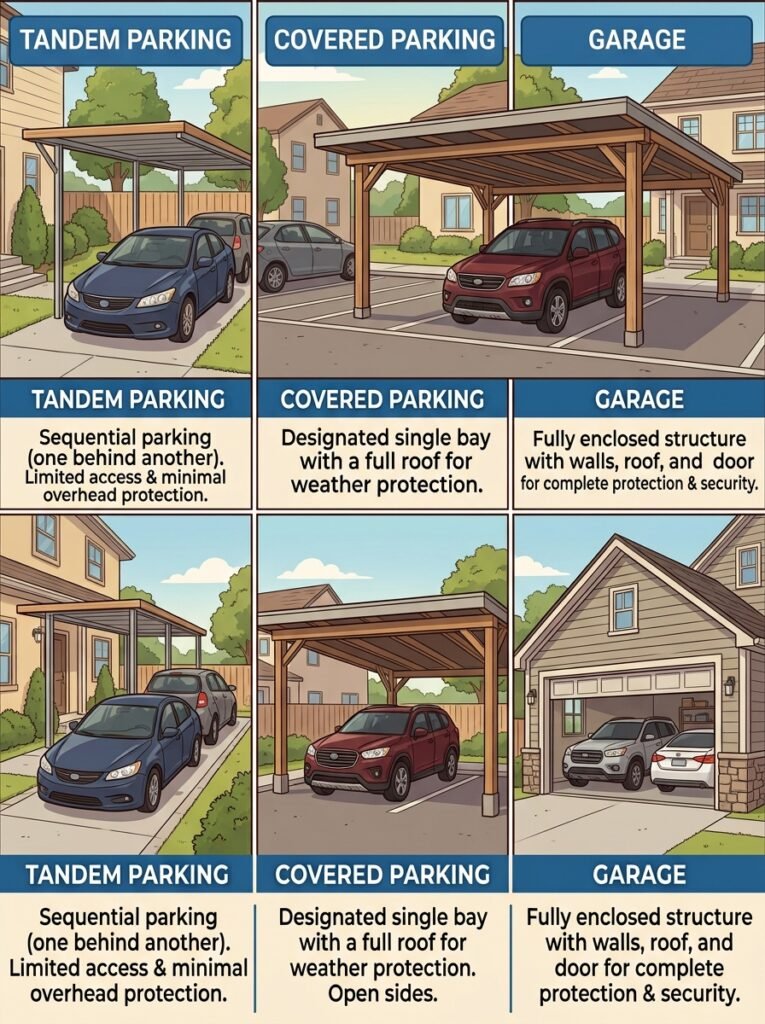
Not all tandem spaces are created equal. A tandem space in a climate-controlled, underground garage is vastly superior to an uncovered tandem space in a dirt lot behind a triplex. Always verify the type of structure your tandem space is located in.
| Feature | Tandem Parking | Covered Parking | Garage Parking |
| Weather Protection | Low (if outdoors) | Medium (roof, open sides) | High (fully enclosed) |
| Security | Low to Medium | Medium | High |
| Cost | $ | $$\vert{}$$$ | |
| Access | Requires coordination | Easy, independent access | Easy, independent access |
| Space | 2 cars in 1 spot | 1 car per spot | 1 car per spot |
Tandem Parking vs. Carport vs. Driveway (Comparison)
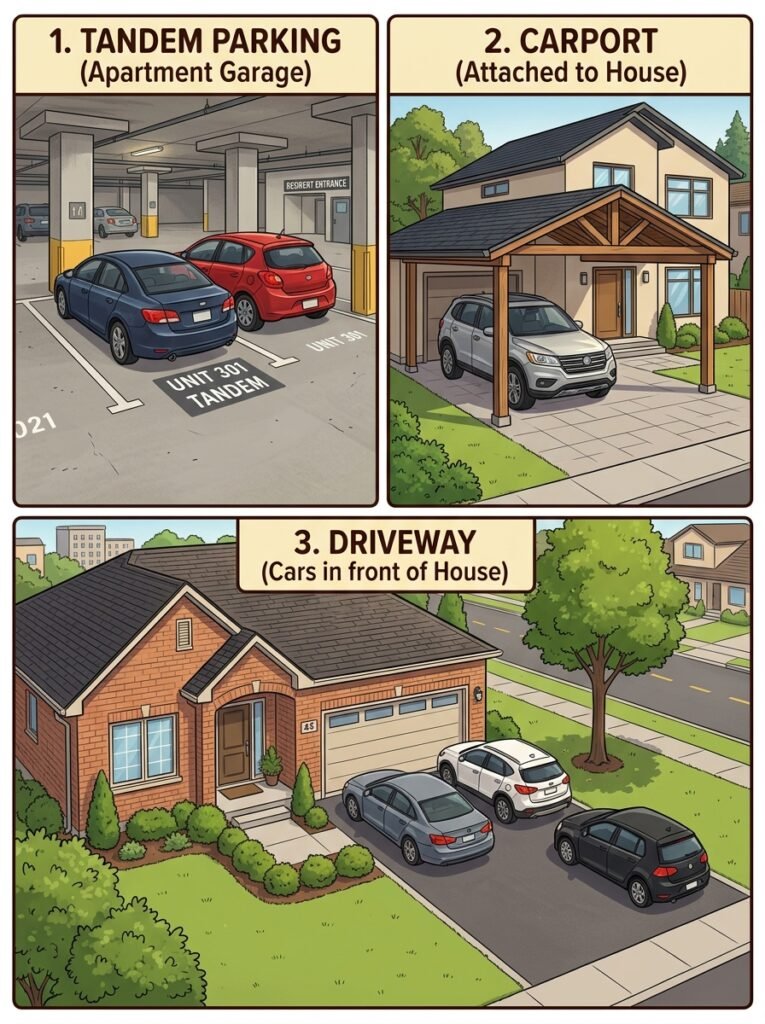
If you are renting a townhouse, condo, or single-family home rather than a high-rise apartment, your parking options will look a bit different. Driveways naturally act as tandem parking spaces, but because they are usually attached to a private home, they don’t carry the same HOA fees or security risks as an apartment garage.
| Feature | Tandem Parking (Apartment) | Carport (Townhouse) | Driveway (Single-Family) |
| Weather Protection | Varies by building | Medium | Low |
| Security | Medium (if gated) | Low | Low |
| Cost | $$(often a monthly fee) \vert{}$$$ (built into rent) | Free | |
| Space | 2 cars in 1 spot | 1 car per port | 2-3 cars stacked |
| HOA/Landlord Approval | Yes | Yes | No |
Frequently Asked Questions (FAQ)

What is tandem parking?
Tandem parking is a space-saving parking setup where two cars park in one elongated space, one directly behind the other. The rear car cannot leave until the front car moves.
What is a tandem parking spot?
It is a single, continuous parking space designed mathematically to fit exactly two standard-sized vehicles parked nose-to-tail.
What is a tandem parking space?
This is exactly the same as a tandem parking spot—one long strip of concrete designated for two vehicles to share.
How does tandem parking work?
The first vehicle parks deep into the space (the rear). The second vehicle parks directly behind it (the front). The rear car is now blocked in and can only exit the space once the front vehicle is moved out of the way.
What is tandem parking vs regular parking?
Regular parking provides independent, side-by-side spots where any car can enter and exit freely at any time. Tandem parking requires cars to be stacked, demanding coordination between drivers to get the blocked car out.
What is tandem parking in an apartment?
It is a space-saving compromise used by urban apartment complexes to maximize limited lot space. It allows landlords to offer off-street parking to more tenants in dense cities.
Is tandem parking cheaper than two spots?
Yes, it is almost always significantly cheaper than paying for two separate, independent parking spaces in the same building. Sometimes, it is even bundled into the rent for free.
What is tandem car parking?
The exact same concept as tandem parking—two cars stacked in one long space, requiring the front car to move for the back car to exit.
What is a tandem garage?
A tandem garage is a private garage that is built deep rather than wide. Instead of pulling in side-by-side, you pull one car all the way to the back wall, and park the second car right behind the bumper of the first.
What is tandem garage parking?
This refers to parking your vehicles inside a deeply constructed, enclosed garage designed specifically for two cars to park in a front-to-back configuration.
What does tandem parking mean in a lease?
If your lease specifies “tandem parking,” it legally means your assigned apartment parking spot will require coordination between two cars, as one vehicle will inevitably block the other. You will not get two side-by-side spots.
What is a tandem parking lot?
A parking lot specifically mapped out and painted with extra-long lanes designed for two cars each, rather than standard single-vehicle squares.
Conclusion
At the end of the day, tandem parking is a highly effective, space-saving setup where two cars park in one long spot, one behind the other. It is an incredibly common reality in apartments and city buildings, especially when square footage is at a premium and street parking is a nightmare.
While it comes with a slight learning curve, it doesn’t have to be a dealbreaker. If you are considering an apartment with a tandem setup, talk to your roommate or partner about schedules, daily communication, and expectations before signing the lease. A little proactive planning goes a long way in keeping the peace—and keeping your cars safe.

Maren started MyFirstLease after a rough first lease taught him everything the internet didn’t. He covers the logistical side of renting — move-in checklists, utilities, and the unglamorous first-week stuff nobody explains — and oversees everything published on the site.