
You’ve been evicted. Now every apartment application seems to end in rejection. You feel stuck — but there’s hope. Getting a denial letter after paying application fee after application fee is financially draining and emotionally exhausting. It is completely normal to feel overwhelmed when an old mistake or a past string of bad luck is standing between you and a safe place to sleep.
Learning how to get an apartment with an eviction requires changing your approach, gathering the right documentation, and targeting landlords who are willing to look past a background check. You do not have to settle for unsafe living conditions, and you do not have to put your life on hold. This comprehensive guide will walk you through exactly what you need to do to rebuild your rental history, find second-chance properties, and finally sign a new lease.
Quick Answer: Can You Get an Apartment with an Eviction?

Yes, you can absolutely secure housing with an eviction on your record, though it will require a more strategic approach than a standard rental search. You will need to target independent property owners over large corporate management companies, as private landlords have the flexibility to hear your story and make exceptions.
- Landlords who are eviction-friendly exist and operate in almost every city.
- You’ll need to work harder on other criteria, such as proving steady income and building excellent references.
- Higher deposits and co-signers can help significantly reduce the landlord’s financial risk.
- Time matters — older evictions are much easier to overcome than ones from the past twelve months.
What Are Eviction-Friendly Apartments?

Eviction-friendly apartments are rental units where the landlord or property management company is willing to consider applicants who have a prior eviction on their record. Instead of automatically rejecting you when the eviction surfaces on a background check, these housing providers look at your full situation, your current financial stability, and the context of your past housing issues. They specialize in second-chance leasing.
| Feature | Traditional Apartment | Eviction-Friendly Apartment |
| Eviction History | Immediate rejection | Case-by-case review |
| Credit Check | Strict (650+ score required) | More lenient |
| Background Check | Zero tolerance | Case-by-case |
| Security Deposit | 1 month’s rent | Often 1-2 months’ rent |
| Application Process | Standard | May require additional documentation |
7 Eligibility Criteria for Eviction-Friendly Apartments
1. Proof of Stable Income
Financial stability is the number one metric eviction-friendly landlords use to offset the risk of your past eviction. They need absolute certainty that you currently have the cash flow to make rent on the first of every month.
- Monthly income at least 2-3x the rent.
- Consistent employment (6+ months at your current job).
- Verifiable proof through pay stubs, bank statements, or official tax returns.
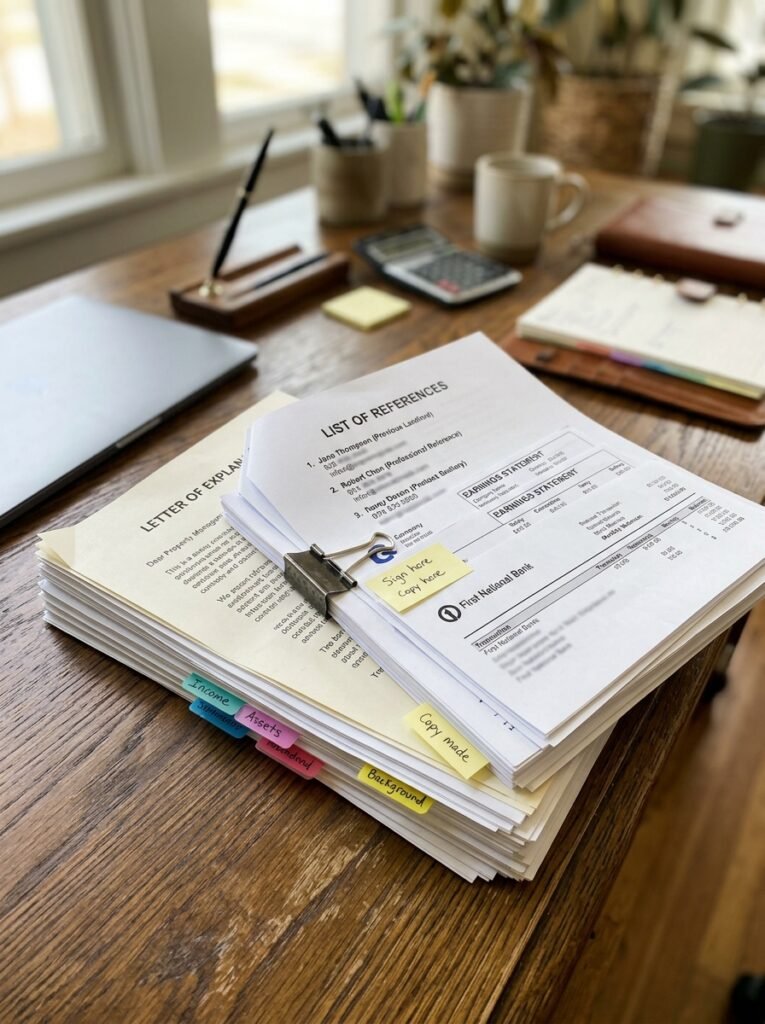
To prove this, gather the following documentation before you even schedule a viewing:
- 3-6 months of recent pay stubs.
- Bank statements showing regular, consistent deposits.
- A formal employment verification letter signed by your HR department or manager.
- Tax returns (especially crucial if you are self-employed or a gig worker).
Pro Tip: If you have irregular income (freelance, gig work), provide 6-12 months of bank statements to demonstrate a long-term reliable average rather than a short-term spike in cash.
2. The Reason Behind the Eviction
Landlords are human beings who understand that life happens. A job loss, a devastating medical emergency, or a sudden divorce are circumstances out of your control. Landlords want to see that the eviction was an isolated incident of hardship, not a lifelong pattern of property damage or lease violations.
- Honest explanation of the events leading to the eviction.
- Evidence that the eviction was due to temporary hardship (job loss, medical emergency, divorce).
- No pattern of destructive behavior, violence, or severe property damage.
When addressing the elephant in the room:
- Be honest and transparent right from the start.
- Explain what happened briefly and factually, avoiding the urge to over-explain or overly blame others.
- Share what you’ve learned from the experience.
- Show how you’re in a significantly better, more stable place now.
Example Explanation Letter:
“I was evicted from my previous apartment due to a sudden job loss during a company-wide layoff. I struggled to catch up on rent despite my best efforts to find immediate replacement work. Since then, I’ve secured stable employment and have been at my current job for 12 months. I’ve also repaired my credit and saved a substantial emergency fund. I am in a much stronger financial position now and I’m committed to being a responsible, long-term tenant.”
3. How Long Ago the Eviction Happened
Time heals financial wounds. The date stamped on your eviction heavily dictates how a landlord will react to your application.
| Time Since Eviction | Impact on Application |
| Less than 1 year | Hardest — need strong other criteria and likely a co-signer |
| 1-3 years | Manageable with good references, high deposits, and stable income |
| 3-5 years | Much easier — time has passed and stability can be proven |
| 5+ years | Least impact — many landlords overlook it completely |
Pro Tip: The more time that’s passed, the more opportunity you’ve had to demonstrate stability. Use those intervening years to build impeccable rental references from private roommates or temporary housing situations.
4. Your Current Credit Score
Even if a landlord overlooks the eviction, they will still look at your credit score to gauge how you handle debt today. An eviction paired with maxed-out credit cards and accounts in collections is a red flag, whereas an eviction paired with a recovering, healthy credit score shows growth.
| Credit Score | Impact on Application |
| 700+ | Strong — excellent chance of approval despite the eviction |
| 650-699 | Good — likely to be approved with standard documentation |
| 580-649 | Workable — may need a co-signer or a slightly higher deposit |
| Below 580 | Challenging — need strong other criteria, hefty deposit, and a guarantor |
Pro Tip: If your score is low, be upfront and explain the context (e.g., lingering medical bills, past job loss). Pair your explanation with incredibly strong income proof and glowing references to balance the scales.
5. Rental References
If your paper trail is damaged by an eviction, your personal trail needs to shine. Strong character and rental references can sway a private landlord who is on the fence.
| Who to Ask | Why They Matter |
| Previous Landlord | Best option — can vouch for your rental history before or after the eviction |
| Employer | Can vouch for your daily reliability, punctuality, and steady income |
| Community Leader | Pastor, teacher, or mentor who knows you well and can speak to your character |
Pro Tip: Ask your references before applying. Give them a heads-up, explain your housing situation, and prepare them for the call so they aren’t caught off guard when a landlord reaches out.
6. Criminal Background History
- Many eviction-friendly landlords still run criminal background checks to ensure the safety of their community.
- Minor offenses (especially older ones) are often overlooked when combined with a strong current application.
- Some states and cities have enacted “fair chance” housing laws that restrict how far back a landlord can look into your criminal history, or what types of convictions they can use to deny you.
Pro Tip: Address any criminal history directly in your application rather than hoping the landlord won’t bring it up. Transparency builds trust; hiding facts destroys it.
7. Willingness to Pay a Higher Security Deposit
Money talks. Offering more cash upfront is the most effective way to ease a landlord’s anxiety about your eviction history. It proves you have liquid capital and provides a financial safety net for the property owner.
| Standard Deposit | Higher Deposit |
| 1 month’s rent | 1.5-2 months’ rent |
Pro Tip: If you can, offer a higher security deposit upfront before they even ask. It shows immense good faith, proves your financial stability, and significantly reduces the landlord’s perceived risk.
How to Find Eviction-Friendly Apartments

1. Apartment Locator Services
Apartment locators (also known as rental brokers) maintain active databases of local properties and exact tenant criteria.
- They know exactly which buildings accept evictions and which will auto-deny you.
- They save you from paying non-refundable application fees to places that will inevitably reject you.
- They are often completely free for renters, as the property management companies pay the locator a commission for bringing them a tenant.
To find a reliable locator in your area, search Google for “eviction-friendly apartment locator” or “second chance apartment locator” plus your city. You can also ask for reputable referrals from local housing counselors.
2. Private Landlords
Corporate apartment complexes use automated software that flags and rejects evictions automatically. Private, independent landlords do not.
- Private owners are inherently more flexible than corporate complexes with rigid corporate policies.
- They can make decisions on a case-by-case basis.
- They are much more willing to sit down, look you in the eye, and listen to your story.
To connect with private owners, drive through your target neighborhoods looking for handmade “For Rent” signs in yards or windows. Check local classifieds, community bulletin boards, and ask local real estate agents who manage small portfolios of rental homes.
3. Online Search Tips
Knowing how to query rental platforms is vital to filtering out corporate mega-complexes.
| Platform | Search Tips |
| Search: “apartments accept evictions near me” or “second chance leasing [City]” | |
| Craigslist | Search terms: “eviction friendly,” “second chance,” “by owner,” “willing to work with” |
| Facebook Marketplace | Look for listings tagged “for rent by owner” and check local neighborhood groups |
4. Local Housing Agencies
Government and non-profit organizations exist specifically to bridge the gap between vulnerable renters and safe housing.
- Nonprofits and government agencies often maintain vetted lists of eviction-friendly landlords in your zip code.
- They may offer rental assistance, guarantee funds, or landlord mediation services that make you a more attractive applicant.
Visit the U.S. Department of Housing and Urban Development (HUD) website to find your local Public Housing Agency, or Google “housing assistance” plus your city to find local tenant rights organizations.
What to Do Before Applying

1. Resolve Outstanding Balances
An eviction with a $0 balance looks drastically better than an eviction with $3,000 still owed to a previous landlord. Do whatever it takes to pay back any money owed to your previous landlord. If you cannot afford to pay the balance in full, contact the property management company and negotiate a realistic monthly payment plan. Always get this agreement in writing so you can show prospective landlords that you are actively making amends.
2. Get Your Story Straight
Inconsistency makes landlords nervous. Write a clear, honest, and concise explanation of what happened during your eviction. Keep the tone objective and focus heavily on what you’ve learned and how you’ve improved your financial habits since then. Practice telling your story confidently in front of a mirror or with a friend so that when a landlord asks, you don’t panic or ramble.
3. Gather Documents
Having a pristine, organized application packet ready to hand over immediately shows a landlord you are serious, organized, and reliable.
| Document | Why It’s Needed |
| Pay Stubs | Proof of current income and employment stability |
| Bank Statements | Proof of financial stability and responsible spending habits |
| Credit Report | Shows your current financial situation and debt-to-income ratio |
| References | Character and rental history vouches from trusted community members |
| Explanation Letter | Explains your eviction clearly and professionally |
| ID/SSN | Identity verification for the background check |
4. Check Your Credit
Never let a landlord discover something on your credit report that you don’t already know about. Pull your free annual credit report from authoritative sources like AnnualCreditReport.com before applying anywhere. Dispute any outstanding errors immediately, and prepare to explain any legitimate negative marks (like medical debt or the eviction itself) in your explanation letter.
How to Apply for an Apartment with an Eviction
- Build Your “Renter Resume” Packet: Print out your ID, 3-6 months of pay stubs, bank statements, your printed credit report, your letter of explanation, and a list of your professional and personal references. Put this in a neat folder.
- Pre-Screen the Landlord: Before handing over a $50 application fee, call the landlord or property manager. Say, “I love the property and meet the income requirements, but I want to be upfront that I have an eviction from two years ago due to a medical emergency. Do you accept applicants with an eviction if I can provide a higher deposit and proof of strong income?”
- Submit the Application In Person: Whenever possible, hand your application packet to the landlord directly. Making eye contact and being well-dressed makes a lasting human impression that an online web portal simply cannot.
- Offer Solutions Immediately: When handing over your application, immediately state your willingness to pay a 1.5x or 2x security deposit, or mention that you have a co-signer ready to sign the lease.
- Follow Up Professionally: Wait 48 hours, then follow up with a polite phone call or email checking on the status of your application. Reiterate your enthusiasm for the unit and your commitment to being an excellent tenant.
Common Mistakes to Avoid

| Mistake | Why It’s a Problem |
| Lying about your eviction | It will absolutely come out on the background check — and you’ll be rejected instantly or evicted again for lease fraud. |
| Not being prepared | Landlords are busy; if your documents are missing or sloppy, they will immediately move on to the next applicant. |
| Only looking at large complexes | Corporate properties have rigid, software-driven rules. You must focus your energy on private, independent landlords. |
| Ignoring your credit | An eviction is bad, but an eviction plus a plummeting credit score is worse. Start repairing your credit while you search. |
| Giving up too soon | Rejection is part of this process. It is a numbers game — if you keep applying and adapting, you will find something. |
Frequently Asked Questions (FAQ)
How to get an apartment with an eviction?
Focus entirely on finding eviction-friendly apartments by targeting private landlords rather than corporate complexes. Offer a higher security deposit, provide rock-solid proof of steady income, and bring strong personal and professional references to back up your character.
Can you get an apartment with an eviction?
Yes — many independent landlords are willing to give you a second chance. It requires transparency, a well-documented explanation of the hardship that caused the eviction, and proof that your financial situation has stabilized.
How long after an eviction can I rent again?
You can technically rent immediately if you find a private landlord willing to take the risk, but it becomes significantly easier after 2-3 years have passed and the eviction ages on your record.
What are eviction-friendly apartments?
They are second-chance apartments where landlords or property managers are willing to look past their standard screening criteria to consider applicants with prior evictions, usually evaluating applications on a case-by-case basis.
What do I need to rent after an eviction?
You will need substantial proof of income (pay stubs and bank statements), strong references, a clear, written explanation of what happened, and ideally, the cash for a higher security deposit to offset the landlord’s risk.
Should I lie about my eviction?
No — honesty is always the best policy. Landlords run comprehensive tenant screening reports. If they catch you lying, you will be rejected immediately for dishonesty, even if they might have otherwise accepted your eviction.
Can I get an apartment with a recent eviction?
Yes, but it is substantially harder. If your eviction is less than a year old, you’ll need incredibly strong income proof, flawless references, a hefty deposit, and likely a co-signer with excellent credit to get approved.
Where can I find apartments that accept evictions near me?
Search online platforms like Craigslist and Facebook Marketplace for “by owner” listings, use a specialized second-chance apartment locator service, or contact local housing assistance non-profits for vetted landlord lists.
How much deposit for an eviction-friendly apartment?
You should expect to pay a higher premium to mitigate the landlord’s risk. Often, landlords will ask for 1.5 to 2 months’ rent as a security deposit upfront, instead of the standard single month.
What if my eviction went to court?
If a judge ruled against you, the eviction will show up on all standard tenant screening reports and civil court records. Be fully honest about the court proceeding, explain the situation, and show how you are rectifying the debt.
Conclusion
Getting an apartment with an eviction is a highly challenging process, but it is absolutely possible with the right strategy and a resilient mindset. To succeed, you must focus your search on eviction-friendly apartments and private landlords, provide undeniable proof of your current income, and be completely honest about your past financial hardships. Don’t give up when you face a few rejections; there are compassionate landlords out there who specialize in second chances. Stay prepared, keep your documents organized, own your story, and keep looking until you find your next home.

Maren started MyFirstLease after a rough first lease taught him everything the internet didn’t. He covers the logistical side of renting — move-in checklists, utilities, and the unglamorous first-week stuff nobody explains — and oversees everything published on the site.