
If you are looking for small apartment hallway decor ideas for renters, you are probably standing in a narrow, dim corridor that feels more like a tunnel than part of your home — landlord-white walls, one bare bulb, and nowhere to put your keys. This guide is written for a first-time renter in exactly that spot: a hallway that is too narrow for furniture, too dark to show off art, and off-limits for drilling.
You will work through the hallway in the order that makes the biggest difference first — light, then walls, then the floor, then storage — and every idea here is removable, so your deposit stays safe and everything can move with you to the next place.
The fastest way to fix a dark, narrow rental hallway without drilling is to add warm, battery-powered light, lean art or a mirror against the wall instead of hanging it, lay a slim low-pile runner, and use the door and corners for storage. Start with light, add one wall idea and one floor idea, and stop before the passage feels crowded.
Executive Summary

A hallway is the smallest room in most apartments, and that is actually an advantage: it takes very little to change how it feels. One warm light, one leaned frame, and one runner can turn a bare corridor into a welcoming entry, because there is simply less space to fill. The mistake is to start by shopping for wall decor while the hallway is still dark — art nobody can see does not make a hallway feel better.
This article follows the order that works. It starts with light for a windowless hallway, then covers leaning art and mirrors, a slim runner, using the door and corners, storage that fits a narrow passage, and tricks that make the space feel wider, and ends with how to keep the walkway clear. Every step is renter-safe, and the starter checklist in H2 7 ranks the purchases worth making first, with cost bands labelled as planning ranges.
1. Brighten a Dark Hallway

Most rental hallways have one problem before any other: not enough light. Many have no window at all, and the single ceiling fixture casts a flat, cool light that makes white walls look grey. Fixing the light first changes everything else — colours look warmer, art becomes visible, and the corridor stops feeling like a tunnel.
Start by swapping the bulb, if the fixture allows it and the lease permits it. A warm white bulb softens the whole space for the cost of a bulb, and it is worth doing before buying any decor. Keep the original bulb in a drawer so it can go back in at move-out. If the fixture is a bare bulb, a simple clip-on or screw-in shade — one that fits without tools — can diffuse the glare, but check that it fits the fixture safely and does not trap heat.
Then add light where people actually walk. Battery-powered, adhesive-backed LED strips along the top of a door frame, or small motion-sensor puck lights near the floor, add a warm glow without wiring or holes. Motion sensors are especially useful in a hallway: the light comes on when you walk through with your hands full and switches itself off. Stick-on lights should go on clean, dry paint and be removed slowly at move-out, following the maker’s instructions, so they do not pull paint with them.
A common mistake is to add a bright light and call it done. One harsh light makes a narrow hallway feel smaller, not bigger. Several small pools of warm light — the ceiling fixture plus one low light near the floor — feel layered and inviting in a way a single bright bulb never does. If the hallway borrows light from a room at one end, keep that doorway clear and avoid hanging anything that blocks it.
2. Lean Art, Don’t Hang It

Wall art is the quickest way to give a hallway personality, and in a rental the safest way to put it up is not to put it up at all. Leaning a frame on the floor against the wall, or on a slim console if there is room for one, gives the same finished look as hanging — with no holes, no adhesive, and nothing to repair at move-out.
Choose tall, narrow frames. A portrait-shaped print draws the eye upward and makes a low ceiling feel higher, which matters in a corridor that is already tight. One larger leaned frame at the end of the hallway works better than a row of small ones along the side wall, where they compete for attention and narrow the walkway visually. If the hallway ends in a door, lean the frame on the floor beside it, angled slightly, so it reads as intentional rather than forgotten.
Adhesive strips and hooks have their place for very light frames, and this is where hallway decor without drilling usually starts. They work best on smooth, clean paint, for frames within the maker’s stated weight limit — always check that limit, and use two strips rather than one for anything heavier than a postcard. They work poorly on textured walls, fresh paint, or wallpaper, and they can pull paint when removed, so test one in a hidden spot first and follow the removal instructions exactly. For anything heavy, a framed canvas, or a mirror, leaning is the safer choice.
Keep the display simple. One frame, or a pair of matching frames leaned side by side, is enough for a short hallway. A gallery wall along a narrow corridor quickly becomes a corridor of clutter, and every extra frame is another thing to dust and another thing to bump into with a bag or a coat.
3. Add a Slim Runner

A runner does three jobs in a hallway at once: it warms up a cold floor, it quiets footsteps, and it pulls the eye down the length of the corridor so the space feels intentional. In a small apartment hallway, it is often the single biggest visual change after lighting.
Measure before buying anything. Measure the length of the hallway and its width, then leave a few inches of bare floor showing on each side of the runner — a runner that touches both walls looks stuffed in, and one that is too short looks like a doormat that lost its way. In most small rentals, a runner around 2 feet wide fits a passage that is 3 to 4 feet wide, but measure your own hallway rather than trusting a standard size.
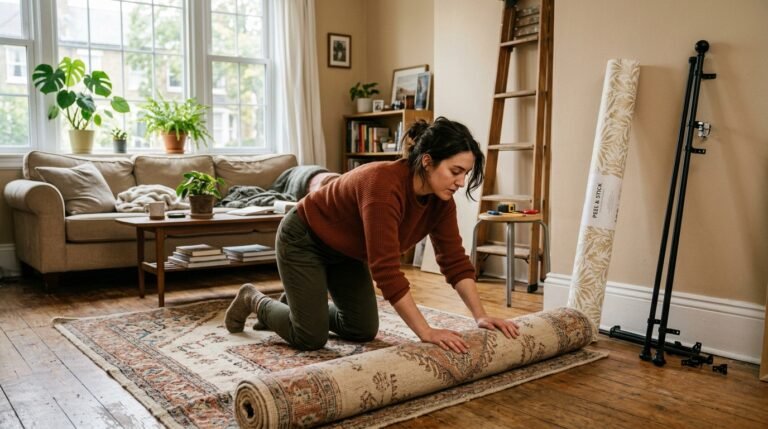
Choose low-pile and washable. A low-pile runner lies flat, does not catch on shoes or a vacuum, and is less of a trip risk than a thick rug in a narrow space. A washable runner is worth the search in a hallway, because this is the floor that collects outdoor dirt, pet hair, and spills. A non-slip pad underneath, cut to size, keeps the runner from creeping — and in a rental it also protects the floor beneath it.
A pattern helps in a dark hallway, but keep it simple. A runner with a light background and a small, regular pattern brightens the floor without shouting, while a very dark runner makes a dim corridor feel darker. Stripes running along the length of the hallway make it feel longer; stripes across it make it feel wider, which can help a very long, tunnel-like passage. Either way, pick one pattern for the runner and keep the rest of the hallway plain, so the space does not feel busy.
4. Use Doors and Corners

A narrow hallway has almost no wall space to spare, but it does have doors and corners — and those are the places where apartment entryway hallway decor can do double duty as storage. The trick is to use surfaces that already exist, rather than adding furniture that eats into the walkway.
An over-the-door hook rack or organiser on the inside of the front door, or on a bedroom door that opens onto the hallway, holds coats, bags, and keys without a single hole. Choose one that hangs over the top of the door and lifts off cleanly; check that the door still closes fully, since a rack that is too thick can stop the latch from catching. A small over-the-door mirror on the back of a door is another useful addition — it is the last check before leaving, and it needs no wall space at all.
Corners are the other wasted space in a hallway. A tall, narrow corner shelf that stands on the floor, or a small triangular basket tucked into a corner, holds shoes, a dog lead, or a reusable shopping bag without blocking the path. A slim umbrella stand in the corner by the front door does the same job and keeps wet umbrellas off the runner. Whatever goes in a corner should be narrower than the corner is deep, so nothing sticks out into the walkway.
Keep the entry end of the hallway working hardest. A small tray or bowl on a slim console — or, if there is no room for a console, a small adhesive hook by the door for keys — stops the daily hunt for keys and wallet. If there is no console, a wall-mounted key hook on adhesive strips, placed where it will not be knocked, does the same job. The goal is a hallway that greets you with order, not a pile of things dropped just inside the door.
5. Slim Storage That Fits

Storage is where small hallway decorating ideas most often go wrong. A hallway is a passage first and a room second, so any storage in it has to be shallow, stable, and easy to walk past — otherwise it becomes an obstacle course. The rule is simple: nothing in a hallway should stick out further than a closed fist from the wall.
A slim shoe cabinet, around 6 to 8 inches deep, is the one piece of furniture that earns its place in many small hallways. It hides shoes, keeps the runner clear, and its flat top doubles as a surface for keys and mail. Measure the hallway width first and leave enough room to walk past comfortably — in a passage narrower than about 36 inches, even a slim cabinet may be too much, and an over-the-door shoe organiser is the better choice.
Baskets are the flexible alternative. A flat woven basket on the floor against the wall holds shoes, hats, or gloves, and it can be picked up and moved when the hallway needs clearing. A lidded basket on top of a shoe cabinet hides clutter and gives the hallway a finished top surface. Avoid open shelving at head height in a narrow hallway: it narrows the space visually and puts things at exactly the height where a bag or an elbow will knock them off.
Small hallway storage decor works best when it is also the decor. A basket in a natural fibre, a cabinet in a light colour that matches the walls, or a row of matching hooks all look intentional, while a jumble of different containers looks like a storage cupboard that spilled. Pick one material and one colour for hallway storage, and let the art and the runner carry the personality instead.
6. Make It Feel Wider

A narrow hallway cannot be made wider, but it can be made to feel wider — and the tricks that do it cost little and need no drilling. The key is to keep sightlines open and to use light, reflective surfaces rather than dark, heavy ones.
A mirror is the most effective tool here, and it works best leaned, not hung. A tall, narrow mirror leaned against the wall at the end of a hallway, or on the floor beside a console, bounces light down the corridor and makes the space feel twice as deep. Keep it slim and keep it low enough that it reflects the lit part of the hallway rather than the ceiling. A mirror on a side wall, opposite a light source, works too — but in a very narrow hallway, a mirror that sticks out from the wall narrows the passage, so leaning it flat against the wall is the safer fit.
Colour does the rest of the work. Light, warm neutrals on the runner, the storage, and the art make a hallway feel open; dark, heavy pieces close it in. This does not mean everything has to be white — a soft sage, a pale warm grey, or a light wood tone all read as light in a dim corridor, while black frames and dark furniture absorb the little light there is. If the frames are dark, balance them with a light mat inside the frame, so the art reads as bright rather than heavy.
Finally, keep the ceiling line clean. Anything that hangs down into a hallway — a low pendant, a hanging plant, a sign strung across the corridor — makes the ceiling feel lower and the passage tighter. Keep decor at eye level or below, keep the top of the walls empty, and let the eye travel along the hallway rather than stopping at something overhead. Narrow hallway decor for renters works best when the space above eye level stays clear.
7. Keep the Path Clear

A decorated hallway that is hard to walk through has failed at its first job. Before adding anything else, walk the hallway the way it is actually used: carrying groceries, with a laundry basket, in the dark, half asleep. Anything that has to be stepped around, ducked under, or squeezed past does not belong there.
Leave a clear walking lane down the centre of the hallway, at least wide enough to pass comfortably with a bag in each hand. That means no furniture on both sides at once, no baskets poking out from under a console, and no runner edge curling up where a foot catches it. Tape the runner’s corners down with rug tape if they lift, and check the non-slip pad every few months.
Set a one-in, one-out rule for the hallway. It is the smallest space in the apartment, so it fills up fastest — a new coat, a new pair of shoes, a new bag all land here first. When something new moves into the hallway, something old moves out to a closet, or the hallway quietly becomes a storage room. A small basket by the door for items that need to leave the apartment — returns, donations, library books — keeps the hallway from becoming a holding pen.
The starter checklist below ranks the purchases worth making first, with cost bands given as general planning ranges, not vendor quotes, as of 2026. It is a downloadable-candidate for the editor: a reader can work down it in order and stop whenever the budget runs out, because the free and cheap steps above already did most of the work.
Hallway starter checklist — work down in order, stop when the budget runs out:
| Order | Upgrade | Cost band (planning range) | Payoff |
|---|---|---|---|
| 1 | Warm white bulb for the existing ceiling fixture (keep the original to refit at move-out) | Under $10 | High — softens the whole hallway |
| 2 | Battery motion-sensor lights or adhesive LED strip | $10–$25 | High — light where you walk, no wiring |
| 3 | Washable low-pile runner, measured to fit, with non-slip pad | $25–$75 | High — warms, quiets, and defines the space |
| 4 | One tall leaned frame or leaned mirror | $15–$50 | Medium–high — personality and reflected light |
| 5 | Over-the-door hook rack or shoe organiser | $10–$25 | Medium — coats, bags, and shoes off the floor |
| 6 | Slim shoe cabinet or flat basket (only if the width allows) | $25–$75 | Medium — hides shoes, keeps the path clear |
| 7 | Small tray or bowl for keys, and adhesive key hook if there is no surface | Under $15 | Medium — ends the daily key hunt |
A few buying cautions are worth keeping. Measure the hallway before ordering anything, and check return policies before buying a runner, since sizes vary and a runner that does not fit is hard to use elsewhere. Check adhesive products’ weight limits and removal instructions before use, and test them in a hidden spot first. Keep receipts and original packaging for anything bought new, in case it does not suit the space. For a broader look at decorating without overspending, see: Decorate an Apartment on a Budget
Frequently Asked Questions
How can I decorate a rental hallway without drilling?
Use leaning art and mirrors, adhesive strips and hooks for very light frames within the maker’s weight limit, over-the-door racks, freestanding storage, and a runner. Nothing in this guide needs a hole in the wall, so the deposit is not put at risk — but always test adhesive products in a hidden spot first and follow their removal instructions.
What is the best way to brighten a dark hallway in a rental?
Swap the ceiling bulb for a warm white one if the fixture and lease allow it, then add battery-powered motion-sensor lights or an adhesive LED strip near the floor. A leaned mirror at the end of the hallway bounces that light further down the corridor, and a light-coloured runner keeps the floor from absorbing it.
How do I decorate a very narrow hallway?
Keep everything slim and flat against the wall: one tall leaned frame, a runner no wider than the space allows, and storage no deeper than 6 to 8 inches. Use doors and corners instead of adding furniture, keep the centre of the passage clear, and avoid anything at head height that can be knocked.
What size runner should I use in a small apartment hallway?
Measure the hallway first. Leave a few inches of bare floor showing on each side, and choose a low-pile, washable runner with a non-slip pad underneath. In most small rentals a runner around 2 feet wide fits a passage 3 to 4 feet wide, but measure your own hallway rather than trusting a standard size.
Can I hang a mirror in a rental hallway without drilling?
Yes — lean a tall, narrow mirror against the wall instead of hanging it. A leaned mirror is safer for a heavy item, needs no holes or adhesive, and can be moved easily. Keep it flat against the wall so it does not narrow the walkway, and place it where it reflects a light source rather than a blank ceiling.
How do I add storage to a hallway without blocking it?
Use an over-the-door shoe organiser or hook rack, a slim shoe cabinet no deeper than 6 to 8 inches, or a flat basket against the wall. In a passage narrower than about 36 inches, skip furniture entirely and use the door and corners. Keep a clear walking lane down the centre and set a one-in, one-out rule so the hallway does not fill up.
What colours work best in a dark, narrow hallway?
Light, warm neutrals — a pale warm grey, soft sage, light wood tones, and a light-coloured runner — make a dim corridor feel open. Dark furniture and black frames absorb the little light there is, so if frames are dark, balance them with a light mat inside the frame.
Conclusion

Small apartment hallway decor ideas for renters come down to order: light first, then one leaned piece of art or a mirror, then a slim runner, then storage that fits the width you actually have — and nothing that blocks the path. A narrow, dark hallway does not need a lot of new things to feel welcoming; it needs warm light, one personal touch, a soft floor underfoot, and a clear way through. Start this weekend with the bulb and the measuring tape, and save this guide to work through the starter checklist when the budget allows.
For more ideas in this pillar, see the site’s Decorating & Small Space Living guides.

Maren started MyFirstLease after a rough first lease taught him everything the internet didn’t. He covers the logistical side of renting — move-in checklists, utilities, and the unglamorous first-week stuff nobody explains — and oversees everything published on the site.