
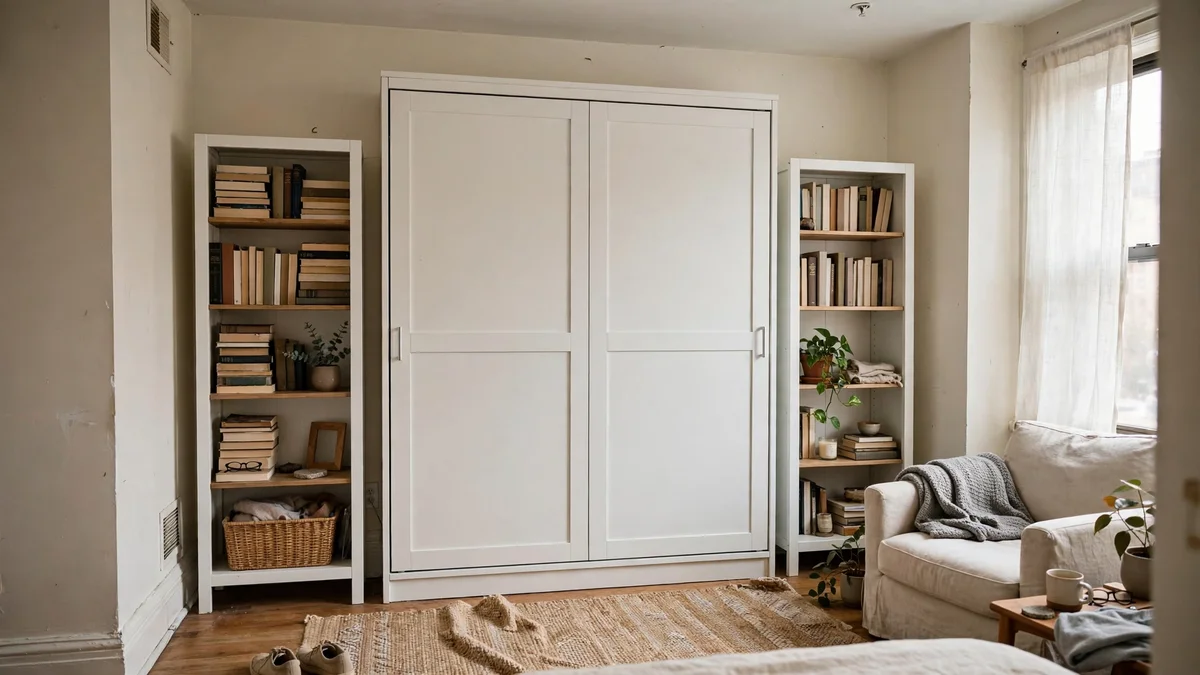
Apartment bedroom decor ideas for renters with a murphy bed start with a problem most bedroom guides never mention: the biggest piece of furniture in the room disappears every morning and reappears every night. Decorate for only one of those states and the room looks wrong half the day — bare and echoing with the bed up, or crowded and cluttered with the bed down.
This guide is written for a first-time renter in a studio or a small bedroom whose murphy bed dominates the room, and who cannot drill into the bed, repaint the cabinet, or change the mechanism. Every idea below decorates around the bed, works in both positions, and comes off cleanly at move-out. For more small-space projects in the same spirit, browse the Decorating & Small Space Living guides.
Direct answer: Apartment bedroom decor ideas for renters with a murphy bed work best when you treat the closed cabinet as a wall, keep the fold-down footprint clear, and choose decor that looks right with the bed up and down. Use freestanding furniture, removable adhesive, and a low rug — never drill into the cabinet or block the bed’s path.
Executive Summary

A murphy bed bedroom is really two rooms sharing one floor plan, and the decor has to serve both. When the bed is folded up, the closed cabinet is the largest flat surface in the room — it reads as a wall, a wardrobe, or a blank panel, depending on how it is dressed. When the bed is folded down, that same wall becomes a bed, and everything on the floor in front of it has to be either under the bed, beside it, or easy to move.
Below are ten ideas, ordered from the biggest decision — how to treat the bed wall itself — down to the small finishes that make the room feel like a bedroom at night and a living space by day. Each section covers both bed positions, flags the clearance and weight rules that matter for a folding bed, and notes the lease risk honestly. Nothing here modifies the murphy bed mechanism, drills into the cabinet, or attaches anything heavy to a moving part.
1. Treat the Closed Bed as a Wall
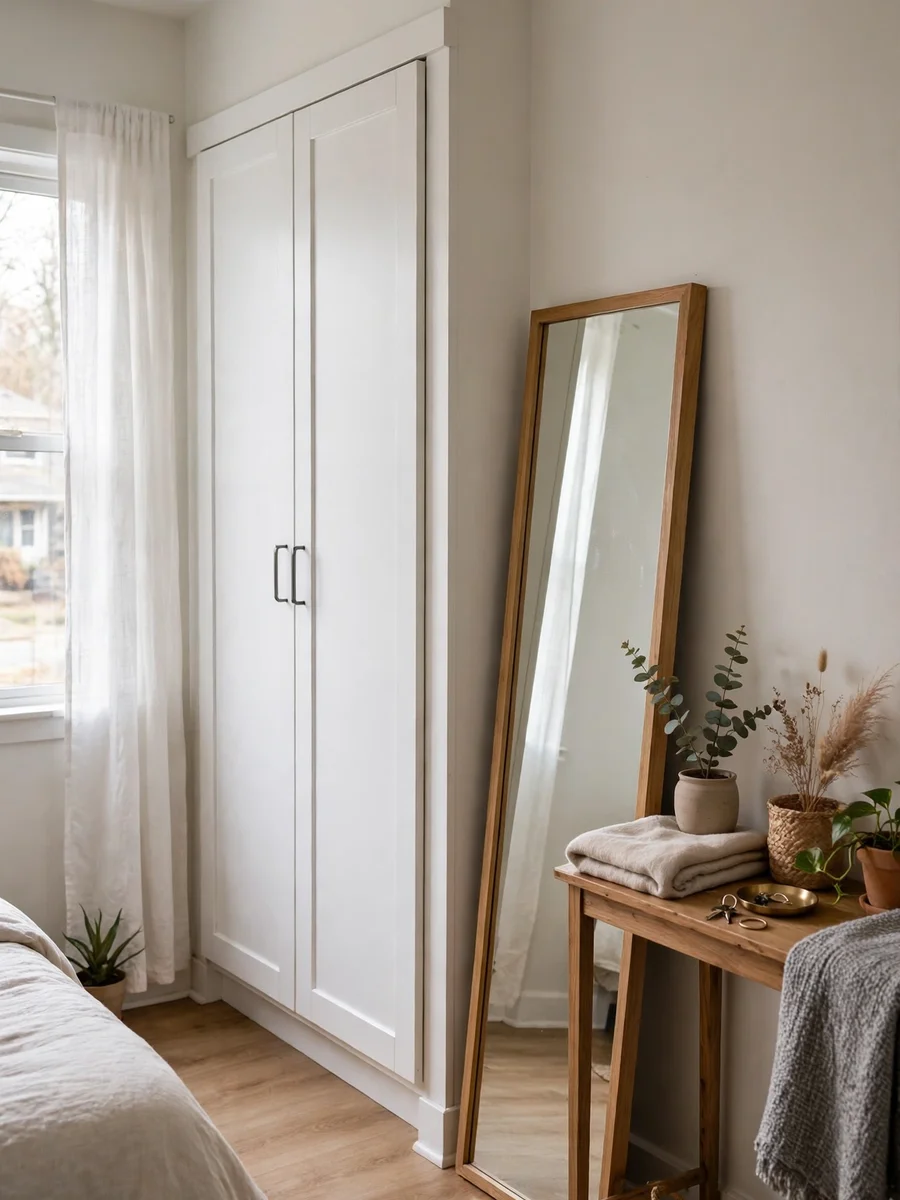
The single biggest decorating decision in a murphy bed bedroom is what the closed cabinet looks like during the day, because it is the largest surface in the room for most of the day. Treat it as a wall, not as a bed that happens to be vertical: give it the same treatment a plain wall would get, using only things that sit in front of it or beside it, never things screwed into it.
A tall leaning floor mirror, a narrow console table, or a pair of freestanding bookshelves placed tight against the cabinet’s sides can make the whole wall read as intentional furniture rather than a folded-away bed. A large piece of leaning art — a canvas or framed print propped on the floor or on a low bench in front of the cabinet, clear of the fold-down path — softens the flat panel without touching it. Keep the palette of these pieces close to the cabinet’s finish so the wall reads as one composition instead of a cabinet plus unrelated objects.
The rule that governs this idea, and every idea after it, is clearance: measure the bed’s full fold-down footprint on the floor, mark it with painter’s tape for a day, and make sure nothing in front of the cabinet sits inside that rectangle. Anything that does will have to move every night, and anything left there will get hit, scuffed, or trapped under the bed. Leaning pieces should be light enough to lift with one hand and stable enough not to tip when the bed swings down nearby.
2. Frame the Bed With Flanking Furniture
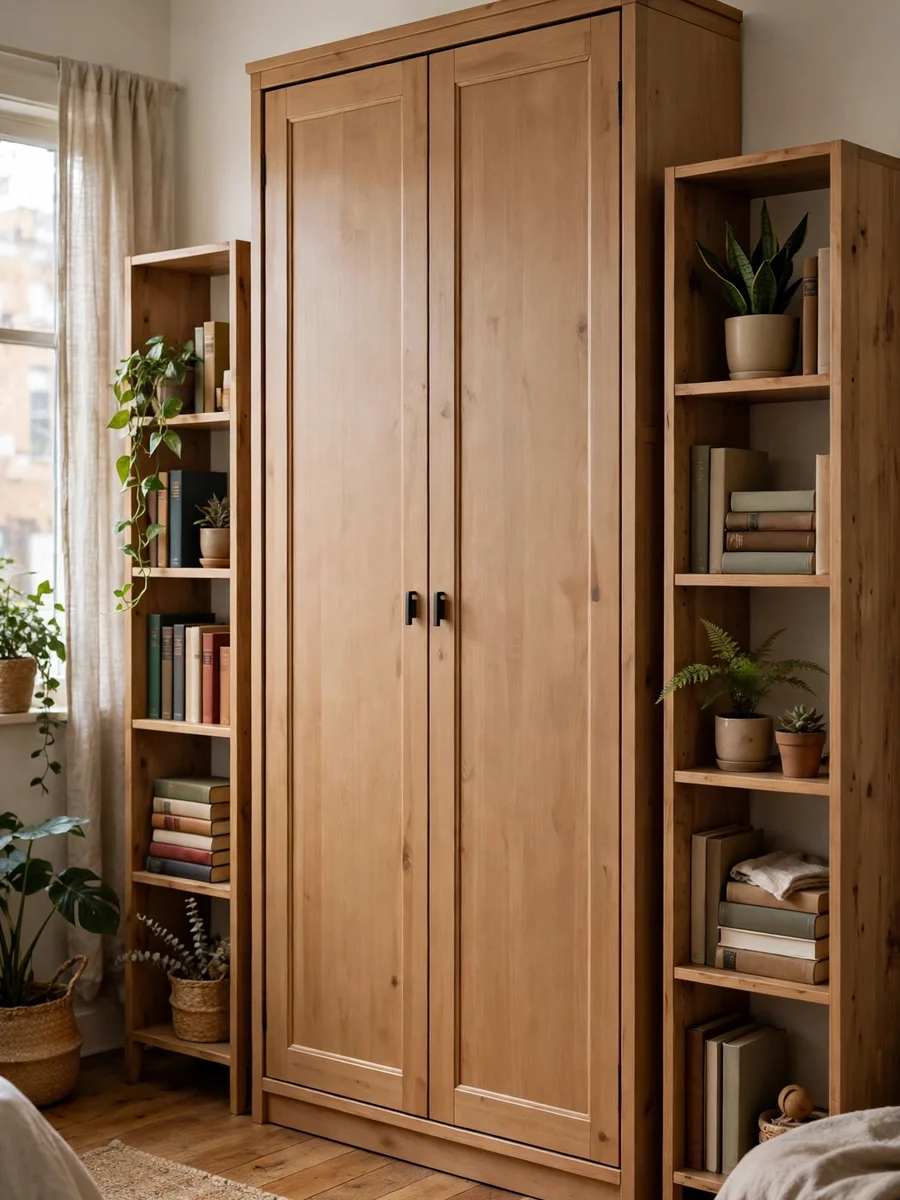
Two matching pieces flanking the murphy bed — slim bookcases, narrow wardrobes, or tall plant stands — turn a lone cabinet into a built-in-looking wall, without a single screw. This is the closest a renter gets to the built-in murphy bed walls in homeowner guides, and it works because the eye reads symmetry as intention.
Choose pieces that are narrower than the bed cabinet and no taller than it, so the bed stays the visual anchor. Open shelving works well here: books, plants, and baskets on the shelves give the wall texture and storage, and open shelves stay useful whether the bed is up or down. Closed wardrobes on either side work too, and they solve the closet problem in a studio where the murphy bed ate the wardrobe wall — but leave a gap of a few inches between each flanking piece and the cabinet so the bed’s side panels and handles clear them when the bed folds down.
Expect to pay roughly $60–$200 per slim bookcase as of 2026, depending on size and material, or much less secondhand. Anchor tall freestanding furniture to the wall only if the lease allows it and only with removable, landlord-approved hardware — many leases forbid wall anchors, and a tall bookcase next to a moving bed is exactly the piece that should not be able to tip. If anchoring is not allowed, keep flanking pieces short and wide rather than tall and narrow, keep heavy items on the lowest shelves, and never store anything on top of a flanking piece that could fall onto the bed’s path.
3. Bedding That Folds Away Neatly
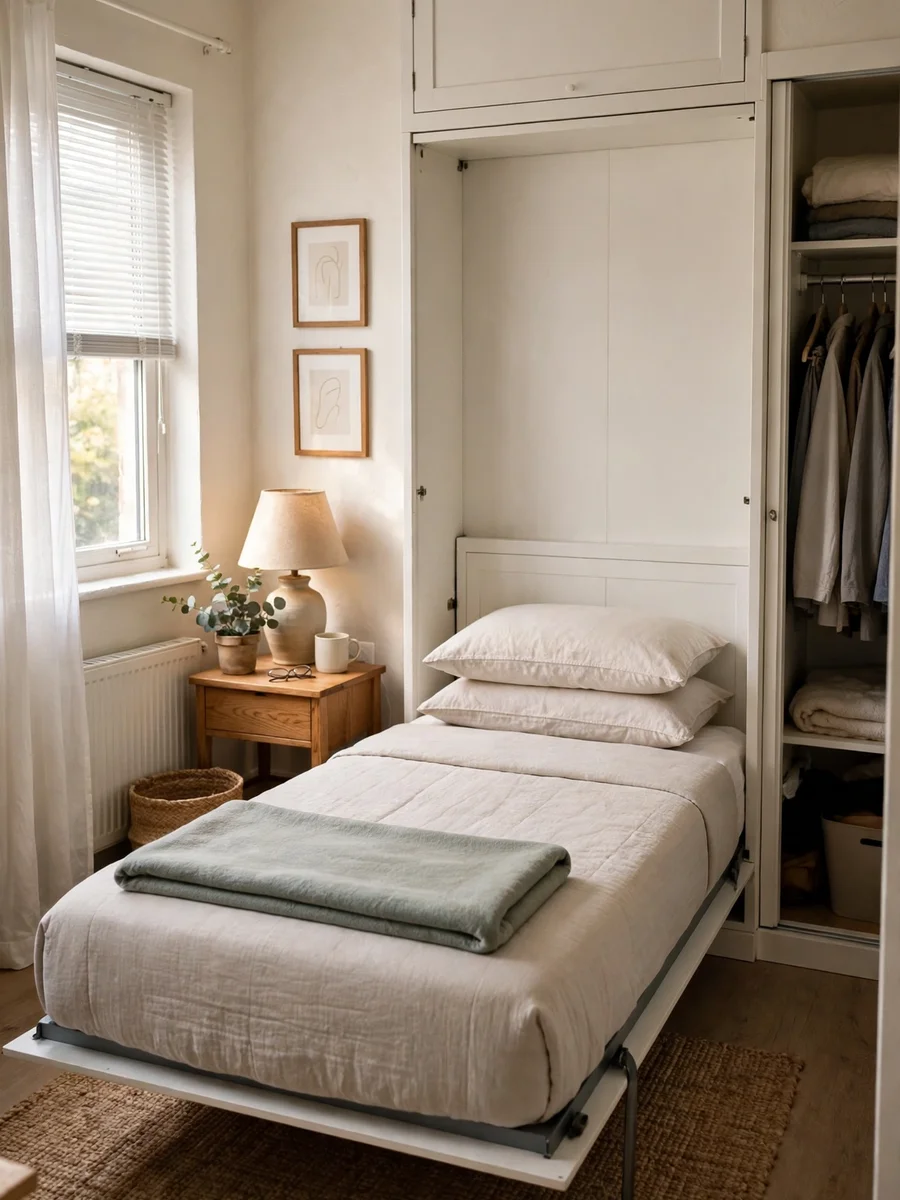
Murphy bed styling for renters lives or dies on the bedding, because the bedding is what the bed looks like when it is down — and what has to disappear, or at least compress, when the bed goes up. Thick, heavy bedding that bunches against the cabinet looks messy folded away and can stop the bed from closing fully, which strains the mechanism and leaves the cabinet ajar.
Choose a slim, low-loft duvet or a lightweight quilt rather than a thick comforter, and a fitted sheet with deep-enough pockets to stay put when the bed stands upright. Fold the duvet in thirds toward the foot of the bed before lifting it, and tuck pillows flat at the head end or store them in a basket beside the bed — pillows left loose tend to slide and jam the fold. A set of slim, wrinkle-resistant sheets and a light quilt runs roughly $40–$100 as of 2026, and it is the cheapest visible upgrade in this whole guide.
Keep the bedding palette simple and tied to the rest of the room: one solid color for the duvet, one accent color for the throw and pillowcases, and nothing else competing for attention. The throw is doing double duty — it is the bed’s daytime decoration when the bed is down in the evening, and it folds into a basket when the bed goes up. Avoid anything with long tassels, heavy beading, or loose ties near the bed’s hinges and latches, where fabric can catch.
4. A Rug That Marks the Sleep Zone
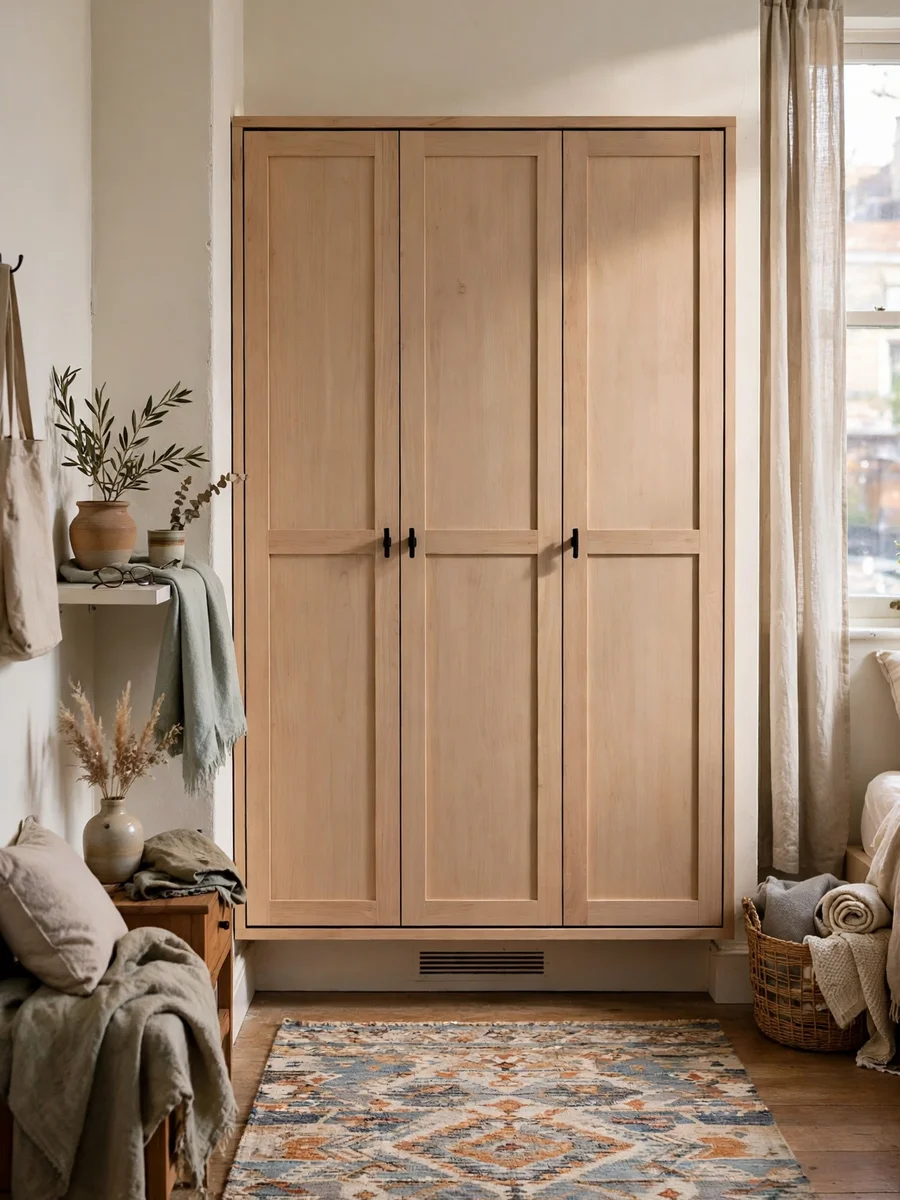
A rug does the job a headboard and bedside tables usually do in a regular bedroom: it tells the eye where the bed belongs, even when the bed is folded into the wall. Place a low-pile rug in the fold-down footprint so that, with the bed down, the rug runs under the bed’s lower half and extends out past the foot — and with the bed up, the same rug defines an open floor area for a chair, a yoga mat, or just empty space.
Low pile matters. A thick, plush rug can bunch under the bed’s feet, catch on the frame as it lowers, and make the bed sit unevenly. A flat-weave or low-pile rug, roughly $50–$150 for a size that fits a small bedroom as of 2026, lies flat, vacuums easily, and does not interfere with the bed. Measure the footprint first: the rug should be wider than the bed by a few inches on each side and long enough to extend at least two feet past the foot of the bed when it is down, so the rug still reads as a zone when the bed is up.
Choose a rug with a pattern or color that can carry the room on its own during the day, since it will be the main floor decoration when the bed is folded away. A rug pad underneath keeps it from sliding when the bed lowers onto it — use a thin, non-slip pad rather than a thick cushioned one, and check that the bed’s feet still sit level on the rug plus pad. If the bed wobbles or the feet sink unevenly, skip the pad under the bed’s feet and use it only on the exposed part of the rug.
5. Lighting for Both Bed Positions
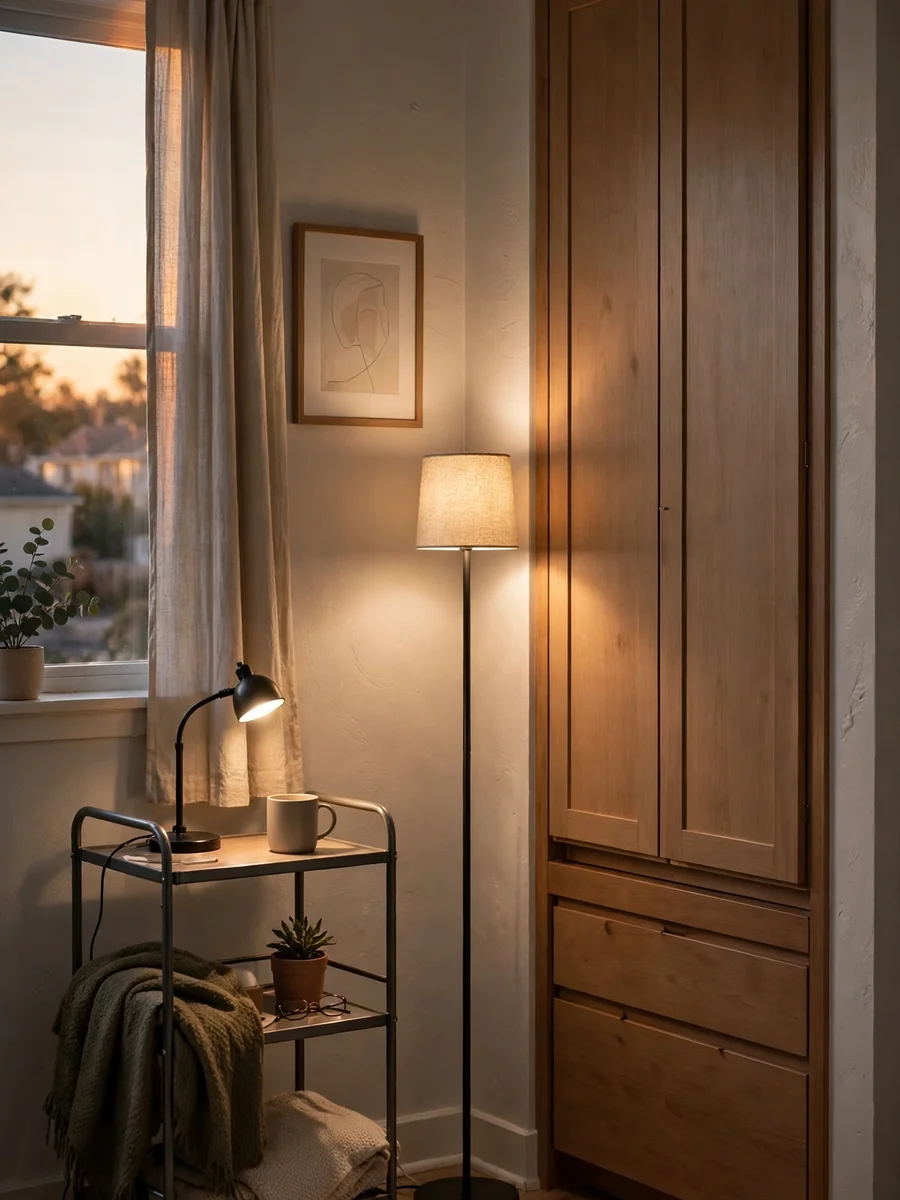
Lighting is the idea most murphy bed guides get wrong, because a lamp that works beside a bed disappears when the bed folds up — and a sconce on the cabinet wall is out of reach, and usually forbidden, for a renter. The fix is to light the room, not the bed: choose lighting that works in both positions and never attaches to the moving cabinet.
A floor lamp with a slim base placed beside the bed wall, clear of the fold-down footprint, lights the bed for reading when it is down and lights the daytime room when it is up. A pair of small table lamps on the flanking furniture from idea 2 does the same job and adds symmetry. For reading in bed, a clip-on or freestanding battery-powered reading light that lives in the bedside basket avoids any wiring near the bed at all. Floor lamps run roughly $30–$80 as of 2026; battery reading lights are roughly $10–$25.
Do not mount anything on the murphy bed cabinet or on the wall directly above where the bed folds down, and do not run cords across the fold-down path — a cord under a lowering bed is a trip hazard and a fire risk if it gets pinched. Keep cords along the wall and behind furniture, and use battery-powered or plug-in lamps with cords routed away from the bed’s swing. If the room has only one ceiling light, a warm-toned bulb and a dimmer-style plug-in lamp give the evening bedroom feel without any installation. Low ceilings bring their own constraints — see these apartment bedroom decor ideas for renters with low ceilings for lighting and layout that works under a low ceiling.
6. Nightstands That Move
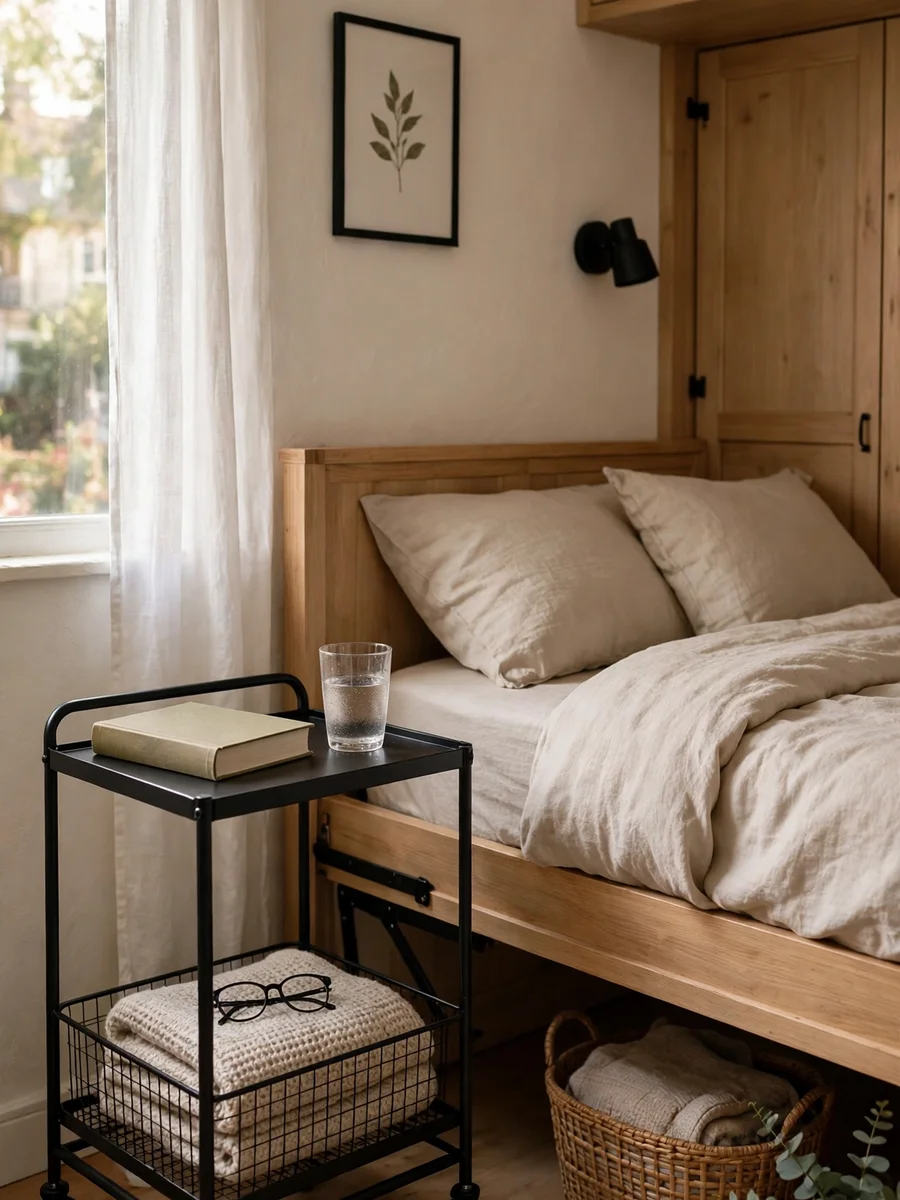
A fixed nightstand beside a murphy bed is a collision waiting to happen: the bed needs that floor space when it folds down, and a nightstand that sits too close will block the bed or get shoved every night. The renter’s answer is a nightstand that moves — a small rolling cart, a folding tray table, or a slim stool that slides away in seconds.
A two-tier rolling cart, roughly $25–$60 as of 2026, holds a book, a phone, a glass of water, and a reading light, and it rolls to the side of the room during the day, where it works as a plant stand or a work caddy. A folding tray table does the same job for less and folds flat against the wall. Whichever you choose, keep it light, keep the top clear of anything that would spill if it gets bumped, and keep the wheels locked or the legs steady while you sleep — a cart that rolls when you reach for your phone at night is worse than no nightstand at all.
During the day, the same piece earns its keep elsewhere in the room instead of sitting empty beside a folded bed. That is the test for every piece of furniture in a murphy bed bedroom: if it only works in one bed position, it is wasting space in the other. A moving nightstand passes the test; a heavy wooden nightstand bolted to the wall beside the bed does not.
7. Storage Beside, Not On, the Bed
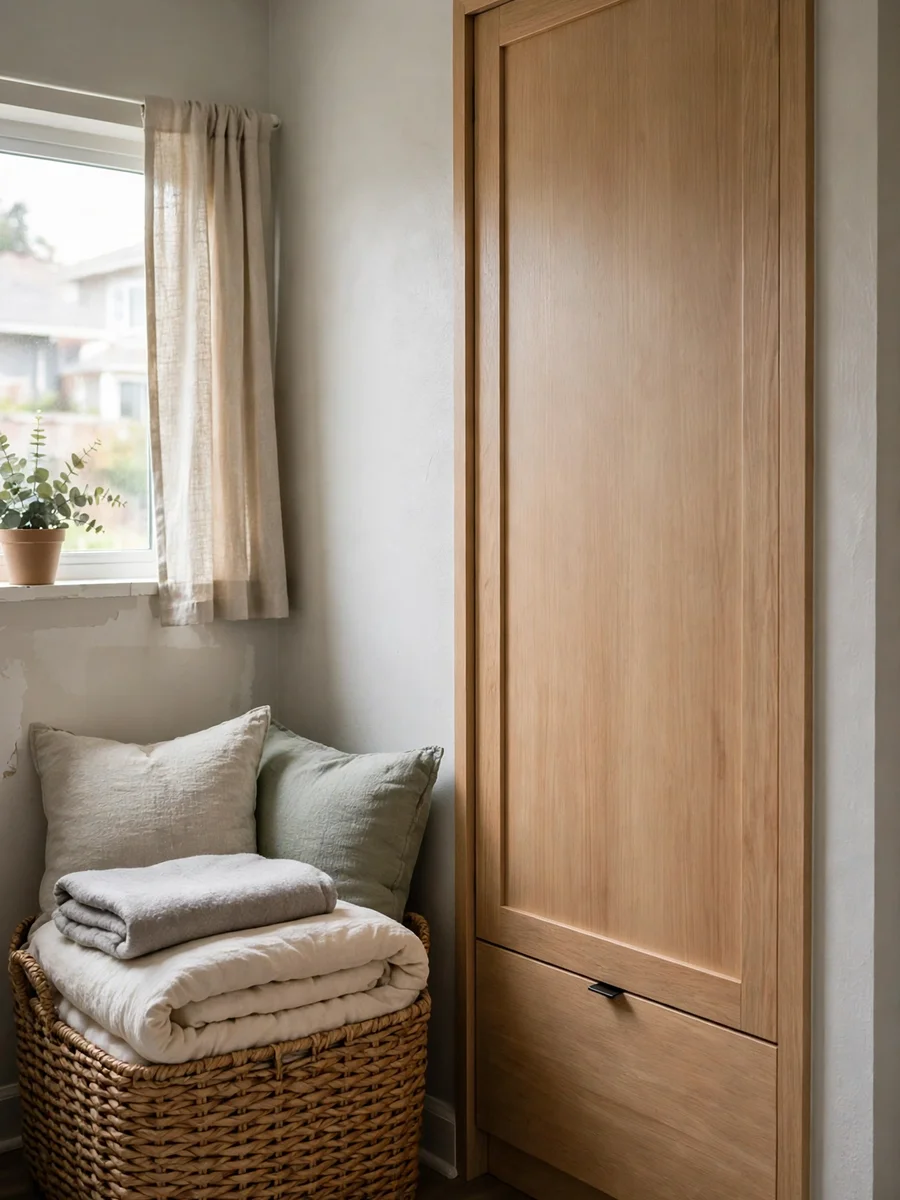
It is tempting to use the murphy bed cabinet as storage — to hang things from it, stick shelves to it, or pile items on top of it. Resist that temptation. Anything attached to the cabinet adds weight to a moving part, can interfere with the latches, and will almost certainly violate the lease or the bed manufacturer’s instructions, since most rental murphy beds are installed by the landlord or a previous tenant and the renter has no record of their weight limits.
Store bedding, pillows, and sleep accessories beside the bed instead: a lidded basket or a fabric storage cube on the floor next to the flanking furniture, or a slim rolling under-bed-style bin that slides under a nearby dresser. A large woven basket, roughly $20–$50 as of 2026, holds a folded quilt, two pillows, and a throw, and it looks like decor during the day. Keep the basket outside the fold-down footprint so it never has to move at bedtime.
The same rule applies to the top of the cabinet: do not store heavy items there, and do not treat it as a shelf. A lightweight, unbreakable decorative object is the most that should sit on top, and only if it cannot fall onto someone when the bed moves — in most rentals, the safest choice is to leave the top clear entirely. Check the manufacturer’s weight limit on anything attached near the bed before adding it, and if no limit is documented, assume the answer is no.
8. Art on the Cabinet Face, No Drilling
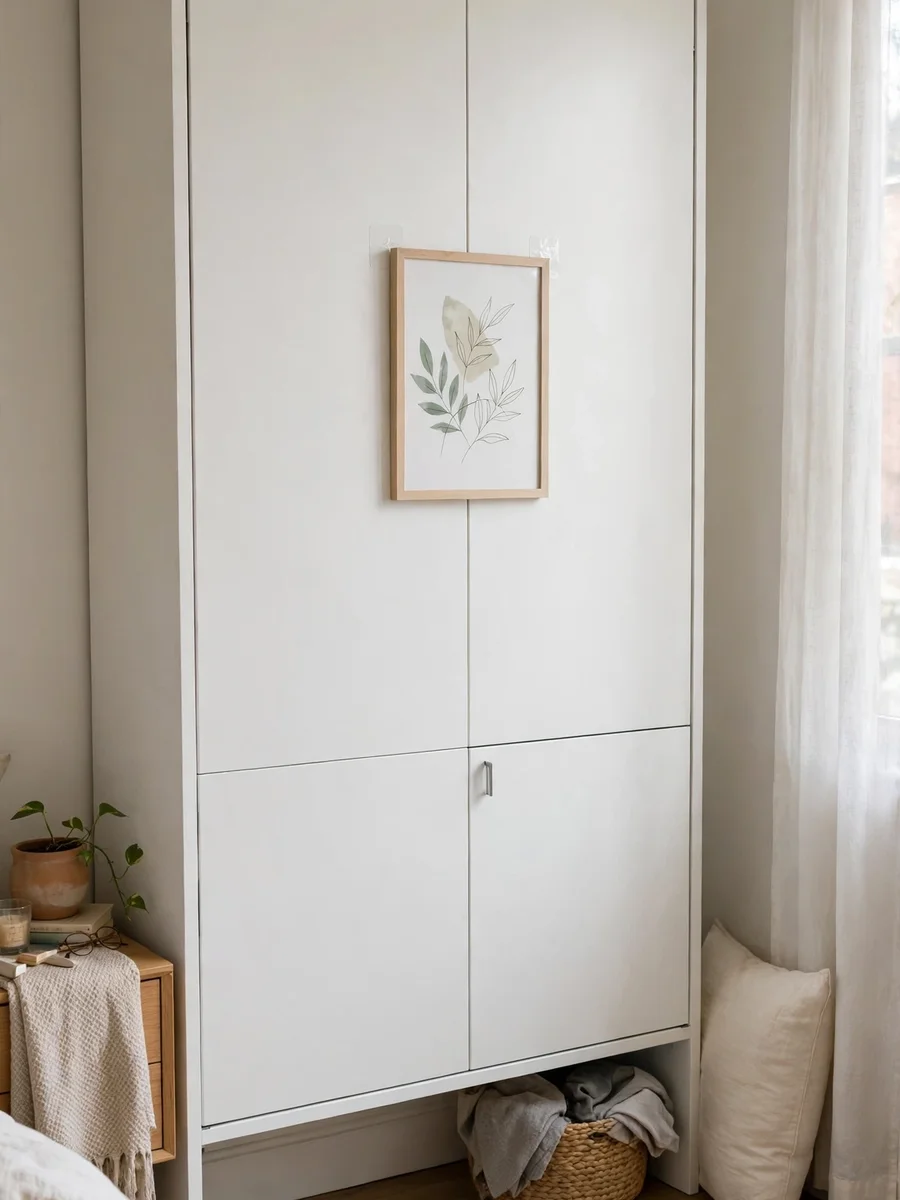
The front of a closed murphy bed is prime decorating space — it is a big, flat, eye-level surface — but it is also a moving surface, so anything on it has to be light, flat, and removable, and it has to survive being vertical all day. This is the no-drilling idea in the list, and it is where the weight rule matters most.
Removable adhesive strips rated for the item’s actual weight, with a comfortable margin, can hold a lightweight framed print, a thin canvas, or a fabric wall hanging on the cabinet face — if the frame weighs two pounds, use strips rated for at least four. Use two strips, not one, so a single failure does not drop the art, and press them onto a clean, dry surface and wait the full curing time on the package before hanging anything. Keep the total weight low — under three pounds is a sensible ceiling for adhesive on a moving cabinet face — and never hang glass-fronted frames or anything breakable there, since a falling frame lands on the floor where the bed folds down. Read whether adhesive strips damage walls before trusting them with anything you care about: the same paint-pull risk applies to a painted cabinet face, so test one strip on a hidden edge first and check it after a few days.
An even safer option is to skip the cabinet face entirely and hang art on the wall beside the bed, where it stays put in both positions, or to lean a large canvas against the cabinet’s side. Both give the room the same finished look with zero risk to the bed. Whichever route you choose, keep art clear of the bed’s handles, latches, and hinges — nothing should cover a latch or catch on a handle when the bed folds down.
9. Daytime Room, Nighttime Bedroom
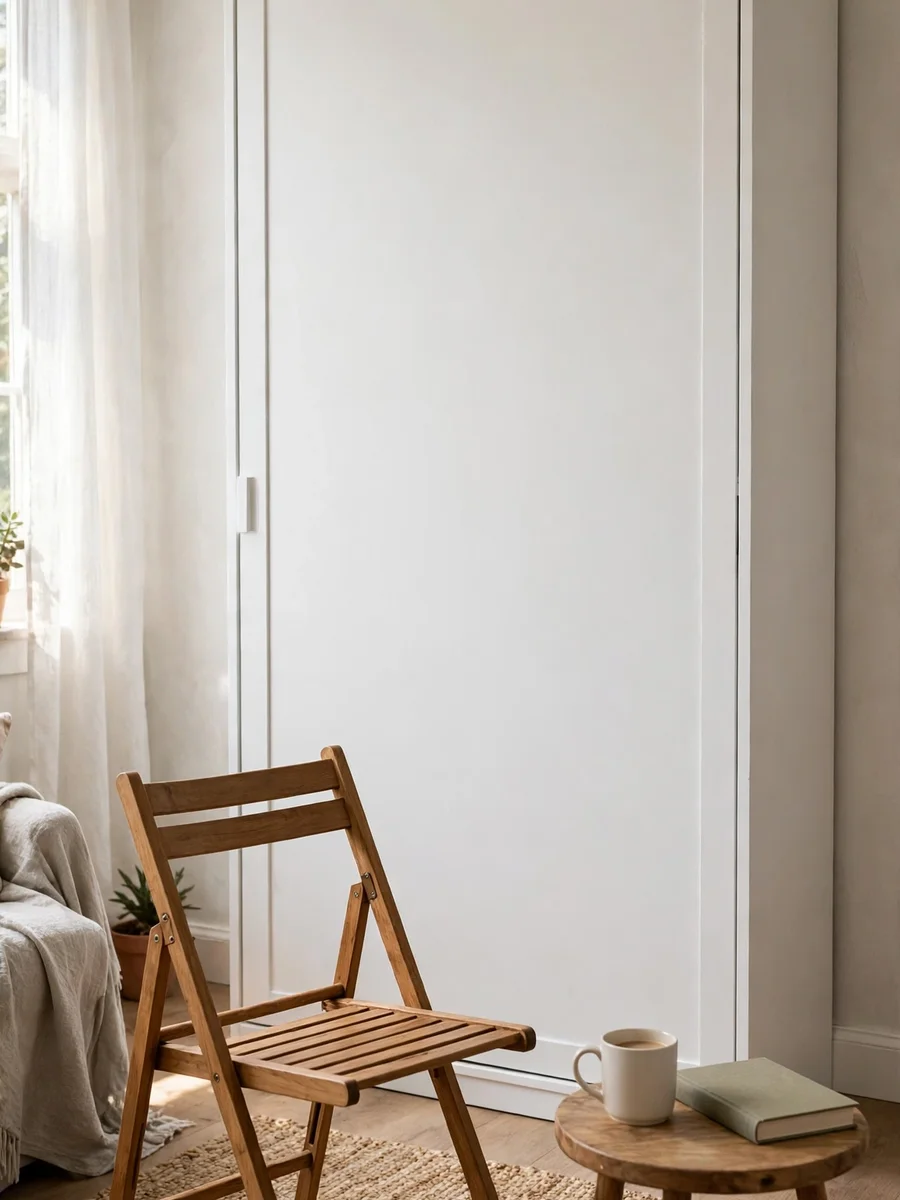
A studio bedroom with a murphy bed has to be two rooms, and the decor should say so clearly: by day it is a living room, a workspace, or a reading nook; by night it is a bedroom. The trick is to give the daytime room one anchor piece that defines it and that moves or folds away at night without a fight.
A folding chair and a small folding side table, a floor cushion set that stacks in a corner, or a slim desk on casters all work as the daytime anchor. Set the chair in the middle of the rug from idea 4 during the day, with a throw and a book on it, and the room reads as a sitting area. At night, the chair folds or rolls to the wall beside the flanking furniture, the side table joins it, and the rug is clear for the bed. A folding chair and side table together run roughly $40–$100 as of 2026.
Keep the daytime setup to two pieces at most. A room that needs five pieces moved every night will not get moved — the bed will stay down, or the furniture will end up piled in the hallway, and the whole point of the murphy bed is lost. Write the nightly routine down until it is habit: chair to the wall, cart to the side, rug clear, bed down. A room that converts in under two minutes gets used as two rooms; a room that takes ten minutes becomes a bedroom with furniture in the way.
10. A Headboard Moment When Down
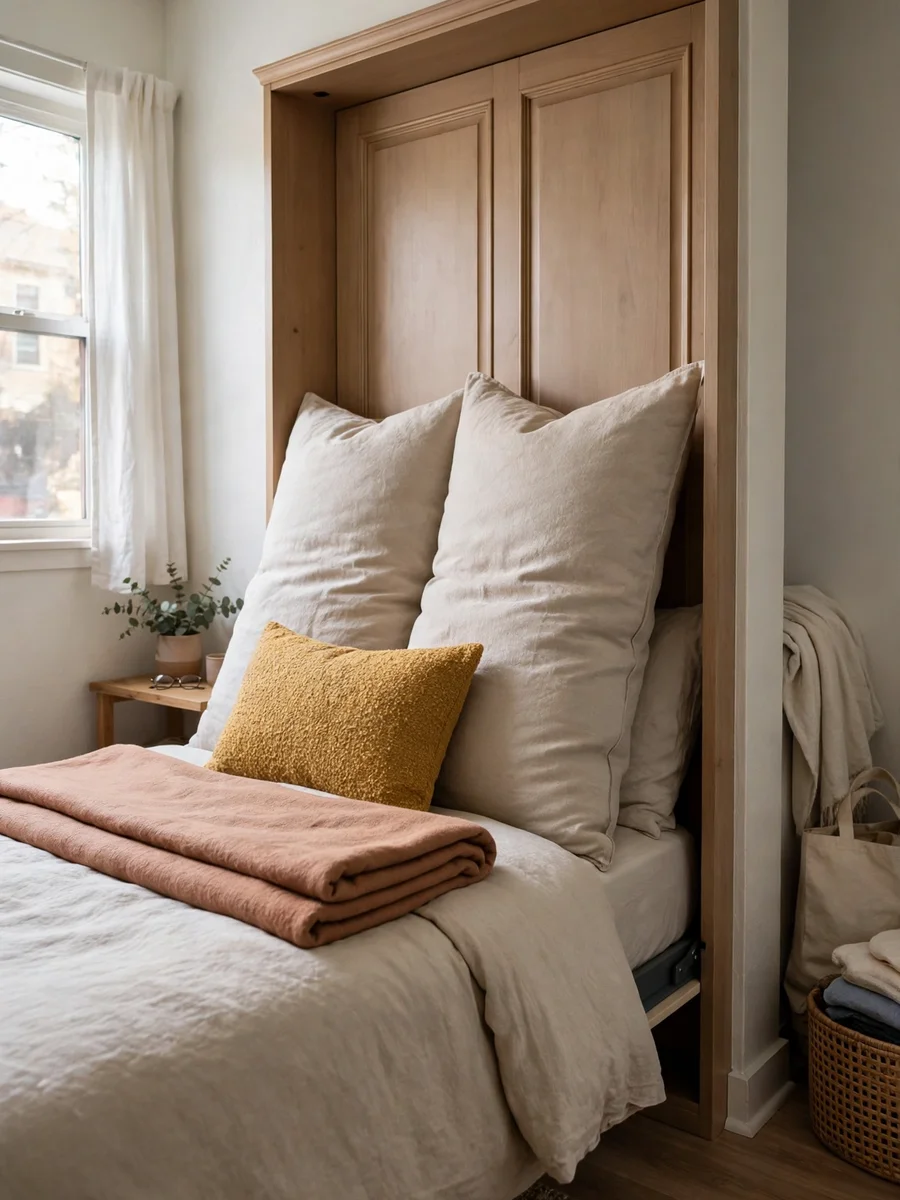
A murphy bed has no headboard, and without one the bed can feel like a mattress that fell off the wall — comfortable, but unfinished. A renter cannot bolt a headboard to the cabinet, but can create the same visual anchor with things that live beside the bed or behind the pillows only when the bed is down.
Two large Euro pillows propped against the cabinet face, a folded throw draped across the head end, and a small cushion in an accent color give the head of the bed shape and color in seconds, and they all fold into the storage basket from idea 7 in the morning. A freestanding, floor-standing headboard panel — a lightweight upholstered or rattan panel that stands on the floor behind the bed’s head end and leans against the cabinet — is a stronger option if the room has the floor space, roughly $80–$180 as of 2026, but it must stand clear of the bed’s hinges and must be moved aside before the bed folds up, so choose one light enough to lift with one hand.
Whatever creates the headboard moment, it should take under a minute to set up and under a minute to put away. If it takes longer, it will be skipped on tired nights, and the bed will go back to looking unfinished. That is the honest test for this idea and for the whole room: the best murphy bed decor is the decor that survives a tired Tuesday night, not just a photo-ready Sunday morning. For more small-bedroom ideas in the same spirit, see these small apartment bedroom decor ideas for couples renters, which cover shared small bedrooms without a folding bed.
[EDITOR’S PICK — : which option would you personally choose, and why? Leave blank if you don’t have a genuine opinion here.]
Frequently Asked Questions
Can you decorate a murphy bed?
Yes — decorate around it, not on its mechanism. Dress the closed cabinet like a wall with freestanding furniture and leaning art beside it, use removable adhesive only for very light, flat pieces on the cabinet face, and keep bedding slim so the bed closes fully. Never drill into the cabinet, paint it, or attach anything heavy to a moving part, and check the manufacturer’s weight limits before adding anything near the bed.
How do I decorate around a murphy bed in an apartment?
Start by marking the bed’s full fold-down footprint on the floor and keeping it clear. Then frame the bed wall with slim flanking furniture, put a low-pile rug in the sleep zone, and add lighting and a rolling nightstand that work with the bed up and down. Everything in the room should either sit outside the footprint or move away in seconds at bedtime.
Can I hang things on a murphy bed cabinet?
Only very light, flat things, and only with removable adhesive strips rated well above the item’s weight — under three pounds is a sensible ceiling, with two strips, no glass, and nothing covering a latch or handle. Test a strip on a hidden edge first, since adhesive can pull paint off a cabinet face. The safer choice is to hang art on the wall beside the bed or lean it against the cabinet’s side.
What kind of rug goes under a murphy bed?
A low-pile or flat-weave rug that lies flat under the bed’s feet and does not bunch as the bed lowers. It should be wider than the bed by a few inches on each side and extend at least two feet past the foot of the bed when it is down. Skip thick plush rugs and thick rug pads under the bed’s feet — if the bed wobbles or sits unevenly on the rug, use a thin non-slip pad only on the exposed part.
How do I make a murphy bed room feel like a bedroom?
Give the bed a headboard moment when it is down — large pillows propped against the cabinet, a throw across the head end, and an accent cushion — plus warm lighting and a rug that marks the sleep zone. At night, the pillows, the throw, and the warm lamp light do more to make the room feel like a bedroom than any permanent fixture could.
Do I need my landlord’s permission to decorate around a murphy bed?
For freestanding furniture, rugs, bedding, and removable adhesive, usually not, since nothing is permanently altered — but a murphy bed is often landlord-installed, so read the lease and any instructions left with the bed before attaching anything to it. Anything that drills, screws, paints, or modifies the bed or its cabinet needs explicit written permission, and in most rentals the answer will be no. When in doubt, ask in writing and save the reply.
Can a murphy bed work in a studio apartment?
Yes — a murphy bed is one of the best fits for a studio, because it turns one room into a living space by day and a bedroom by night. The room works when the daytime setup is small — one chair and one side table that move in seconds — and the fold-down footprint stays clear. If the room needs more than two pieces moved every night, the setup is too complicated and the bed will end up staying down.
Conclusion

Apartment bedroom decor ideas for renters with a murphy bed come down to one habit: decorate for both positions of the bed, not just the one you see right now. Treat the closed cabinet as a wall, frame it with furniture that never touches it, keep the fold-down path clear, and let a rug, warm light, and slim bedding do the work of making the room feel like a bedroom at night and a living space by day.
Start with the footprint — tape it out, keep it clear, and build everything else outside it. Do that, and the murphy bed stops being the awkward thing that dominates the room and becomes the reason the room works twice as hard.

Maren started MyFirstLease after a rough first lease taught him everything the internet didn’t. He covers the logistical side of renting — move-in checklists, utilities, and the unglamorous first-week stuff nobody explains — and oversees everything published on the site.