
When you’re trying to figure out how to verify a landlord is legitimate before signing lease paperwork, the stakes feel abstract right up until they don’t — a deposit and a month’s rent are real money, and rental scams disproportionately target people hunting for their first apartment online. This guide is written for young adults renting straight out of the family home: no rental history, no landlord contacts to compare notes with, and most listings viewed on a phone.
Unlike the generic advice currently ranking — most of it written for landlords or for renters in other countries — this walks you through the actual checks that work in the United States: public property records, licensing rules, fake-listing tells, and the exact contents of a lease package you should expect from a real landlord. Twelve checks, in the order that saves you the most trouble the fastest.
The Short Answer
To verify a landlord is legitimate before signing a lease, confirm the property owner through your county assessor or tax records, check that any leasing agent holds a valid state license if your state requires one, read tenant reviews across multiple sites, tour the unit in person, and pay deposits only through traceable methods to the verified owner or their authorized agent. Never wire money or pay in cash to someone who won’t show the property, show ID, or provide a complete written lease.
Executive Summary

Verifying a landlord boils down to three questions: does this person have the right to rent this property, is their track record clean, and does the paperwork protect you? Most of the checks below are free, take minutes each, and use public records your county and state already publish online — you don’t need special access or money to run them.
The checks also cover the two places first-time renters get hurt most: fake listings that collect deposits for apartments that don’t exist, and sloppy lease packages from real-but-disorganized landlords that leave you unprotected later. Work through the list in order, and don’t hand over any money until every check passes.
1. Start With Public Records

A legitimate landlord either owns the property or is formally authorized to manage it. Everything else — ID, business cards, a polished website — is secondary to that one fact. In the US, property ownership is public record, which means you can check it yourself before you believe anything anyone tells you.
Start by writing down the exact property address and the full name of the person or company you’re dealing with. Then look up the county assessor’s or tax collector’s website for the county where the property sits (search “[county name] assessor property search”). Most counties let you enter an address and see the legal owner’s name, the mailing address where tax bills go, and the parcel number — usually for free, no account needed.
Note the mailing address for tax bills specifically. If the “landlord” claims to own the property but tax bills go somewhere else under a different name, that’s a question that deserves a real answer — it could be a family arrangement, a recent sale, or a scammer. You just need to know which one.
2. Confirm Ownership Online

Once you have the owner’s name from the county records, compare it to the name on the listing, the lease draft, and whoever is asking for money. They should match, or the difference should be explained in writing — for example, a management company operating under contract for the owner.
If the owner is listed as a company or LLC rather than a person, look the company up in that state’s Secretary of State business database. You’re confirming the business is active and in good standing, and finding the registered agent — the person legally authorized to act for the company. As of 2026, every state’s Secretary of State site offers this search free. A business that doesn’t exist in the registry, or one marked inactive or dissolved, is a hard stop until you get an explanation.
Also check whether the rental is being offered by someone who is clearly not the owner — a “friend of the owner,” a current tenant subletting without permission, or someone who “inherited” the listing. Those situations can be legitimate, but each one needs documented authorization before money changes hands.
3. Check Rental Licensing Rules

Some cities and counties require landlords to hold a rental license or register their rental properties; others don’t regulate this at all. This is a genuinely local question, which is exactly why generic national guides skip it — but it’s one of the strongest legitimacy signals where it applies.
Search “[your city] landlord rental license requirements” or check the city’s housing or code-enforcement department website. If licensing is required, ask the landlord for their license number and verify it in the city’s registry. An unlicensed landlord in a city that requires licensing may still legally owe you your deposit back in a dispute — but it tells you this person doesn’t follow the rules, and tenants in unlicensed units sometimes have trouble getting inspections or code enforcement help.
If your city doesn’t require licensing, don’t treat that as a red flag — it just means you weight the other checks more. And if a landlord claims “licensing isn’t required here” in a city where it is, that’s a lie you caught early, which is the whole point of the exercise.
4. Read Reviews Like an Investigator

Search the landlord’s name, company name, and the property address across Google, the Better Business Bureau, and renter-focused review sites. You’re not looking for perfection — every long-running landlord has some unhappy tenants — you’re looking for patterns: repeated complaints about the same problem (deposits not returned, maintenance ignored, surprise fees) across different people and different years.
Weight reviews by specificity. A one-star review that says “terrible, avoid” tells you nothing; a review that describes a specific deposit dispute with dates and amounts is data. Also read the landlord’s responses if any exist — a landlord who answers complaints calmly and specifically looks very different from one who insults reviewers or never responds.
A few caution flags here: brand-new companies with zero reviews aren’t automatically scams, especially small private landlords — but they also haven’t earned trust, so lean harder on the records checks. And be suspicious of review pages where every review is five stars, posted in the same month, with nearly identical phrasing — that’s a reputation being manufactured, and it happens in rentals too.
5. Learn the Fake-Listing Playbook

Rental scams aimed at first-time renters follow recognizable patterns, and knowing them is half the defense. The classic version: a listing far below market rent for the neighborhood, photos stolen from a real listing elsewhere, and a “landlord” who can’t show the property because they’re out of state, deployed, or traveling — but who can email you a lease and collect a deposit by wire transfer or payment app right away.
Run the listing photos through a reverse image search. If the same photos appear on other listings in other cities, or on a for-sale listing for a home that’s clearly not for rent, walk away. Check whether the rent is plausible for the area — if every comparable apartment is $1,400 and this one is $800 with no catch, the catch is the scam.
Other tells: the listing asks you to fill out a detailed application and pay an application fee before you’ve seen anything; the email address is a free account with a name that doesn’t match the supposed landlord; the lease arrives as a blurry photo or a one-page document; and any request to pay via wire transfer, gift cards, cryptocurrency, or a peer-to-peer app to a personal account. Legitimate landlords use bank transfers, checks, or established payment portals — methods with a paper trail. For a broader look at what should happen after verification, see the Moving In & Apartment Basics hub.
6. Tour the Actual Unit

Never sign a lease or pay a deposit for a place you haven’t walked through — this single rule would prevent most rental fraud against first-time renters. The tour doesn’t just confirm the apartment exists; it confirms the person showing it has access to it, which a scammer almost never does.
During the tour, check the basics a legitimate landlord or agent will know cold: where the utilities connect, how trash and parking work, which appliances stay, the condition of locks and windows. Someone fumbling through a unit they can’t unlock properly, who arrived at the same time you did, and who can’t answer basic questions about the building is not your landlord.
If you’re renting sight-unseen from another city, don’t skip this step — substitute it. Ask a trusted person to tour for you, or request a live video walkthrough where you can ask the person to show you specific things (the view from the kitchen window, the water meter, the mailbox with the unit number). A prerecorded video proves nothing; a live tour where you direct the camera proves access.

A legitimate landlord expects to be asked who they are and can prove it. When you meet — or on a video call if you’re remote — ask for a government-issued photo ID and compare the name to the county records owner, the lease, and the person you’ve been communicating with.
If they manage the property for someone else, ask for the management agreement or a written authorization letter from the owner, and check that the owner’s name on it matches the county records. Property management companies should also have a business license and, in many states, a real estate broker’s license for whoever handles leasing — verify the license in your state’s real estate commission database, which is public and free.
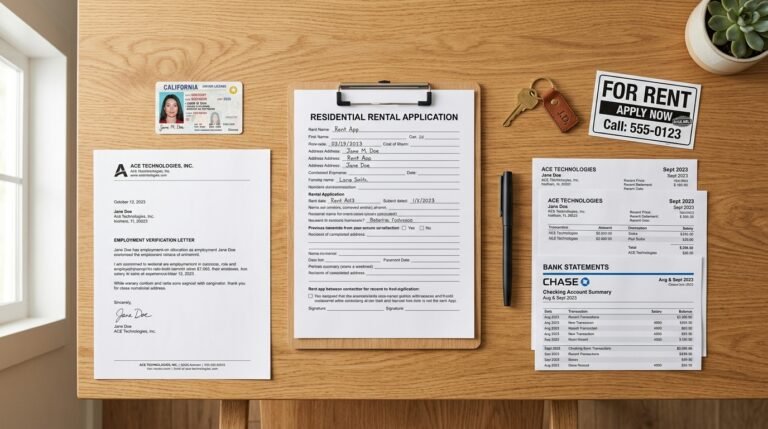
One more paperwork point, in the other direction: the landlord will ask you for documents too — ID, pay stubs, sometimes bank statements. That’s normal. What isn’t normal is a landlord who demands your full Social Security number, bank logins, or copies of everything before you’ve verified them. Keep your own paperwork tight until the landlord’s legitimacy checks out; what you’ll actually need for the application itself is a short, standard list.
8. Trace the Money Trail

How a landlord asks to be paid is one of the clearest legitimacy tests there is, because scammers can’t fake this part — they need your money to move fast and irreversibly. Legitimate landlords accept traceable payment: checks, bank transfers, or established rent-payment portals, made out to the owner or management company named in the lease.
Refuse any request to wire money, buy gift cards, send cryptocurrency, or pay through a peer-to-peer app to a personal account — especially before signing. Also be wary of urgency manufactured around money: “three other applicants will take it today,” “the deposit price goes up tomorrow,” “pay now to hold it.” Real landlords with real vacancies don’t need to panic you into paying; scarcity pressure is a sales tactic, and in rentals it’s often a fraud tactic.
Get every payment documented in writing — amount, what it’s for (deposit, first month, application fee), who received it, and the date. A legitimate landlord provides receipts without being asked twice. If someone resists putting payment terms in writing, treat the resistance itself as the answer.
9. Inspect the Lease Package

A real landlord produces a complete, professional lease package before asking for your signature — and the package itself is a legitimacy document. At minimum, expect: the full legal names of all parties (matching the county records owner or authorized manager), the exact property address and unit, the lease term with start and end dates, the monthly rent amount and due date, the security deposit amount and the conditions for its return, who pays which utilities, maintenance and repair responsibilities, and the rules on subletting, guests, and pets.
Read the whole thing before signing, not after — and compare the names and address against everything you verified in checks 1 through 3. Mismatches between the lease and the public records are not paperwork quirks; they’re the exact thing you did the research to catch. If anything is missing, ask for it in writing. Vague deposit-return language (“deposit refundable at landlord’s discretion”) is a future dispute wearing a costume — push for specific conditions and timelines, as your state’s law may set requirements the lease has to meet anyway.
If you’d like the full picture of what to read and negotiate in the lease itself, our walkthrough of things to know before signing your first US lease pairs with this guide: this article verifies the landlord, that one stress-tests the lease.
10. Vet the Property Manager

Many first-time renters never deal with the actual owner — they deal with a property management company or an on-site manager, which is completely normal. It just shifts the verification target: you’re now checking the company, not (only) the person.
Verify the management company the same way you’d verify an owner: state business registration, reviews across multiple sites, a real office address and working phone number (call it — an unanswered number on a company with thirty listings is informative). In many states, anyone who leases property for others needs a real estate license — check the individual agent’s license in the state real estate commission’s public database, and confirm the license is active and in good standing.
Ask the manager directly: how many units do you manage, who handles maintenance requests, and what happens if I need to reach someone after hours? Legitimate operations answer these easily because they live them daily. Evasive or annoyed answers to basic operational questions suggest either disorganization or something worse — and disorganization costs tenants money too.
11. Watch for Pressure Tactics

Legitimate landlords want good tenants and will give you time to verify them, because good tenants verify. Scammers and bad landlords both use pressure for the same reason: it stops you from checking.
The common tactics: artificial deadlines (“sign by tonight or it’s gone”), discouraging verification (“you don’t need to check all that, I have plenty of references”), refusing written documentation (“we do everything on a handshake”), and love-bombing followed by a sudden urgent payment request. Each one is, on its own, possibly just a pushy personality — but two or more together is a pattern, and patterns are information.
Give yourself a hard personal rule before you start apartment hunting: no money changes hands and no lease gets signed on the same day you first see a listing. A 24-hour cooling-off period costs you nothing and defeats almost every pressure tactic in the book. If a landlord won’t honor even a single day, they’ve told you everything about how the rest of the tenancy would go.
12. Walk Away and Report

Walking away from a suspicious rental isn’t losing an apartment — it’s keeping your deposit. If the checks above turn up ownership mismatches, a nonexistent business, fake listing photos, or payment demands that don’t survive scrutiny, stop communicating, don’t send money, and don’t sign anything. You owe a suspected scammer no explanation and no courtesy reply.
Then report it, because reporting is what makes the next renter’s checks work. Report fake listings to the platform where you found them. File a complaint with your state attorney general’s consumer protection division and the Federal Trade Commission (the FTC takes rental fraud reports online). If you sent money, contact your bank or payment provider immediately — and file a police report with the property’s local department, which gives you a paper trail if recovery or prosecution becomes possible.
Keep copies of everything: the listing, all messages, the fake lease if one was sent, payment receipts. Organized evidence is the difference between a report that goes somewhere and one that doesn’t.
Your 12-Point Verification Worksheet
Before any money changes hands, confirm each line:
- County assessor/tax records show the legal owner; the name matches the lease
- Any LLC or company owner is active in the Secretary of State database
- City rental license verified, if your city requires one
- Reviews checked across 2–3 sites; no repeated pattern of the same complaint
- Listing photos pass a reverse image search; rent is plausible for the area
- You (or a trusted person, or a live video tour you directed) saw inside the unit
- Landlord showed photo ID; manager showed written owner authorization and active license where required
- All payments go by traceable method to the owner/company named in the lease
- Complete lease package received and read; names and address match your research
- Management company’s registration, license, and office contact verified
- No pressure tactics, no same-day sign-and-pay
- You know where to report (platform, state AG, FTC) if anything surfaces later
Frequently Asked Questions
How can I check who owns a rental property for free?
Search your county assessor’s or tax collector’s website for the property address — most counties publish the legal owner’s name, tax-bill mailing address, and parcel number at no charge. If the county site is hard to navigate, your county’s main website usually links to it, and the tax collector’s office can help by phone.
What are the biggest red flags of a fake landlord?
A rent far below market with no explanation, refusal to show the property in person or by live video, pressure to pay immediately by wire transfer or gift cards, a lease that arrives blurry or incomplete, and an owner name that doesn’t match county records. Any two of these together should end the conversation.
No — verify the landlord first, then provide application documents. Legitimate landlords do need some personal information to run background and credit checks, but that exchange happens after you’ve confirmed they’re real, and you should know exactly how your data will be stored and used.
Does a landlord have to show me ID?
There’s no universal law requiring it, but a legitimate landlord expects the question and can produce government-issued photo ID plus proof of ownership or management authorization. Refusal to identify themselves is itself the answer to your verification question.
Can I verify a landlord if I’m renting from another state?
Yes — every records check in this guide works remotely: county assessor sites, Secretary of State business databases, state license lookups, and review sites are all online. Substitute the in-person tour with a live video walkthrough you direct, and never let distance become the reason you skip a check.
What should I do if I already sent money to a scammer?
Contact your bank or payment provider immediately to attempt a reversal, file a police report with the property’s local department, and report to the FTC and your state attorney general. Keep every message, listing screenshot, and receipt — organized evidence is what makes recovery possible.
Is it safe to pay a deposit through a payment app?
Only if the app payment goes to the verified owner or management company named in the lease, the amount and purpose are documented in writing, and you initiated the transfer yourself through the app — never through a link someone sent you. Wire transfers, gift cards, and cryptocurrency for rental deposits are effectively never legitimate.
How do I report rental fraud?
Report the listing to the platform where you found it, file with the FTC’s fraud reporting site and your state attorney general’s consumer protection division, and file a police report in the property’s jurisdiction. If a licensed agent was involved, also complain to your state’s real estate commission.
Conclusion

Learning how to verify a landlord is legitimate before signing lease paperwork is really learning one habit: check before you trust. County records confirm ownership, licensing databases confirm authority, reviews confirm track record, and a complete lease package confirms professionalism — and every one of these checks is free and takes minutes. If this guide saved you from even one bad rental, it’s done its job — save it, share it with anyone hunting their first apartment, and run the worksheet every time before any money changes hands.

Maren started MyFirstLease after a rough first lease taught him everything the internet didn’t. He covers the logistical side of renting — move-in checklists, utilities, and the unglamorous first-week stuff nobody explains — and oversees everything published on the site.